White House Makes Press Secretary Candidates Explain Trump Before He Finishes Talking
Karoline Leavitt’s search for a replacement reportedly begins with the only skill Washington cannot teach: hearing the sentence after the sentence.
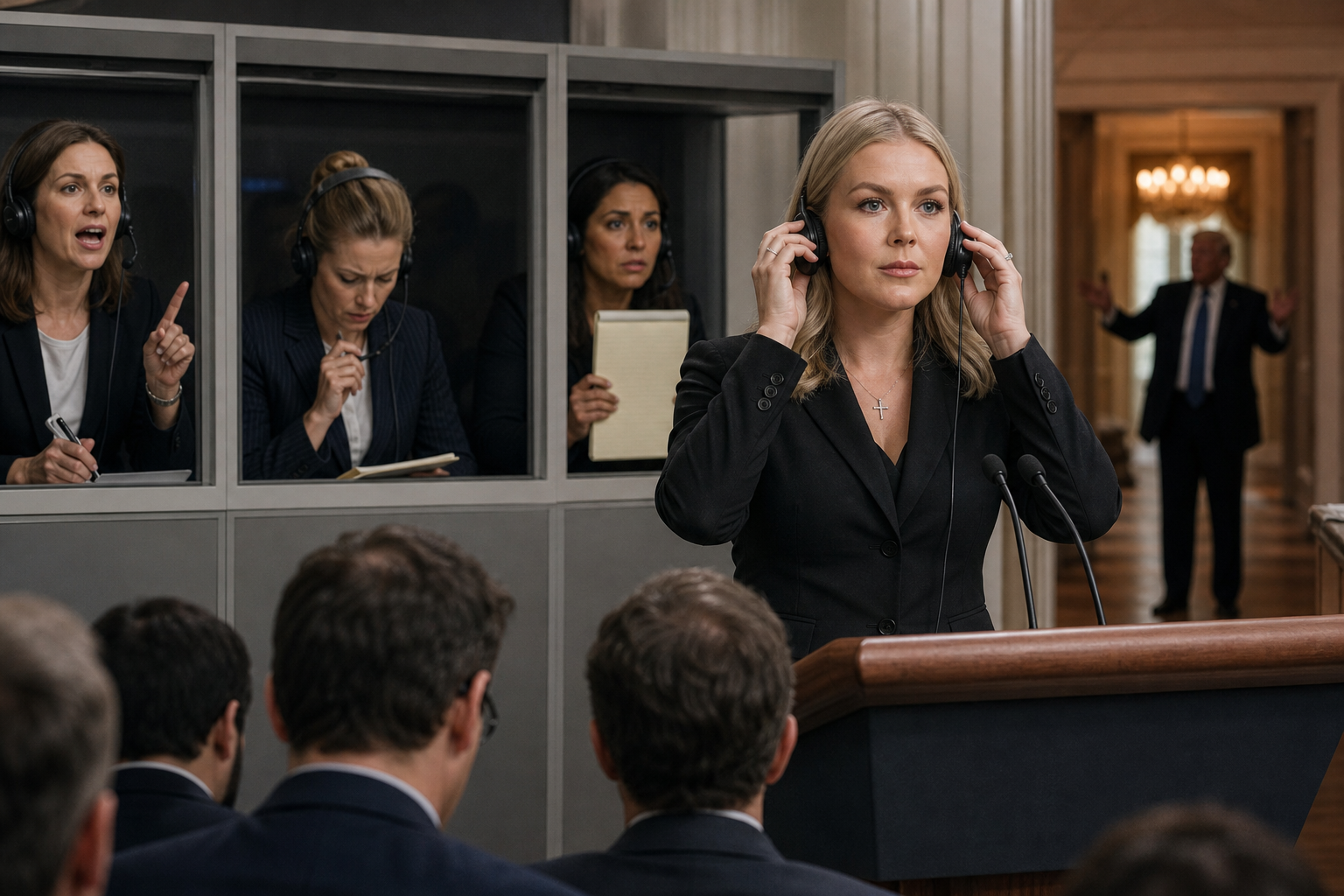
WASHINGTON — This is parody.
The White House has reportedly redesigned its search for a new press secretary around a problem too urgent for ordinary interviews: finding someone capable of explaining President Trump’s remarks before he has completed making them.
Karoline Leavitt, who recently discussed assisting with the search after Katie Zacharia’s exit, unveiled the fictional hiring process Friday at the briefing room podium, where applicants were issued a headset, a glass of water and a laminated card reading DO NOT WAIT FOR CONTEXT.
Each candidate is seated in a soundproof booth beside a live feed of the president speaking to reporters, donors, construction equipment or a group of people who believed they were attending a ribbon-cutting. At the first mention of a tariff, a foreign leader, a television host or a personal grievance dating to 1987, the applicant must begin translating.
Not translating into another language. Translating into an answer that can be printed by a newspaper, repeated by a cabinet secretary and quietly removed from a briefing transcript by sunset.
“The old model asked whether a press secretary could communicate the president’s agenda,” said a fictional senior administration official, staring solemnly at a whiteboard labeled AGENDA, IF APPLICABLE. “Now we need someone who can identify the agenda while it is still looking for parking.”
The first exercise, called Interpretive Sprint, begins with a Trump statement about gasoline prices. Candidates have 14 seconds to determine whether he is announcing a policy, complimenting himself, criticizing a predecessor, threatening an oil company or merely remembering that gasoline exists.
Those who say “I’d have to check” are escorted out through the press office’s traditional employee exit: a producer asking whether they can do a friendly segment at 6:40 a.m.
Leavitt told applicants that Zacharia’s experience had clarified an essential truth about the job. “It wasn’t for her,” she said in the real-world account that inspired this parody, a phrase the fictional personnel office has now expanded into an entire management philosophy.
Under the new system, candidates are told the position may not be for them, but they will not know that until they have tried to clarify a presidential post using only the words “obviously,” “the president has been very clear,” and “what he means is.”
The process took an unexpected turn during the afternoon’s advanced round, when a candidate successfully explained one Trump remark so cleanly that reporters understood it. Alarms sounded. The briefing room lights shifted to an anxious amber. A communications aide rushed in carrying a folder marked TOO DEFINITIVE.
“We had to stop the test immediately,” the fictional official said. “A press secretary cannot create the impression that a sentence has one stable relationship to its own meaning. That would expose the administration to expectations.”
The candidate was then asked to restate the answer with enough strategic fog to allow three cable panels to debate it until dinner. She did so magnificently, describing the president’s position as “firm, flexible, under review, historically consistent and responsive to changing conditions, including the conditions created by the statement itself.”
She advanced to the final round.
That round, known internally as The Echo, places candidates at the podium five minutes after Trump has answered a question from the South Lawn helicopter. No transcript is provided. No aide may say what they heard. The candidate must reconstruct the remarks from a reporter’s horrified expression, two competing all-caps posts and the faint sound of Treasury officials looking for a chair.
One applicant reportedly asked whether the White House could simply tell the truth. Leavitt nodded respectfully and handed her a visitor badge.
Another candidate performed strongly by declining to characterize the president’s comments, then characterizing everyone else’s reaction as a misunderstanding caused by insufficient enthusiasm. She was praised for demonstrating “the agility of a spokesperson and the emotional self-preservation of a hostage negotiator.”
But the leading contender is said to be a former airport interpreter who spent years converting delayed-flight announcements into expressions of gratitude. During the final simulation, she rendered a seven-minute Trump answer into one elegant sentence: “The president rejects the premise, welcomes the attention, and has asked somebody else to handle it.”
The room reportedly fell silent, not because the answer resolved anything, but because it was the first time anyone had heard a White House message arrive before the cleanup crew.
White House Makes Press Secretary Candidates Explain Trump Before He Finishes Talking
Karoline Leavitt’s search for a replacement reportedly begins with the only skill Washington cannot teach: hearing the sentence after the sentence.
WHAT STARTED THIS MESS
The event underneath the joke is real. The SPILL premise, dialogue and escalation above are fictional parody.