Wall Street Begs New Democratic Congress to Stay Exactly This Theoretical
After a market rally, investors ask the incoming majority to preserve the one thing every institution fears most: expectations.
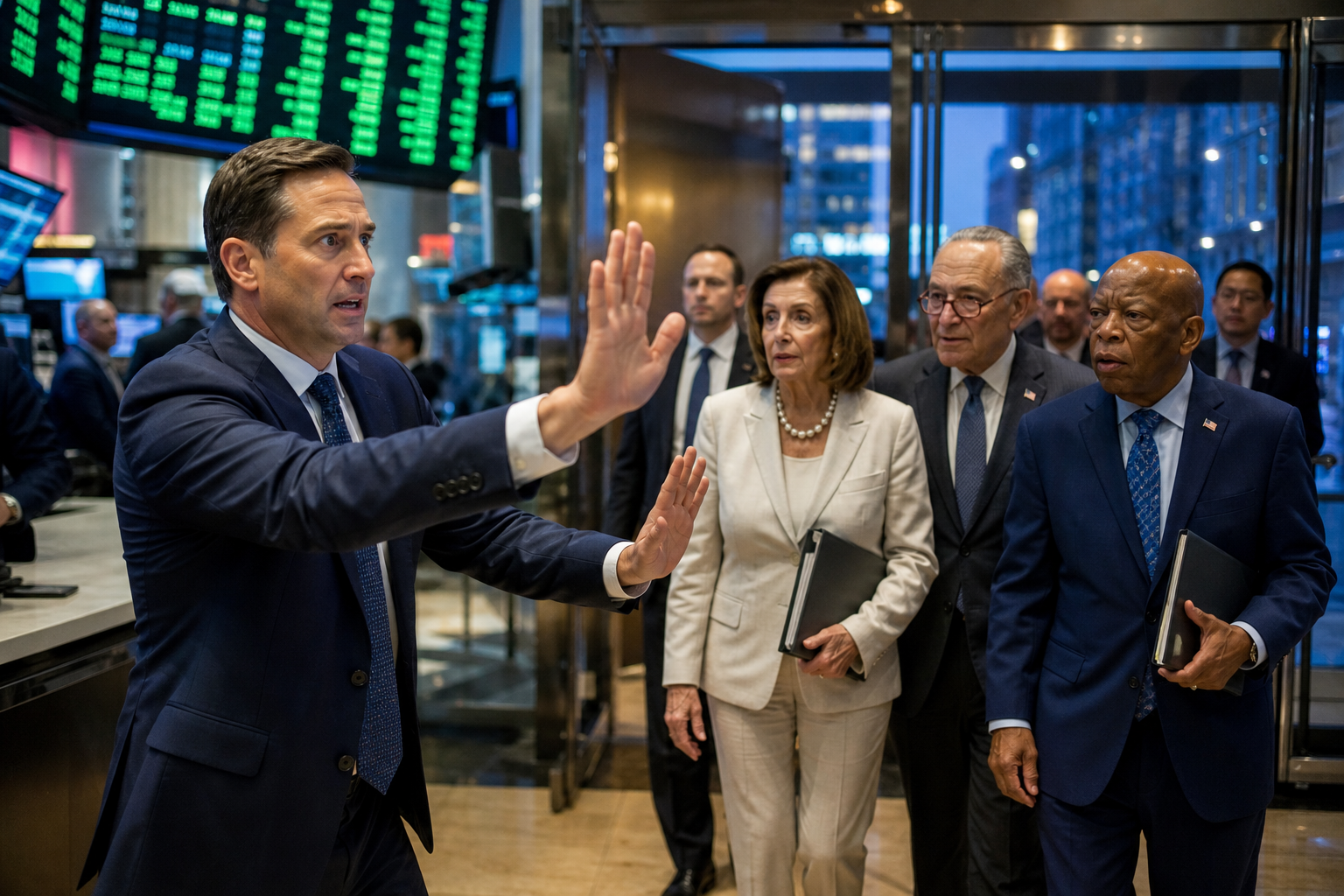
Within minutes of Democrats taking control of Congress, Wall Street issued a warm but unusually specific welcome: congratulations, and please do not touch anything.
The Dow’s explosive reaction to the election result has left investors deeply attached to the new Democratic majority in its current form: victorious, vague, and incapable of scheduling a subcommittee hearing. Trading desks reportedly spent Wednesday morning admiring the caucus the way collectors admire a mint-condition action figure still sealed in its packaging.
“The market loves clarity,” said one fictional strategist, pointing at a chart that rose sharply the moment networks called the chamber and then began trembling at the first rumor someone might draft legislation. “Right now, Democrats represent stability, accountability, lower prices, stronger wages, restrained spending, fiscal discipline, clean energy, energy abundance, and whatever the Fed was hoping we meant by all that. It’s a beautiful consensus. We urge them not to ruin it with nouns.”
Democratic leaders initially mistook the rally for a mandate. Aides said they began assembling a list of priorities, only to receive a premarket note from several major firms asking whether the party could pursue those priorities “in a spiritually nonbinding manner.”
The note reportedly praised the caucus for restoring investor confidence while gently requesting that any future bill be released first as “a mood board with no enforcement mechanism.” One banker recommended Congress hold all oversight hearings off-camera, after market close, and in a language no agency can administer.
The new majority’s first closed-door meeting was interrupted by a delegation of portfolio managers carrying bouquets, decaf coffee and a laminated reminder that nothing crushes a rally like a governing agenda with page numbers.
“We have every confidence they can solve the country’s problems,” said a fictional fund manager. “We simply need them to solve those problems at the same soothing distance from reality that they occupied at 9:31 a.m. Tuesday.”
The Perils of Delivering
By afternoon, lawmakers had been assigned investor-relations advisers. Committee chairs were instructed to stop calling policies “plans” and begin calling them “long-term value narratives.” Any proposal expected to cost money had to be accompanied by a slide showing a sunrise, a family-owned hardware store and the words disciplined optimism in a font investors associate with private aviation.
The House Budget Committee, which had hoped to discuss spending, was instead asked to issue quarterly guidance about its emotional relationship with spending. The Judiciary Committee was told its investigations should be framed as “governance enhancements.” The Oversight Committee was cautioned that the word “oversight” itself sounded bearish and was encouraged to consider “confidence maintenance.”
Then came the complication: Republicans noticed that the market was enjoying Democratic control.
Suddenly, the opposition found itself cast in the only role Wall Street still considers indispensable: the risk factor. Party strategists moved quickly to reassure investors that they would continue providing volatility, cable-news urgency and just enough procedural brinkmanship to keep the country from confusing a rally with peace.
“A functioning two-party system requires checks and balances,” said one fictional Republican consultant. “Also, somebody has to remind the S&P 500 that Congress can still discover a deadline at 11:47 p.m.”
The arrangement briefly appeared workable. Democrats would embody the market’s optimism. Republicans would embody the market’s contingency language. Both parties would avoid passing anything substantial until analysts had fully modeled its impact on yacht deliveries.
But the alliance collapsed after an influential analyst asked a devastating question: what happens when the theoretical Congress becomes the actual Congress?
That possibility sent shares lower for nearly six minutes.
Democratic aides responded with emergency reassurance, promising that no major initiative would be announced without first being described as “historic” by three people who had not read it. Leadership also floated a pilot program in which members could vote only on bills that had already been favorably reviewed by a panel of nervous retirees watching business television in airport lounges.
By the closing bell, markets had recovered after congressional leaders pledged to spend the next several weeks doing the one thing American institutions have mastered perfectly: celebrating a result before anyone has to explain what it means.
The rally ended only when someone asked whether Congress would be seated in January, at which point every trader on Wall Street remembered it came with buttons.
Wall Street Begs New Democratic Congress to Stay Exactly This Theoretical
After a market rally, investors ask the incoming majority to preserve the one thing every institution fears most: expectations.
WHAT STARTED THIS MESS
The event underneath the joke is real. The SPILL premise, dialogue and escalation above are fictional parody.
- Reuters Novo Nordisk hikes 2026 outlook again as Wegovy pill beats forecasts ↗
- MS NOW Republicans set their sights on one last reconciliation bill before Democrats take over ↗
- CNN Dow futures jump by 1,100 points as Democrats take control of Congress ↗
- CBS Stocks soar after Democrats take control of Congress ↗
- FOX Jimmy Kimmel revels in Democrats' blue wave as party takes back control of Congress ↗