Trump’s Board of Peace Puts Its Own Ceasefire on a PIP
The plan has 30 days to demonstrate measurable progress, though its managers remain unclear on who approved the plan in the first place.
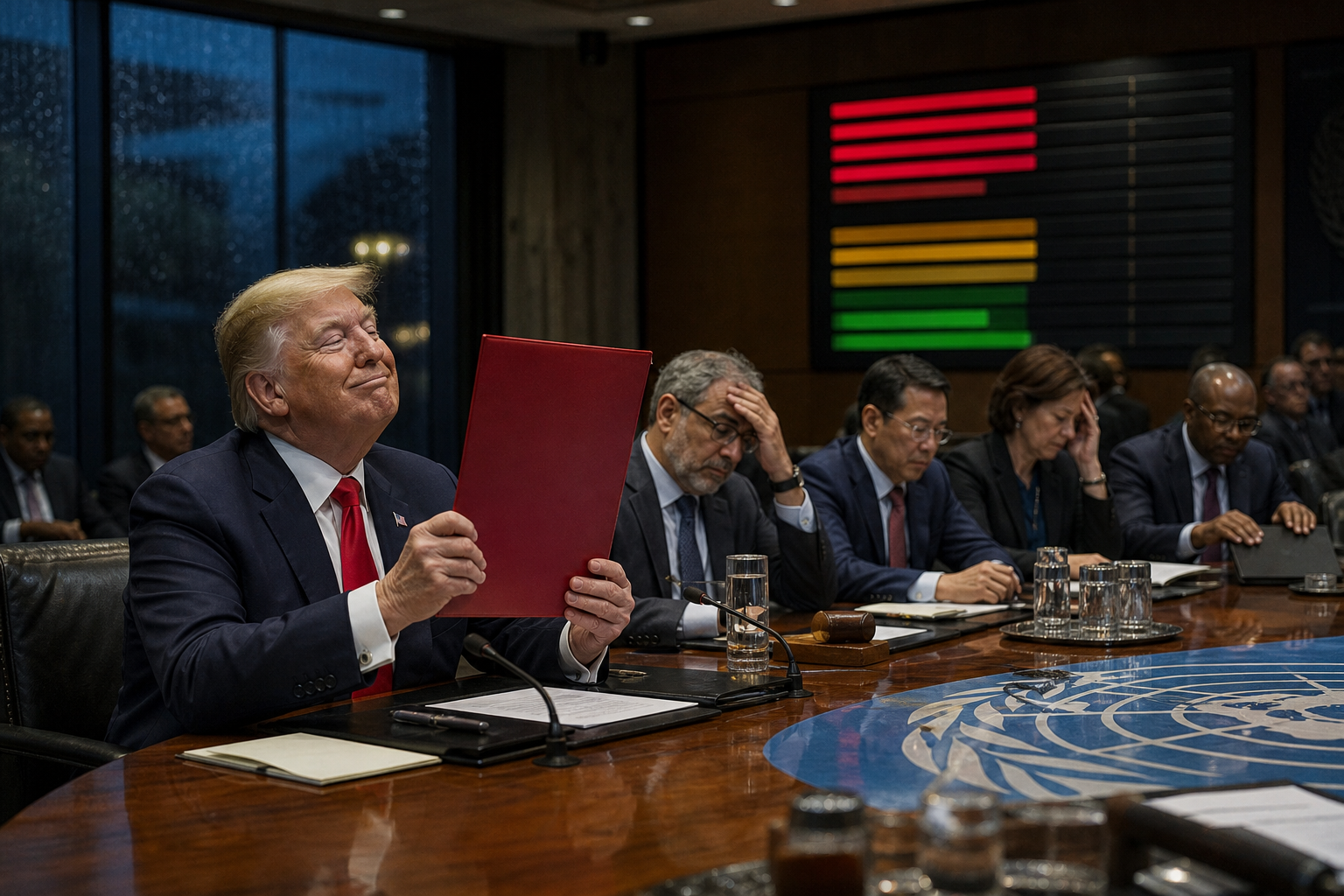
In this fictional parody, Trump’s Board of Peace has responded to its own bleak Gaza assessment by placing the ceasefire on a 30-day Performance Improvement Plan, becoming the first international agreement ever asked to “circle back with a more solutions-oriented attitude.”
The ceasefire received the notice Tuesday in a windowless conference room at the United Nations, where a Board representative explained that the arrangement had “repeatedly failed to convert alignment into execution, despite several very actionable emails.” The ceasefire, represented by a laminated copy of the original roadmap placed at the end of the table, was told it would need to show immediate improvement in such core competencies as stopping violence, allowing aid, establishing civilian administration, rebuilding Gaza and making progress sufficiently visible for a quarterly update.
“We believe in this ceasefire,” said the fictional Board chair, speaking with the encouraging urgency of a manager who has just discovered an entire department has been surviving on vibes. “But belief is not a deliverable. At some point, peace has to own its journey.”
The PIP includes weekly check-ins, measurable milestones and a mandatory listening session in which every party must describe what it needs from the other party without using the phrase “security concerns” as an emergency exit from the conversation. A preliminary draft also asks participants to identify “one small win” from the previous week, a request that reportedly caused several diplomats to stare at a ceiling tile until it achieved observer status.
Board staff initially presented the intervention as a breakthrough in accountability. Instead of merely noting that commitments had not been met, they would now color-code them. Red meant “overdue.” Yellow meant “awaiting conditions.” Green meant “discussed constructively in a meeting where no one had authority to decide anything.”
The system ran into trouble almost immediately. Israel and Hamas each requested clarification on whether the other side’s noncompliance could be entered into the form under “external blockers,” while the Board asked whether a lack of decisions by the people empowered to make decisions should count as an “opportunity for stakeholder alignment.”
Then came the first scheduled progress review, where an exhausted analyst committed what attendees called a “brave but career-limiting act of spreadsheet literacy.” He projected the ceasefire’s deliverables beside the Board’s own responsibilities and noticed the Board had missed nearly every deadline it was using to judge the ceasefire.
The civilian administration had not been fully enabled. Reconstruction remained stalled. Security arrangements existed largely as a sequence of verbs in a document. Humanitarian needs kept arriving with the poor manners of reality, refusing to wait for the implementation framework to finish introducing itself.
“To be clear,” the analyst said, according to a fictional person who was immediately reassigned to a role involving fewer screens, “we may be conducting a performance review of an agreement from inside the agreement’s failure to perform.”
The room went silent. Not diplomatic silence, which is carefully maintained and billable, but the more dangerous kind: organizational silence, when everyone realizes the person holding the clipboard may also be the reason there is a clipboard.
By afternoon, the Board had revised the PIP. The ceasefire was no longer solely responsible for improving. Israel, Hamas, the Board, the Security Council, unnamed regional partners and “all implementation-adjacent stakeholders” would now be evaluated together. The new framework was hailed as a bold rejection of blame, mainly because blame had become too crowded to seat comfortably.
Trump was briefed on the revised approach and reportedly asked whether the ceasefire could be given a strong rating for “brand recognition.” Advisers explained that its problem was not awareness. Everyone knew it existed. The difficulty was that people living under its consequences could not spend another winter waiting for it to become competent.
At press time, the Board had scheduled a morale-building offsite for the ceasefire, where it will be asked to trust the process until the process can locate its own emergency contact.
Trump’s Board of Peace Puts Its Own Ceasefire on a PIP
The plan has 30 days to demonstrate measurable progress, though its managers remain unclear on who approved the plan in the first place.
WHAT STARTED THIS MESS
The event underneath the joke is real. The SPILL premise, dialogue and escalation above are fictional parody.