Trump Orders His Own Promises to Stop Talking About Saudi Arabia
A new White House separation protocol keeps lower gas prices, no new wars and Saudi loyalty from contaminating one another.
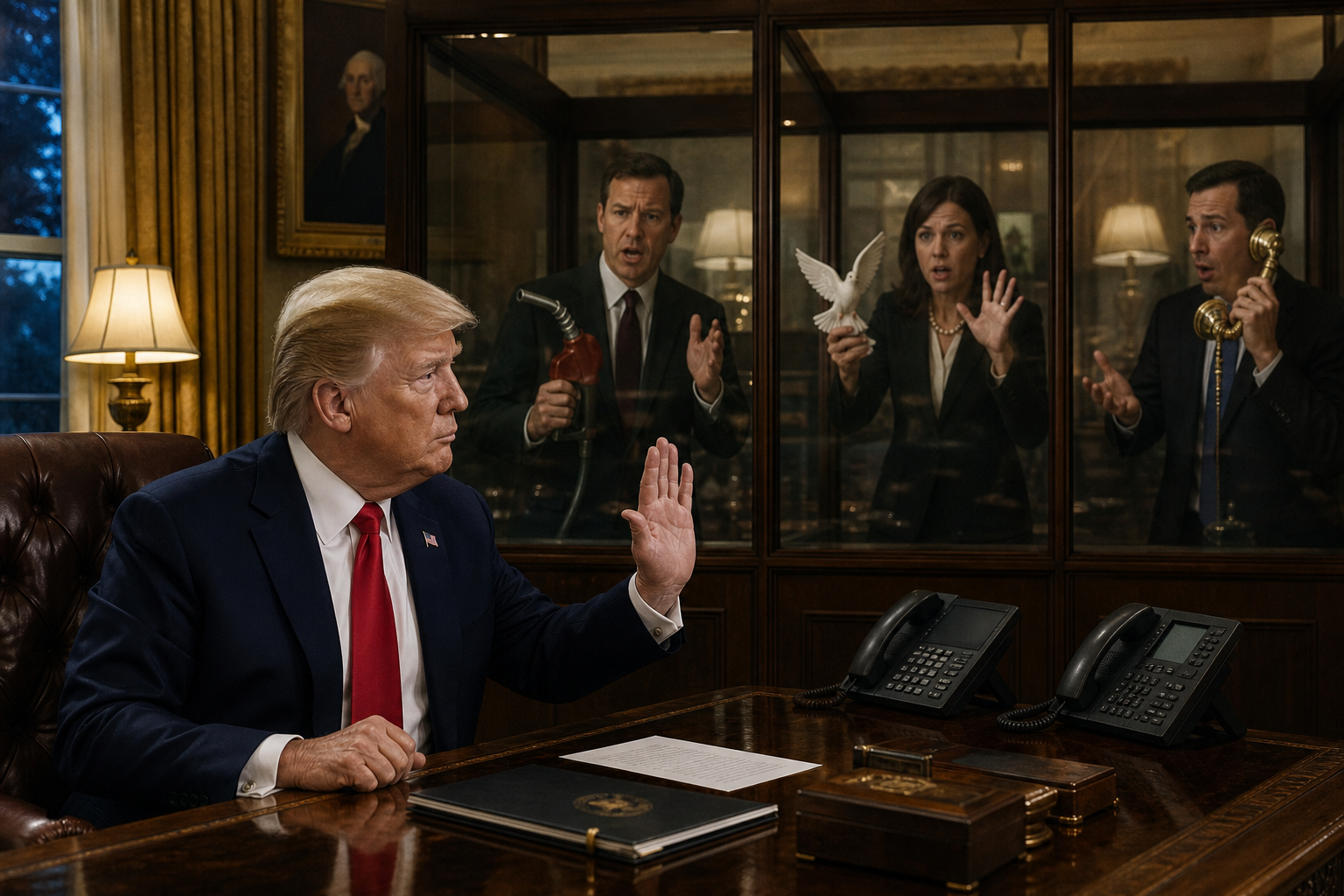
WASHINGTON — In a fictional effort to contain the diplomatic fallout from Houthi attacks on Saudi Arabia, President Trump has ordered three of his own major promises placed under immediate witness separation.
The promises — keep America out of another war, bring down gasoline prices, and stand by Saudi Arabia — may no longer be discussed within 500 feet of one another, according to a White House memo delivered Tuesday in three different envelopes by three staffers instructed not to make eye contact.
“These commitments have each given very compelling testimony,” said a fictional administration lawyer standing beside a velvet rope in the West Wing. “But when allowed to compare notes, they become hostile, emotional and frankly impossible to manage in front of cameras.”
The order follows a week in which Houthi missile and drone attacks have increased pressure on Saudi Arabia, threatening infrastructure central to the kingdom’s oil-dependent economy and forcing Trump toward the sort of decision his foreign-policy messaging has spent years avoiding: whether to deepen American involvement, protect a vital Gulf partner, or prevent energy prices from behaving like an opposition research firm with a receipt scanner.
Under the new protocol, the anti-war promise has been moved to a secure briefing room where it can continue saying “no endless wars” into a mirror. The lower-gas-prices promise has been assigned a different floor, where aides feed it carefully selected charts and assure it that oil markets are merely having a temporary attitude. Saudi loyalty has been given a private line to the Oval Office, although officials insist it is not a hotline because that would imply anyone has decided what the relationship means.
The arrangement initially appeared to work. At Monday’s national-security meeting, aides reportedly presented Trump with three separate versions of the same regional crisis. In the first, the United States had to avoid another Middle East conflict. In the second, the United States had to defend global energy flows. In the third, the United States had to show allies that security partnerships still come with more than commemorative photographs and expensive ballroom lighting.
“The president liked all three briefings very much,” said one fictional aide. “He asked why we couldn’t do all of them, then asked whether they had been tried in a stronger font.”
The system broke down when Saudi officials sought reassurance that Washington would not treat repeated attacks on the kingdom as a customer-service issue to be escalated after business hours. White House staff attempted to route the request through the Energy Promise Office, where it was briefly classified as a pricing concern, then through the No New Wars Unit, where it was classified as an unhelpful tone.
By Tuesday afternoon, the administration had unveiled a compromise called Strategic Support With No Visible Personal Growth. Under the fictional plan, the United States would offer Saudi Arabia every form of assistance that could be described as decisive in a press release and provisional in a follow-up question.
The package included intelligence sharing, defensive assistance, stern language, private concern, public concern, and a newly created “alliance reassurance window” during which foreign leaders may hear the phrase “we’re looking at it” delivered by a senior official with both hands on the desk.
Then came the second problem: the promises began communicating through intermediaries.
The gasoline pledge sent word that any military action capable of shaking oil markets should be postponed until after it had finished explaining why oil markets had already shaken. The anti-war pledge objected that the Saudi relationship was being allowed to enter the building through a side door carrying a folder marked “limited.” Saudi loyalty replied that it had been standing in the lobby for decades and was tired of being told its appointment depended on the price at a gas station in Ohio.
Campaign advisers, alarmed by the cross-examination, requested that the promises be designated “independent political entities.” Under that status, none could be used to impeach another, even if all three were describing the same president, the same region and the same extremely expensive barrel of oil.
At press time, the White House had expanded the separation order to include the words “strength,” “restraint,” “energy dominance,” “peace through strength,” and “we have a great relationship.” The only phrase still cleared to travel freely across the Middle East was the disclaimer.
Trump Orders His Own Promises to Stop Talking About Saudi Arabia
A new White House separation protocol keeps lower gas prices, no new wars and Saudi loyalty from contaminating one another.
WHAT STARTED THIS MESS
The event underneath the joke is real. The SPILL premise, dialogue and escalation above are fictional parody.
- CBS Houthi strikes on Saudi capital intensify after airport attack ↗
- AP Saudi Arabia says it thwarted a missile strike on Medina, and other Middle East developments ↗
- Reuters How the Houthis are helping Iran turn Saudi Arabia into a pressure point ↗
- CNN Iran-aligned Houthis target Yemeni presidential palace, prime minister remains unharmed ↗
- PBS NewsHour Saudi conflict with Houthis escalates with new strikes - PBS ↗
- FOX ANALYSIS: Houthis escalate attacks on Saudi Arabia as China suspected of assisting ↗