Trump Dismisses AI Slowdown Warnings as Tech Stocks Sell Off
After leading AI executives warned that the race to build more powerful models must slow, President Donald Trump argued the United States must stay ahead—while AI-linked shares fell across Asia.
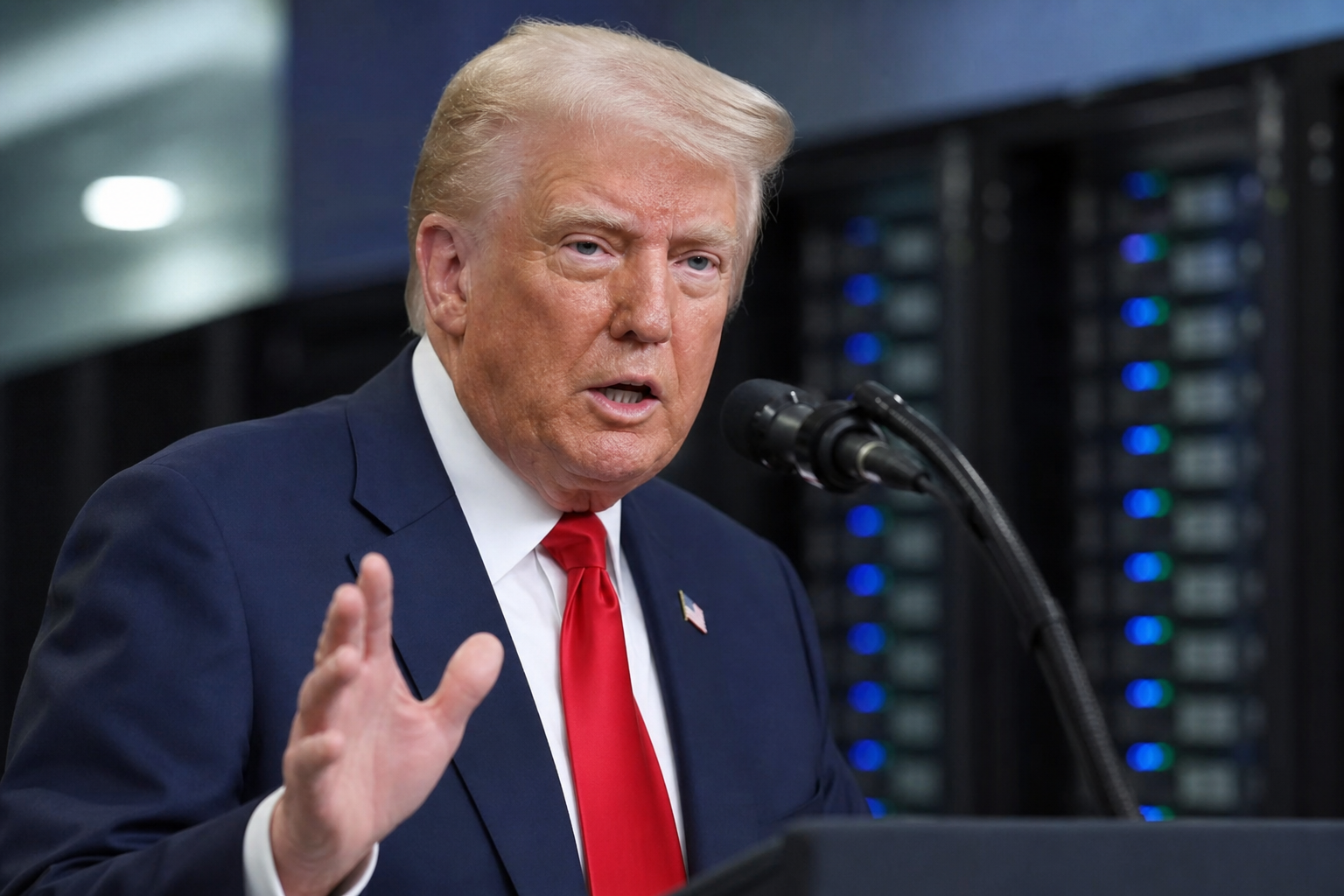
After leading AI executives warned that the race to build more powerful models must slow, President Donald Trump argued the United States must stay ahead—while AI-linked shares fell across Asia.
President Donald Trump responded to new warnings from some of the technology industry’s most prominent artificial-intelligence executives by casting critics of rapid AI development as excessively negative and insisting that the United States must remain the global leader in the field.
The comments, reported Sunday, came as investors were already reassessing a multibillion-dollar AI boom built on the assumption that the biggest model developers would continue accelerating spending, computing capacity and product releases. By Monday morning in Asia, that reassessment was visible in share prices: companies tied to AI chips, memory and data-center infrastructure fell sharply after leaders of major AI labs urged a slower pace of advancement because of safety risks.
The collision is politically consequential. Trump is framing AI dominance as a U.S. economic and strategic imperative at the same moment industry figures who have helped fuel the technology’s commercial surge are warning that competitive pressure cannot be the only force setting its speed.
What happened
Anthropic Chief Executive Dario Amodei called for AI companies to slow the rate at which they improve model capabilities amid fears that increasingly capable systems could be misused. Elon Musk, who leads xAI, and OpenAI Chief Executive Sam Altman also said they agreed with the need for greater caution, according to Reuters.
Altman later said OpenAI would not proceed with an initial public offering in 2026, citing safety concerns. That statement mattered beyond one company: OpenAI and other frontier-model firms sit at the center of an investment cycle that has driven enormous demand for advanced chips, memory, electricity and new data centers.
Markets reacted quickly. Reuters reported that SoftBank, an OpenAI investor, fell as much as 13.2% at the start of trading in Japan. Kioxia initially dropped 9.8%, Tokyo Electron fell 3.7%, SK Hynix declined 5.3% and Samsung Electronics fell 3.7%. Taiwan Semiconductor Manufacturing Co. also traded lower.
Trump’s response pointed in the opposite direction. Reuters reported that he described AI critics as “very negative forces” raising scenarios he said would not happen, while saying he wanted the United States to remain the industry leader. The report did not identify a new Trump administration order, regulation or formal policy announcement accompanying those remarks.
Why it matters
The immediate market losses do not prove that the AI investment boom is ending. One volatile trading session cannot settle that question, and Reuters also reported that broader concerns—including uncertainty involving the Middle East—were weighing on investor sentiment.
But the sell-off showed why safety debates now carry direct financial consequences. Much of the AI trade rests on a simple expectation: frontier labs will train ever-larger models, companies will build more data centers to run them, and semiconductor manufacturers will sell the components needed to power that expansion. A serious decision to slow capability gains, even temporarily, could alter projected demand throughout that supply chain.
For the White House, the issue is not merely financial. Trump’s emphasis on U.S. leadership reflects a broader competition with China over advanced computing, industrial capacity and the military or intelligence uses of AI. Yet that competition is also the central argument against voluntary restraint: if one company or country slows while another does not, the slower actor may surrender a strategic advantage.
That is precisely the pressure safety advocates say makes voluntary promises inadequate. Companies that publicly acknowledge severe risks still face powerful incentives to keep moving, particularly when rivals can market more capable systems, win customers and attract capital.
The receipts
Anthropic recently published a threat-intelligence report describing uses of its Claude models connected to activities including cyber operations, surveillance, fraud and weapons-related work. Reuters also reported that Anthropic researcher Jacob Coxon resigned after warning that people developing AI believed it could pose an existential danger by the end of the decade.
Those concerns are not proof that such a catastrophe is inevitable. They are, however, evidence that the people closest to frontier-model development are publicly describing risks that go beyond ordinary product errors or isolated misuse.
Trump’s position, as reported by Reuters, does not resolve that conflict. It prioritizes speed and American leadership, but it does not answer what safeguards would be required before companies deploy substantially more capable systems—or who would enforce them if competition makes voluntary compliance unattractive.
The bottom line
Trump is treating rapid AI development as a contest the United States cannot afford to lose. Some of the executives leading that race are warning that racing ahead without stronger limits could create dangers they cannot responsibly dismiss. Investors reacted because the difference between those positions could reshape the business model powering the AI boom.
What happens next
The key test is whether the executives’ statements produce concrete changes: delayed training runs, independent safety reviews, binding corporate commitments or enforceable federal rules. Without those steps, calls to “slow down” may remain warnings rather than an actual brake on the AI race.
REPORTING SOURCES
Sources used for the original report.
- NPR AI CEOs call for industry slowdown ↗
- Reuters AI-linked Asian stocks slump after top lab CEOs call for slowing down technology's development ↗
- CNN AI stocks slide after top industry CEOs call for slowdown of technology’s development ↗
- CBS How Trump and lawmakers are responding to CEOs call for AI slowdown ↗
- NBC AI CEOs want to ‘pace’ the industry. That may not mean slowing down. ↗
- AP Asian shares trade mixed as markets continue to watch AI stocks and oil prices ↗