Tom Barrack’s Pipeline Advocacy Reclassified as a Complicated Professional Friendship
The State Department insists nobody benefits when two people with history simply happen to discuss a $15 billion future together.
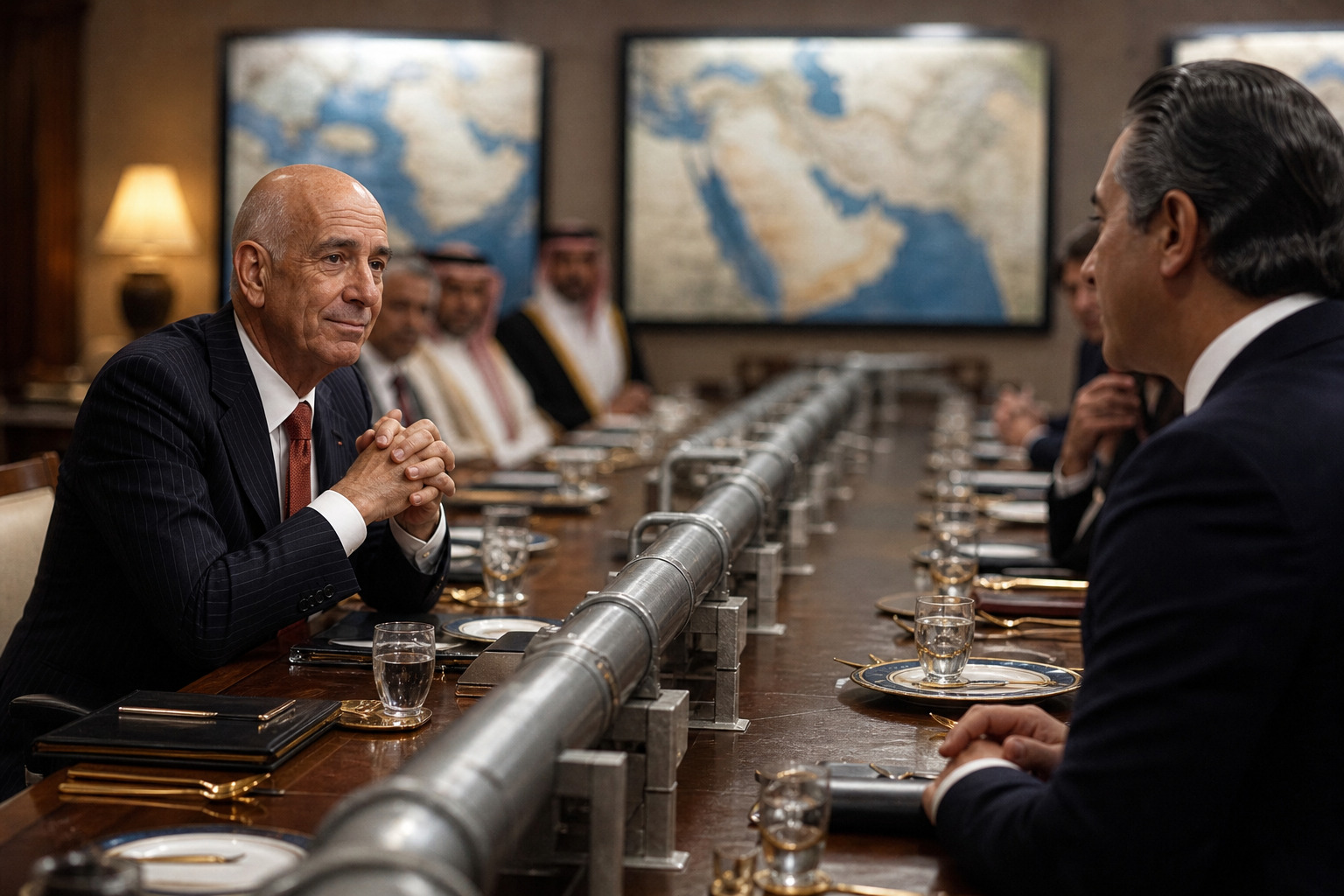
WASHINGTON — The State Department on Friday reclassified envoy Tom Barrack’s involvement in a proposed Iraq-to-Syria oil pipeline as a “complicated professional friendship,” a designation officials said would allow everyone to stop using harsh words like recusal and begin using the more humane vocabulary of two adults who have definitely talked about their boundaries.
The new status follows reports that Barrack advocated for TI Capital’s involvement in a planned $15 billion pipeline project while maintaining financial ties to a separate real-estate venture managed by TI Capital. The department has said Barrack has no role in or financial interest in the pipeline itself and was certified as compliant with ethics rules.
“Americans hear ‘business relationship’ and immediately imagine somebody doing business,” said a fictional spokesperson for the newly created Office of Professional Boundaries. “That is reductive. Sometimes two people share years of trust, a prior investment vehicle, an ongoing profit arrangement connected to an adjacent enterprise, and a mutual interest in remapping Middle Eastern energy flows. That does not mean they are together. It means they are emotionally mature enough to recognize a strategic alignment.”
Under the revised guidance, Barrack may discuss the pipeline only in general terms, such as: “The region needs a major infrastructure partner with unique familiarity, deep institutional confidence, and perhaps a name beginning with T.” He may not say TI Capital aloud, point toward TI Capital on a seating chart, or pause meaningfully after someone else says TI Capital.
The guidance also requires Barrack and TI Capital founder Ziad Ghandour to establish a “healthy communication cadence.” Diplomatic conversations must now begin with the phrase, “I value this relationship, and I want to be clear that I am approaching this corridor as my own sovereign person.” Any mention of oil, Syria, Iraq, Chevron, Qatar, financing, routing, construction timelines or the Strait of Hormuz must be followed by a 20-minute cool-down period in which both parties stare at separate maps.
At first, the arrangement appeared to solve the problem. Barrack reportedly spent Thursday describing the project as “an exciting opportunity for the region to explore what it wants, independently, with someone it has known for years and feels safe with.”
Then the pipeline itself asked where it stood.
According to people familiar with the fictional diplomatic process, the proposed line requested clarity after learning it had been introduced publicly as a regional-security necessity but privately treated like a conversation nobody wanted to label. The pipeline, which has been out of operation for decades and is not expected to be rebuilt quickly, is said to be “tired of being told it is too complicated right now.”
“I am not asking for a ring,” the pipeline reportedly said through a cross-border infrastructure consultant. “I am asking whether I am a strategic priority, a financial study, or the thing people bring up at a conference because it feels good to imagine a future together.”
That forced the State Department into its most delicate diplomatic intervention yet: a couples retreat for officials and projects with unclear ethical boundaries. Barrack, Ghandour, several energy executives and a scale model of the Kirkuk-Baniyas route were scheduled to attend a weekend workshop called Separate Assets, Shared Dreams.
The workshop agenda includes trust falls, conflict disclosure, and an exercise in which participants must identify the exact moment a longstanding professional acquaintance becomes someone whose company should perhaps not be personally championed by a federal official. Organizers initially planned to hold the exercise in a room with a whiteboard, but ethics staff objected that the whiteboard might become a stakeholder.
The department’s central challenge, aides said, is preserving the administration’s preferred distinction between an actual conflict and the much more manageable appearance of one. To that end, officials have developed a three-tier classification system: “totally separate,” “separate but understood,” and “please do not make us diagram this during a press briefing.”
In the final tier, an official may retain a financial interest in one venture involving a company, advocate for that company in another major project, and still assure the public that the relationship is not relevant because the two matters have agreed to see other people.
By late afternoon, the pipeline had reportedly updated its own status to “It’s complicated, but infrastructure is about patience.”
State Department staff celebrated the breakthrough by reminding everyone that the surest sign of ethical distance is when a $15 billion project has to ask whether you’re still thinking about it.
Tom Barrack’s Pipeline Advocacy Reclassified as a Complicated Professional Friendship
The State Department insists nobody benefits when two people with history simply happen to discuss a $15 billion future together.
WHAT STARTED THIS MESS
The event underneath the joke is real. The SPILL premise, dialogue and escalation above are fictional parody.
- AP Brent crude jumps over 4% as Middle East tensions flare, while share prices retreat ↗
- Reuters Oil jumps as Middle East supply concerns persist amid shipping attacks ↗
- CNN Oil prices jump amid record tanker attacks in Hormuz ↗
- MS NOW What is Hegseth HIDING? Top Dem says he was BLOCKED from visiting U.S. bases targeted by Iran ↗