Texas Republicans Convene Emergency Summit on the Meaning of ‘For’
The party insists it has always fought for voters, provided voters understand the term as aspirational metadata.
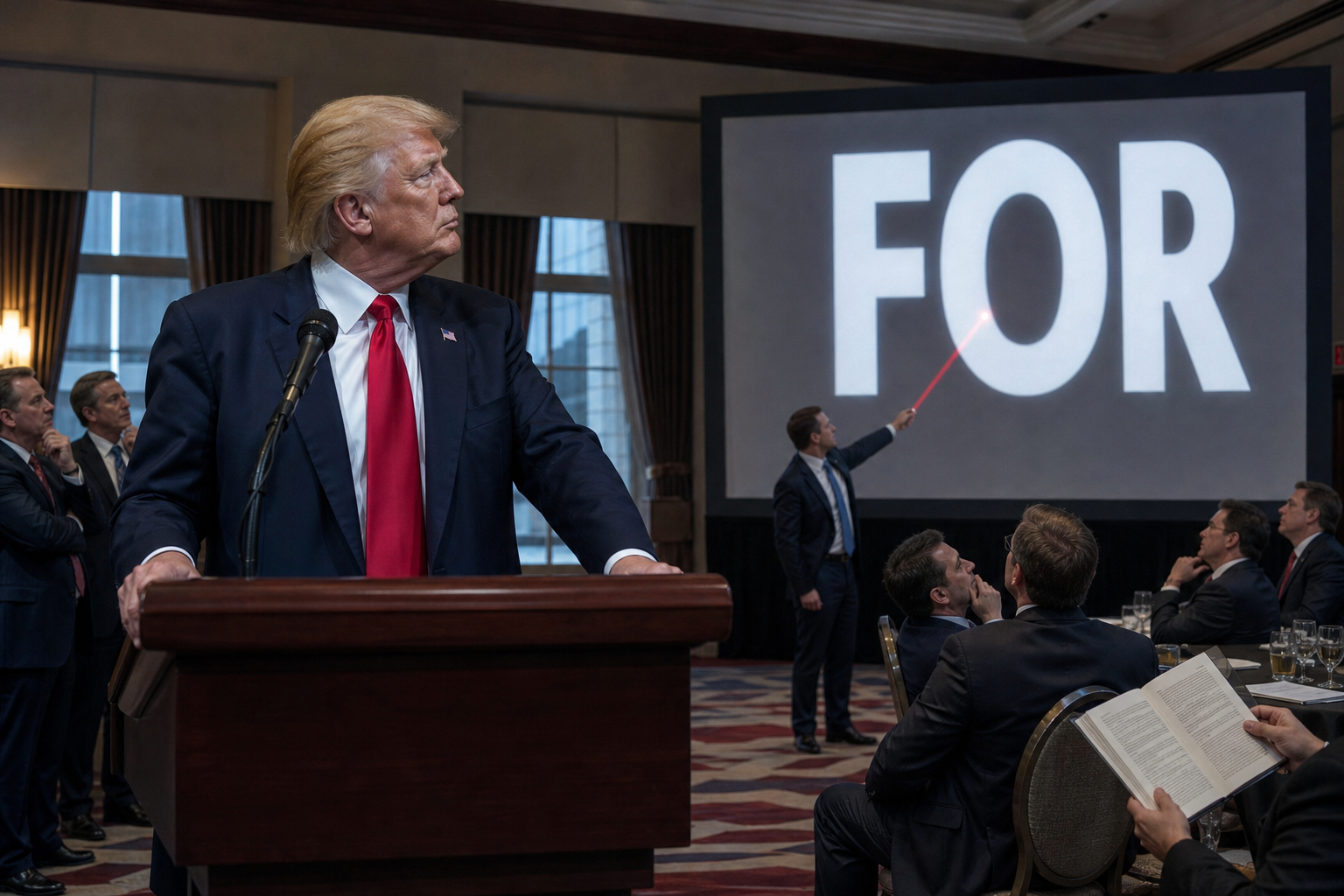
AUSTIN, TEXAS — In an emergency session convened hours after exit-poll data indicated that 73% of Latino voters said President Trump does not fight for people like them, the Texas Republican Party has ordered an immediate review of the preposition for.
“We have spent years proudly saying we fight for working families, fight for communities, fight for people who feel forgotten,” said fictional state party communications director Mallory Vance, standing beside an easel bearing the phrase FIGHT FOR YOU with the word FOR circled in red. “It has come to our attention that some voters interpreted that as an indication that we might, at some point, fight on their behalf. That is not a reading we can responsibly leave unexamined.”
The party’s newly formed Prepositional Integrity Task Force met in a hotel ballroom usually reserved for donor breakfasts and disappointed gubernatorial announcements. There, campaign consultants, pollsters and one man introduced as a “rural-semanticist” debated whether for could mean “in the general vicinity of,” “during the broad historical era of,” or “with a sincere appreciation for the concept of.”
“When a candidate says he’ll fight for you, nobody should leap to the conclusion that you are the beneficiary,” said the semanticist, who had been given a lanyard reading LANGUAGE FREEDOM FELLOW. “In modern campaign speech, ‘you’ is an emotionally available placeholder. It may refer to a voter, a donor, a business sector, an abstract civilization, or a man yelling from a boat ramp.”
The revelation reportedly alarmed senior strategists, who had believed the phrase was too vague to create expectations.
“Our entire message architecture was built on the assumption that ‘for you’ operated like ‘farm fresh’ or ‘limited time only,’” said one fictional consultant. “It was supposed to create warmth without activating a warranty.”
By lunchtime, the task force had produced a 48-page guidance document instructing candidates to replace potentially actionable language such as “I’ll fight for you” with safer alternatives including “I recognize fighting-adjacent conditions,” “Your concerns have achieved campaign visibility,” and “I remain passionately near the idea of affordability.”
Then the meeting took an unexpected turn. Focus-group footage from several Texas communities showed participants repeatedly asking the same impolite question: if campaigns were fighting so intensely for ordinary people, why did ordinary people keep receiving the debris?
That question sent the room into what aides described as “a nonpartisan posture of sudden reflection.” One strategist reportedly asked whether it was possible to fight inflation by describing it as a liberal rumor. Another suggested that voters may have become confused by seeing candidates promise relief while defending policies whose chief visible accomplishment was giving every grocery receipt the dramatic pacing of a hostage note.
“We have a messaging issue,” Vance said, before being interrupted by a pollster who clarified that a messaging issue is what parties call a material issue after it has developed a voting history.
In response, the task force announced a pilot program called Beneficiary Discovery, under which campaigns will attempt to identify one specific person affected by each major policy before filming an ad about it. The initiative immediately encountered resistance when a consultant asked whether the person would need to be present for the policy discussion.
“Absolutely not,” said another consultant. “That could introduce needs.”
By late afternoon, the party had settled on a compromise: candidates may continue saying they fight for Texans, but must deliver the line with what a training memo calls “sufficient interpretive breathing room.” At rallies, supporters will be encouraged to cheer after the word “fight,” while a tasteful instrumental swell covers the rest of the sentence.
The new approach received its first field test when a candidate practiced the revised slogan: “I will fight…” He paused, looked toward the consultants, and finished, “…to maintain an active dialogue with the possibility that somebody somewhere is having a hard time.”
The room erupted in applause. At last, Texas Republicans had found a promise broad enough to include everyone and specific enough to help no one.
Texas Republicans Convene Emergency Summit on the Meaning of ‘For’
The party insists it has always fought for voters, provided voters understand the term as aspirational metadata.
WHAT STARTED THIS MESS
The event underneath the joke is real. The SPILL premise, dialogue and escalation above are fictional parody.