Susie Wiles’ Old Firm Opens MAGA Loyalty Pageant for Corporate Clients
In Washington’s newest competition show, the prize is proving your special interest is spiritually grassroots enough for premium access.
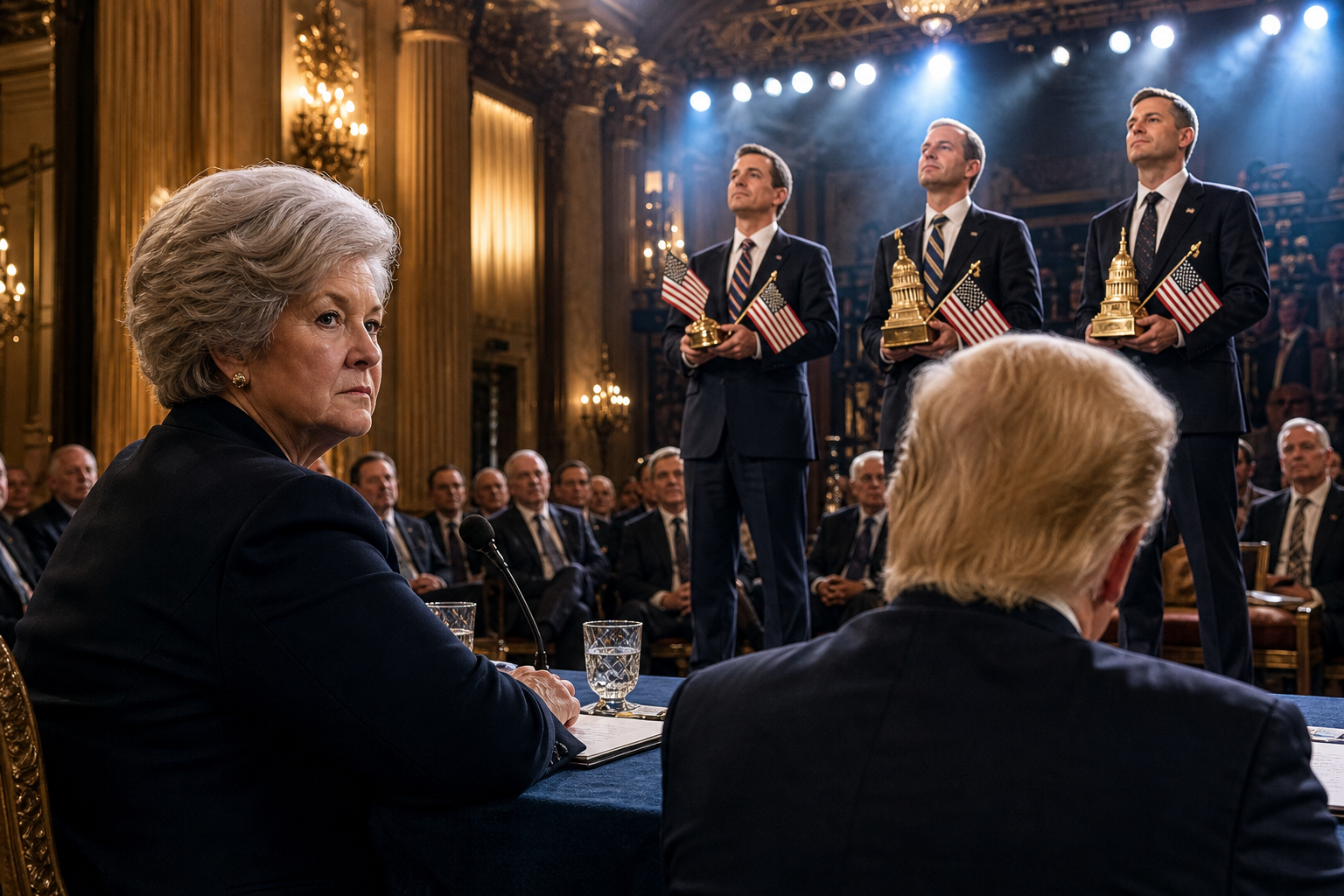
WASHINGTON — Ballard Partners, the lobbying firm formerly managed by Susie Wiles, has unveiled America First, Me First, a fictional prime-time competition in which corporate clients compete for the right to be considered morally compatible with an administration built on opposing precisely the kind of influence they purchased.
The program arrives after the firm’s reported $186 million Trump-era haul became a handy exhibit in the increasingly loud MAGA argument over whether the movement has been infiltrated by lobbyists, or merely achieved the conservative dream of making lobbying feel like a family business with better lighting.
“The public is tired of shadowy influence,” said the show’s fictional host, standing before a gold-curtained stage lined with executives who had each been issued a small flag, a lapel microphone and one nonrefundable opportunity to describe their regulatory priorities as personal hardship. “That’s why we’re bringing influence into the open, where it can be judged on poise, patriotism and whether it has ever been photographed near the phrase ‘stakeholder engagement.’”
In the premiere, representatives from food, pesticide, tobacco, pharmaceutical and technology interests walked the runway in formalwear selected to communicate that they had never once met an earnings call they couldn’t turn into a kitchen-table concern. One contestant, a snack-food conglomerate, received a standing ovation for explaining that its resistance to clearer nutrition standards was really about preserving Americans’ freedom to make difficult choices at a gas station.
The judges did not ask whether a company had hired lobbyists. That question, producers explained, would have eliminated the cast before the cold open. Instead, contestants were asked whether their lobbyists had ever called themselves lobbyists in an emotionally sincere way.
“We prefer the term democratic translators,” said one fictional contestant from a vaping concern, who carried a tiny eagle-shaped fog machine for the talent portion. “Our clients take complicated concerns — like quarterly revenue — and render them into the ancient civic language of protecting small business.”
The first unexpected crisis emerged during the swimsuit segment, renamed the Regulatory Burden Showcase after several contestants objected that the original format made them look insufficiently serious. Companies were required to emerge from a smoke-filled tunnel holding the federal rule they found most personally oppressive. A chemical-industry representative appeared carrying a laminated sentence fragment. A beverage executive carried a fruit punch. A defense contractor rolled out in a ceremonial sash made of procurement exemptions.
Then came the movement’s most punishing test: the Populist Lightning Round. Contestants had 30 seconds to denounce Washington insiders while identifying the exact insider who could get them a meeting before lunch.
It was there that the show nearly collapsed. A contestant from the wellness sector accused the judges of allowing corporate interests to disguise themselves as ordinary Americans. The room went quiet, partly because the accusation landed and partly because three producers had to confirm whether the wellness sector had entered through the corporate-interest entrance or the ordinary-American entrance with a concierge package.
The producers convened an emergency standards panel. After six hours, it ruled that no contestant could be called “the swamp” unless another contestant had first used the term in a podcast with enough conviction to make a fundraising email out of it.
The decision restored calm, though it created an administrative problem: nearly every company on the roster had already submitted evidence that its rivals were the swamp, its own preferred tax treatment was an act of national renewal, and its outside advocates were just citizens who happened to know everyone’s scheduler.
By the finale, the pageant had stopped trying to identify a winner. Instead, the judges crowned every contestant “America’s Most Misunderstood Job Creator” and issued each a commemorative access badge, valid whenever public anger had moved on to another branch of government.
The only disqualification came after one corporation admitted it wanted influence because influence was useful, a breach of pageant etiquette so severe that it was immediately escorted to a bipartisan panel discussion.
Susie Wiles’ Old Firm Opens MAGA Loyalty Pageant for Corporate Clients
In Washington’s newest competition show, the prize is proving your special interest is spiritually grassroots enough for premium access.
WHAT STARTED THIS MESS
The event underneath the joke is real. The SPILL premise, dialogue and escalation above are fictional parody.
- POLITICO Calley Means accuses Susie Wiles of interfering in hemp policy ↗
- CBS Susie Wiles' old lobbying firm made $186 million under Trump. Now it's caught in MAGA's feud. ↗
- MS NOW Buttigieg: 'The moment Trump leaves the scene is the beginning' - MS NOW ↗
- NBC Chinese espionage expert discusses Nvidia CEO investigation ↗
- AP Alice Huang, who reportedly had an affair with Nvidia CEO, is a Chinese banker turned tech exec ↗
- NPR What now for Nvidia’s Jensen Huang, and should Congress ban RSI? : Machine Gods ↗
- PBS NewsHour Nvidia and Huang face lawsuit alleging investors were misled about spy affair - PBS ↗
- Reuters Senior Republican on US Senate banking panel calls on Nvidia CEO Huang to resign ↗