Supreme Court Recognizes Neighborhood Character as Kentucky’s Loudest Religion
The justices now face a grave doctrinal question: can a prayer grotto coexist with a cul-de-sac’s deeply held belief in beige?
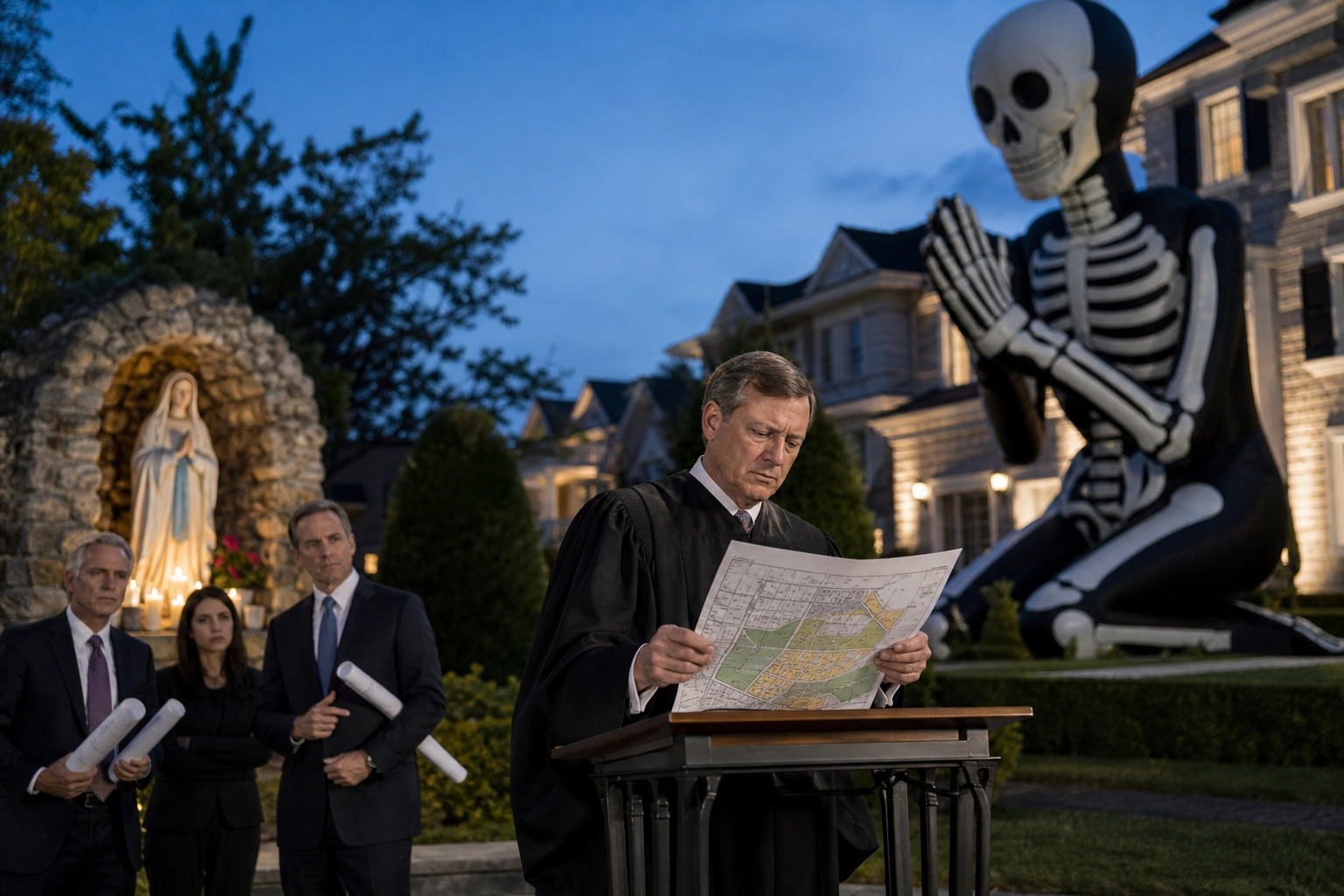
WASHINGTON—The Supreme Court’s decision to hear a Kentucky church’s fight to build a shrine to the Virgin Mary on adjacent residential land has forced the nation’s highest court to confront a previously unexamined religious tradition: Neighborhood Character, the powerful suburban faith whose adherents gather at zoning hearings to recite ancient invocations about sightlines, drainage and “what this could become.”
The case concerns a Catholic organization’s effort to build a modest Marian grotto beside Our Lady of Lourdes Church in Park Hills, Kentucky. But after reviewing arguments from both sides, Court staff concluded that local opposition could not be understood through the thin secular lens of “land use.” It was plainly a collision between two belief systems: one involving prayer, pilgrimage and a shrine honoring the Virgin Mary, and another involving a spiritual conviction that every new structure eventually becomes an event venue.
“We cannot decide whether government has substantially burdened religious exercise until we determine whose religious exercise counts,” said a fictional Court memorandum that immediately became the most cited sacred text in American cul-de-sacs. “For example, residents’ weekly observance of standing in a driveway and saying, ‘This isn’t what we moved here for,’ appears central to their faith.”
Within hours, municipal attorneys across the country began revising zoning codes to accommodate the newly recognized religion. The City of Park Hills reportedly prepared a ceremonial map identifying protected holy sites, including the church, the proposed shrine parcel, three ornamental pear trees, and the exact corner where a man named Dennis has parked his SUV at every hearing since 2019.
The first complication emerged when the Court’s religious-liberty framework required officials to distinguish between sincere doctrine and mere aesthetic preference. That task quickly proved impossible. One resident submitted a 74-page theological affidavit explaining that the neighborhood’s architectural harmony depends on every building appearing to have been designed by an insurance company that recently lost a lawsuit.
Another witness described the proposed grotto’s walking path as an intolerable disruption to a community whose spiritual life has long centered on private sidewalks leading nowhere in particular.
“There is no hostility here,” the witness said in testimony that is entirely fictional. “We welcome all faiths, provided they fit the existing setback requirements and do not create a second reason for anyone to slow down near our mailbox.”
The Court initially considered appointing an expert on comparative religion. That plan collapsed after every nominee admitted some personal connection to a homeowners association, making recusal mathematically inevitable. Justice Department lawyers then proposed a more neutral test: whether the challenged structure would alter the area’s “essential spiritual atmosphere.” Under that standard, the shrine’s supporters would need to prove that a statue of Mary, a plaza and a prayer path were less disruptive than the 14-foot inflatable skeleton currently protected by a grandfathered Halloween exemption.
That revelation changed the case. The issue was no longer whether a church could build a shrine on its own adjacent property. It was whether Neighborhood Character could survive the knowledge that it had already made doctrinal accommodations for a fog machine, a twelve-foot animatronic pirate and a gazebo used once for a wedding where guests arrived by party bus.
By late afternoon, religious leaders from both traditions attempted reconciliation. The church offered to describe the project as a “contemplative exterior amenity.” Neighborhood Character rejected the language as dangerously permissive, noting that an amenity can eventually become a “destination,” and a destination can eventually cause someone to park legally but with unfamiliar intent.
At press time, the Supreme Court had asked both sides for supplemental briefing on a narrow legal question: whether the Constitution permits government to favor a faith whose principal sacrament is forwarding a grainy photo of a contractor’s truck to the entire neighborhood.
Supreme Court Recognizes Neighborhood Character as Kentucky’s Loudest Religion
The justices now face a grave doctrinal question: can a prayer grotto coexist with a cul-de-sac’s deeply held belief in beige?
WHAT STARTED THIS MESS
The event underneath the joke is real. The SPILL premise, dialogue and escalation above are fictional parody.
- MS NOW Trump says he regrets appointing Neil Gorsuch, Brett Kavanaugh and Amy Coney Barrett ↗
- Reuters Trump says he regrets nominating Supreme Court Justices Gorsuch, Barrett and Kavanaugh ↗
- POLITICO Trump’s Supreme Court grievances ↗
- CBS Supreme Court to hear dispute over Trump's mandatory detention policy ↗
- NBC Trump clashes ahead as new Supreme Court term begins ↗
- NPR Supreme Court begins new term with cases on religion, guns and immigration ahead ↗
- PBS NewsHour News Wrap: Supreme Court to review mandatory detention policy for migrants - PBS ↗