State Department Offers Donors a Concierge for Their Unfinished Expectations
The new service promises that no politically connected disappointment will go unanswered, un-escalated, or left without a fruit plate.
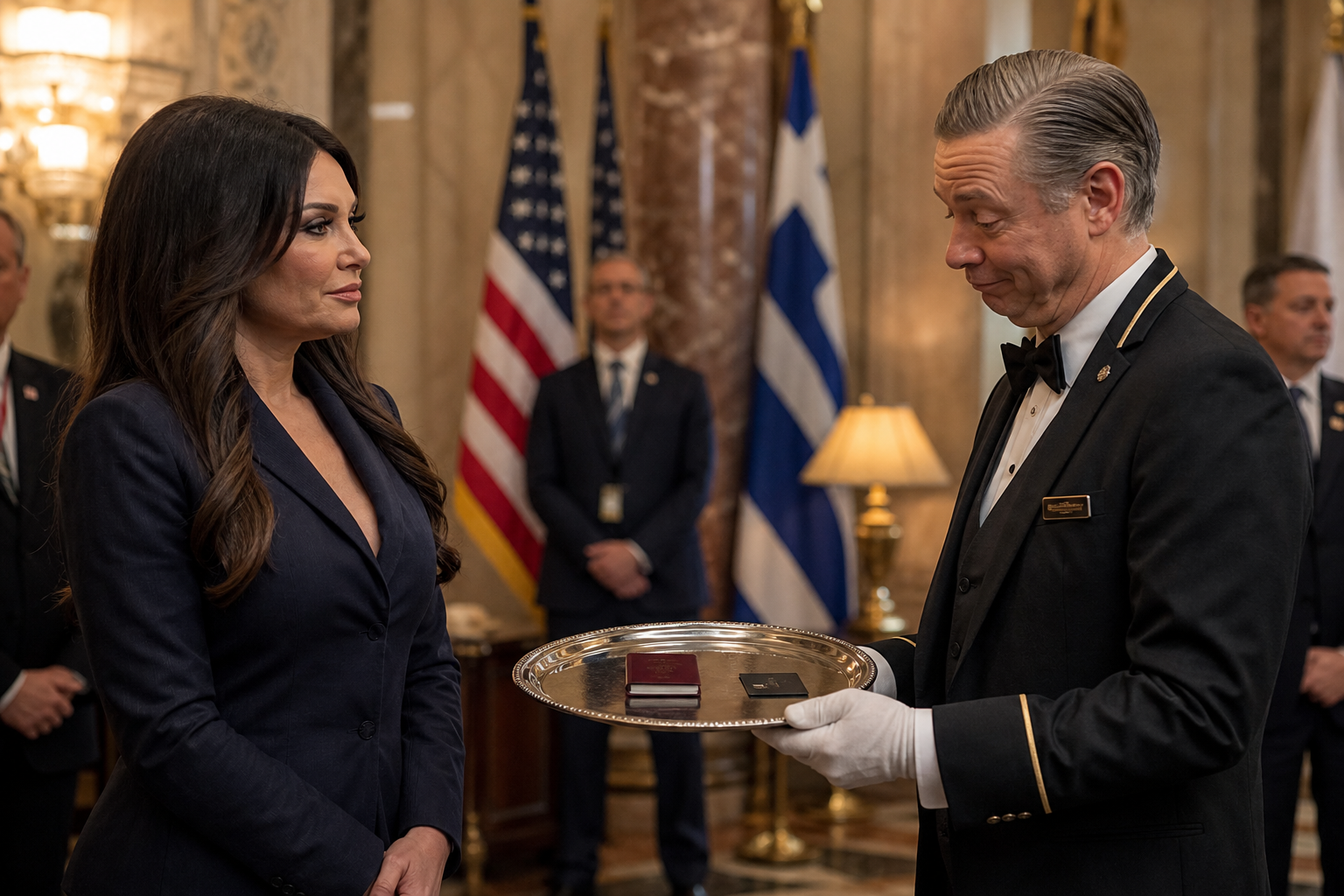
WASHINGTON—Following reports that a State Department watchdog is examining allegations involving U.S. Ambassador to Greece Kimberly Guilfoyle and a Republican donor, the department on Sunday unveiled its new Diplomatic Expectations Concierge, a white-glove service for benefactors who believe their relationship with government failed to deliver the kind of closure normally associated with a luxury resort dispute.
The program, entirely fictional and immediately booked through 2029, assigns every major donor a personal “expectations liaison” trained to distinguish among three delicate categories of political disappointment: access not received, access received but emotionally underperforming, and access technically delivered in a way that did not photograph well enough to justify the amount of access.
“Government has spent too long treating powerful people as though they should simply understand what words like ‘support,’ ‘help,’ and ‘we’ll see what we can do’ mean,” said a fictional State Department hospitality executive, standing before a mood board titled Foreign Service, Domestic Feelings. “That may work for ordinary democracy. It does not work for a platinum-tier relationship.”
The concierge will begin each case with a soothing intake call in which donors may describe the precise emotional texture of their grievance. Were they promised something? Were they merely led to believe something? Did a series of flattering messages create a reasonable expectation that the federal government would eventually start behaving like a rewards program?
Rather than leave those questions to messy public disputes, the department said its fictional liaisons would offer a range of restorative options: a handwritten note thanking the donor for “believing in outcomes,” a private Zoom in which a deputy assistant secretary nods for 42 uninterrupted minutes, or a ceremonial embassy photo in which the donor is positioned near a flag but far enough from the ambassador to preserve plausible deniability.
The initiative initially drew criticism from ethics specialists, who worried it blurred the line between public service and premium customer retention. That concern was addressed at a briefing when a spokesman clarified that the line would remain visible at all times, preserved beneath thick museum glass and available for viewing during normal business hours.
But the program’s real innovation emerged later in the day: dissatisfied donors will not be asked what they wanted. Instead, they will be invited to select from an elegant digital menu of feelings, including “misunderstood,” “under-celebrated,” “strategically forgotten,” and “I did not spend that kind of money to become a person with a calendar conflict.”
Once a feeling is chosen, the concierge will generate a bespoke diplomatic wellness plan. A donor who selects “under-celebrated,” for example, may receive a video message from a career diplomat explaining that every relationship contains seasons. Someone choosing “strategically forgotten” can reserve an evening at the State Department’s new Reflection Lounge, where a leather-bound binder of old group photos will be placed on a side table and nobody will say the word “transaction.”
Officials stressed that the service is not about buying influence, which would be inappropriate. It is about providing an elevated post-influence experience for clients—sorry, citizens—whose expectations may have outrun the government’s ability to provide whatever nobody technically promised.
The department also announced a “soft landing” protocol for cases that become public. Under the protocol, all parties will be issued matching cashmere blankets, encouraged to use the phrase “miscommunication,” and offered a neutral third party from Georgetown who specializes in persuading wealthy adults that a devastating betrayal can also be an excellent networking opportunity.
By nightfall, the first concierge suite had reportedly received hundreds of inquiries, mostly from donors seeking clarification on whether a campaign dinner counts as a diplomatic incident if the shrimp was cold.
State Department Offers Donors a Concierge for Their Unfinished Expectations
The new service promises that no politically connected disappointment will go unanswered, un-escalated, or left without a fruit plate.
WHAT STARTED THIS MESS
The event underneath the joke is real. The SPILL premise, dialogue and escalation above are fictional parody.
- NBC State Department watchdog probing Kimberly Guilfoyle amid alleged $100,000 demand ↗
- MS NOW Trump donor accuses Kimberly Guilfoyle of quid pro quo: ‘She’s a grifter’ ↗
- PBS NewsHour ↗
- FOX Trump names Leavitt successor after weeks of speculation — and she's no stranger to MAGA ↗
- CBS Steve Bannon on the GOP and the midterms: "We can't afford to lose" ↗
- POLITICO Taxpayer-funded pro-Trump ads to end Sunday, Border Patrol official tells court ↗