Saudi Arabia Takes Houthi Missile Threat to Investor Relations
The kingdom’s new security earnings call assures anxious markets that incoming projectiles remain within revised guidance.
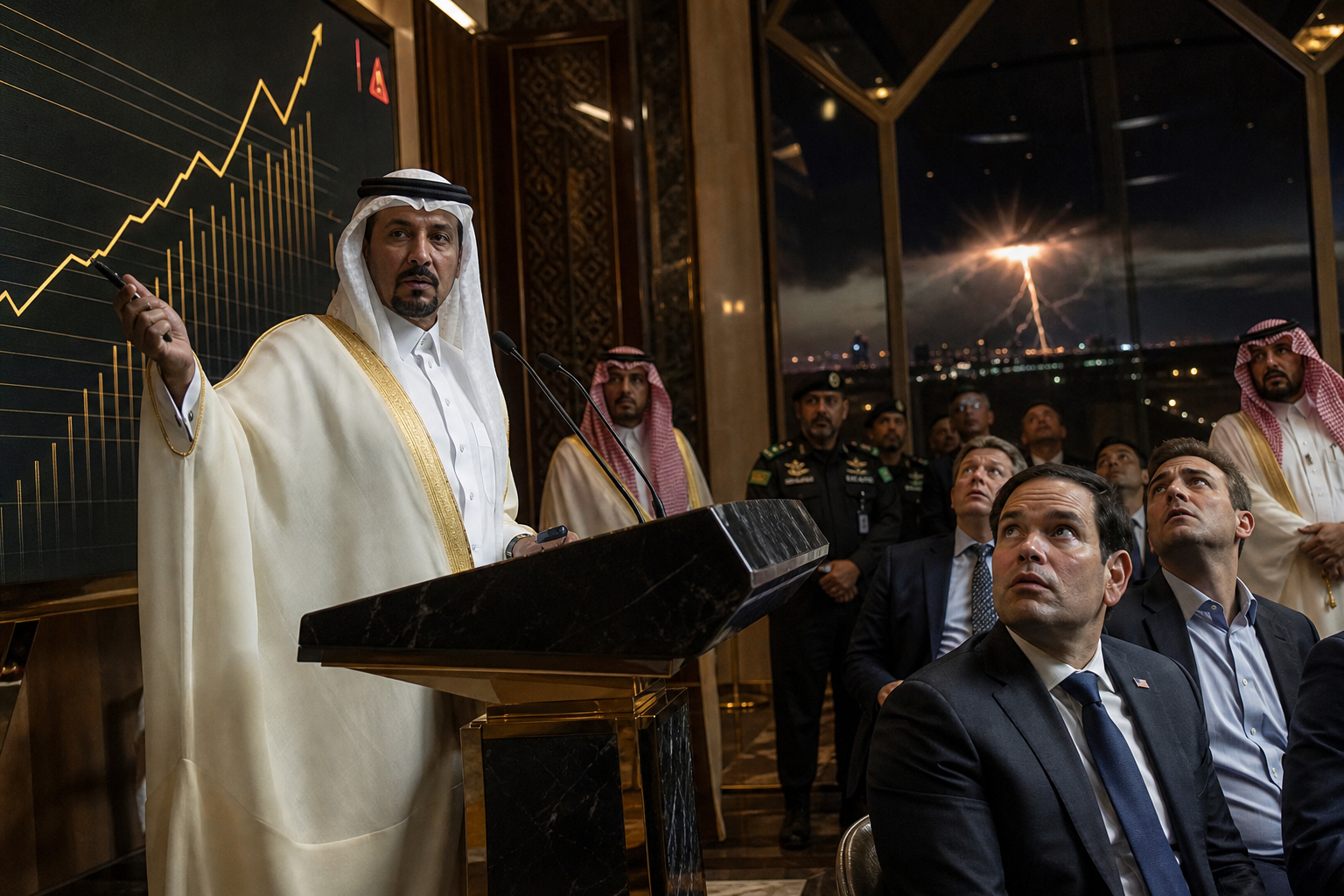
This article is parody inspired by real events.
Following renewed Houthi strikes on Saudi targets and airports, Saudi Arabia has announced the creation of a fictional National Security Investor Relations Office, where every regional escalation will now be presented to global markets as a manageable quarter-over-quarter challenge with strong long-term fundamentals.
At the inaugural briefing, a government spokesperson stood before a giant screen reading “RESILIENCE: STILL ON TRACK” and assured investors that while several recent developments had been “kinetically adjacent to our transportation ecosystem,” the kingdom remained committed to delivering a premium national experience.
“We recognize that some stakeholders may have noticed activity in the sky,” the spokesperson said, clicking to a slide titled Unscheduled Airspace Engagements: A Temporary Headwind. “But it is important to distinguish between a threat environment and a threat narrative. The environment is being addressed. The narrative is outperforming expectations.”
The new office was created after officials concluded that ordinary military statements were failing to communicate the full sophistication of Saudi Arabia’s approach to being attacked. Previous announcements merely described interceptions, damage assessments and security measures. The investor-relations format will instead contextualize every incident through the language of confidence: “event-driven volatility,” “strategic downside containment” and “airport-adjacent brand pressure.”
Airports will no longer be described as targets. They are now “high-visibility mobility assets experiencing temporary investor attention.” Oil facilities, meanwhile, have been reclassified as “legacy revenue nodes with strong emotional importance to commodity markets.”
The presentation’s most popular slide, according to fictional attendees, was a pie chart showing that 84% of the kingdom’s security concerns were “already priced into the vision,” while the remaining 16% had been moved into a smaller pie chart labeled “not material at this time.”
For several hours, the program appeared to be a triumph. Analysts praised its disciplined messaging. One bank upgraded Saudi Arabia’s conflict posture from “concerning” to “concerning, but with excellent typography.” A sovereign-wealth consultant said the kingdom had finally found a way to make an airport warning feel like an invitation to a closed-door infrastructure summit.
Then came the difficult question: if the situation is so contained, why was the government holding a national-security earnings call at all?
The spokesperson paused, glanced at a defense official, then unveiled the office’s second initiative: a new metric called Adjusted Calm. Under the formula, any anxiety caused by attacks can be excluded from the country’s public confidence total if it is deemed nonrecurring, externally generated or visible only from certain runways.
“This is standard international practice,” the spokesperson said. “Nobody evaluates a visionary economy based on every small thing that happens near its airports.”
That answer created a new problem for the Defense Ministry, which had spent the morning trying to provide actual security updates only to discover that every sentence now had to be cleared by both military officials and a luxury-brand consultant. A draft warning about potential risks near oil infrastructure was returned with the note: “Could this be framed as limited-edition access?”
By late afternoon, the government’s crisis team had divided into two camps. Security officials wanted to issue plain public guidance. Investor-relations executives wanted to wait until they could bundle the guidance into a forward-looking statement. The executives won after pointing out that clarity can spook markets, whereas a sentence containing the words “disciplined,” “adaptive” and “ecosystem” can calm a room full of people without making anyone understand what is happening.
To demonstrate transparency, the office opened a question-and-answer session. The first question came from a reporter asking whether renewed attacks meant the conflict had entered a dangerous new phase.
“We would characterize the current phase as an opportunity to demonstrate the depth of our contingency narrative,” the spokesperson replied.
The second question asked whether Saudi citizens and travelers should be worried.
At that point, the investor-relations team gently removed the microphone and announced that consumer confidence would be discussed during the next quarter, after it had been adjusted for optimism.
Before leaving, the spokesperson promised that the kingdom would continue to defend its territory, safeguard critical infrastructure and protect the integrity of its national vision. Behind him, the final slide appeared: “NO CHANGE TO FULL-YEAR GUIDANCE, SUBJECT TO ACTUAL EVENTS.”
Within minutes, the slide was revised to read: “NO CHANGE TO FULL-YEAR GUIDANCE, SUBJECT TO EVENTS, WEATHER, GEOPOLITICS, AND THE CONTINUED EXISTENCE OF AIRPORTS.”
Saudi Arabia Takes Houthi Missile Threat to Investor Relations
The kingdom’s new security earnings call assures anxious markets that incoming projectiles remain within revised guidance.
WHAT STARTED THIS MESS
The event underneath the joke is real. The SPILL premise, dialogue and escalation above are fictional parody.
- AP Houthis strike Saudi targets, olive harvesters attacked in West Bank and other Mideast developments ↗
- Reuters Gulf bourses subdued as Saudi-Houthi hostilities escalate ↗
- CBS Appeals court hears arguments in NYC for lawsuit accusing Saudi Arabia of involvement in 9/11 ↗
- NBC Federal appeals judges don’t reveal how they’ll rule on Saudi Arabia’s effort to end 9/11 litigation ↗
- NPR Former ambassador on NATO's meeting in Ukraine and the ongoing war ↗
- POLITICO War in Ukraine ↗
- PBS NewsHour Saudi Arabia says 3 injured in attacks on its airports as fighting with Houthis reignites - PBS ↗