Rubio Lets Foreign Governments Rate U.S. Residents’ Political Speech
The new fictional State Department dashboard promises every lawful resident the dignity of being reviewed by a country they may have criticized.
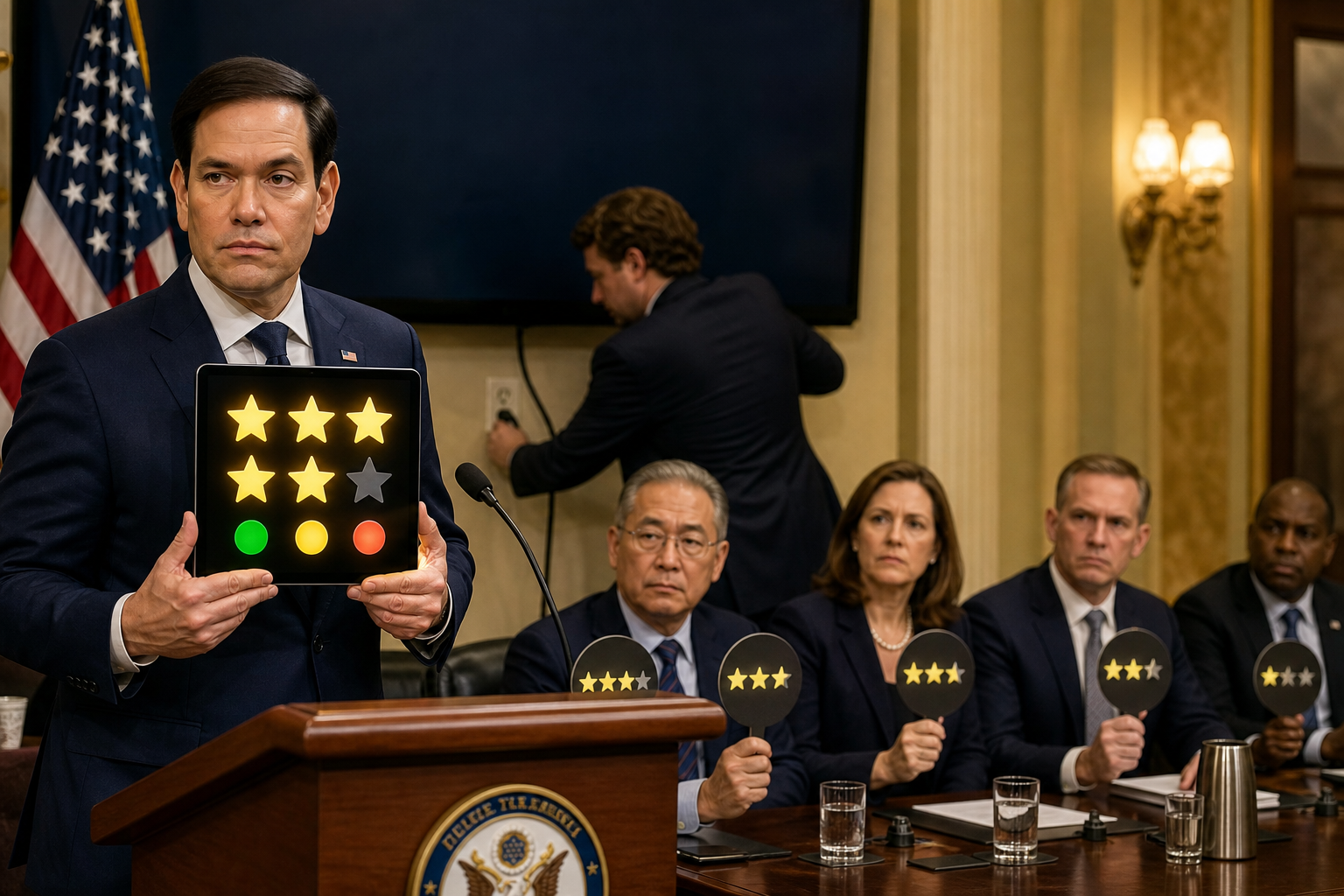
WASHINGTON—Following an immigration judge’s ruling that the president of Wisconsin’s largest mosque could be deported on foreign-policy grounds, Secretary of State Marco Rubio on Thursday unveiled a fictional new State Department tool allowing foreign governments to leave star ratings on the political speech of U.S. residents.
The platform, called Welcome, But Keep It Constructive, will invite allied nations to rate public comments according to tone, gratitude, regional sensitivity and whether the speaker has made a foreign ministry staffer briefly close a laptop and stare into the middle distance.
“For too long, American immigration policy has relied on vague phrases like ‘national interest’ and ‘foreign-policy consequence,’” Rubio said in the imaginary launch video, standing beside a giant gold star that had been blurred for diplomatic reasons. “Now we can make these determinations with the clarity Americans expect from every restaurant where a waiter failed to bring enough ranch.”
Under the fictional system, permanent residents who speak at rallies, write op-eds or post a badly received thread will receive a polite notification: A government you have never visited found your viewpoint difficult to process. Users may appeal a one-star rating by recording a 45-second video explaining that their criticism was intended as “an opportunity for partnership.”
The first unexpected problem emerged almost immediately. Diplomats from several countries reportedly complained that the service had become too efficient, producing a torrent of reviews from governments that had been waiting years to describe a columnist as “passionately misinformed, but the lighting in his video was excellent.”
The State Department responded by adding filters. A resident can now sort feedback by country, severity and whether the reviewing government is currently selling the United States anything expensive.
“We are trying to distinguish an actual foreign-policy concern from a country experiencing the normal human sensation of not enjoying criticism,” said fictional Undersecretary of Diplomacy and User Experience Brent K. Sloat. “That is why every review must now answer the question: Did this speech genuinely threaten bilateral relations, or did it merely make somebody at an embassy say, ‘Can you believe this guy?’”
Administration officials insisted the program would not chill speech. Instead, they said, it would make speech “more legible to our international partners,” a phrase that required a second spokesperson to arrive with a whiteboard.
That reassurance collapsed when the dashboard’s beta version accidentally ranked residents by “global ease of hosting.” A 72-year-old naturalized citizen from Ohio briefly received a platinum badge for never expressing an opinion about anything beyond mulch. A graduate student lost points after referring to an arms deal as “kind of grim.” One Milwaukee man was informed that his comment had been escalated to “the vibes team.”
Rubio’s office said the ranking was only a prototype and would never determine anyone’s status by itself. It would instead be considered alongside a robust portfolio of unreviewable concerns, sealed letters, executive impressions and whatever appeared most troubling when read aloud in a hearing room.
Then came the reveal that transformed the project from a diplomatic innovation into a full-service nightmare: foreign governments were not satisfied with rating speech. They wanted replies.
By late afternoon, the State Department had opened a customer-service chat where residents could communicate directly with offended governments through a cheerful automated mediator named Pax. The bot’s only available responses were “We hear you,” “Your concern has been assigned a case number,” and “Please refrain from using the phrase ‘with all due respect’ while your eligibility is under review.”
A senior official demonstrated the process for reporters by submitting a hypothetical complaint about a permanent resident who had criticized a military campaign. Within seconds, Pax suggested a restorative Zoom session, a handwritten apology to “all stakeholders,” and a six-month pause on having opinions near a microphone.
Asked whether the system gave foreign governments too much influence over people legally living in the United States, the official said that was an unfair characterization.
“They do not influence anything,” he said. “They simply provide the sort of actionable feedback that happens to arrive wearing a blazer, carrying a diplomatic passport and somehow already knowing your immigration file number.”
By evening, the site had crashed after the government of France attempted to leave a 14-page review of an American podcaster’s pronunciation of “croissant.” The resident remains in good standing, although Pax has recommended he attend a sensitivity training in butter.
Rubio Lets Foreign Governments Rate U.S. Residents’ Political Speech
The new fictional State Department dashboard promises every lawful resident the dignity of being reviewed by a country they may have criticized.
WHAT STARTED THIS MESS
The event underneath the joke is real. The SPILL premise, dialogue and escalation above are fictional parody.
- AP US can deport the leader of Wisconsin’s largest mosque on foreign policy grounds, judge rules ↗
- CBS Judge rules US can deport the leader of Wisconsin's largest mosque ↗
- MS NOW Immigration judge rules U.S. can deport leader of Wisconsin’s largest mosque ↗
- Reuters Immigration judge rules US can deport president of Wisconsin's largest mosque ↗
- NBC U.S. can deport the leader of Wisconsin’s largest mosque on national security grounds, judge rules ↗
- FOX Wisconsin mosque leader’s deportation fight takes dramatic turn as Trump admin scores major win ↗