Rahul Gandhi’s Protest Is Flagged as a Duplicate Entry
India’s fictional election bureaucracy says the opposition leader may be real, but his objection has appeared in too many locations.
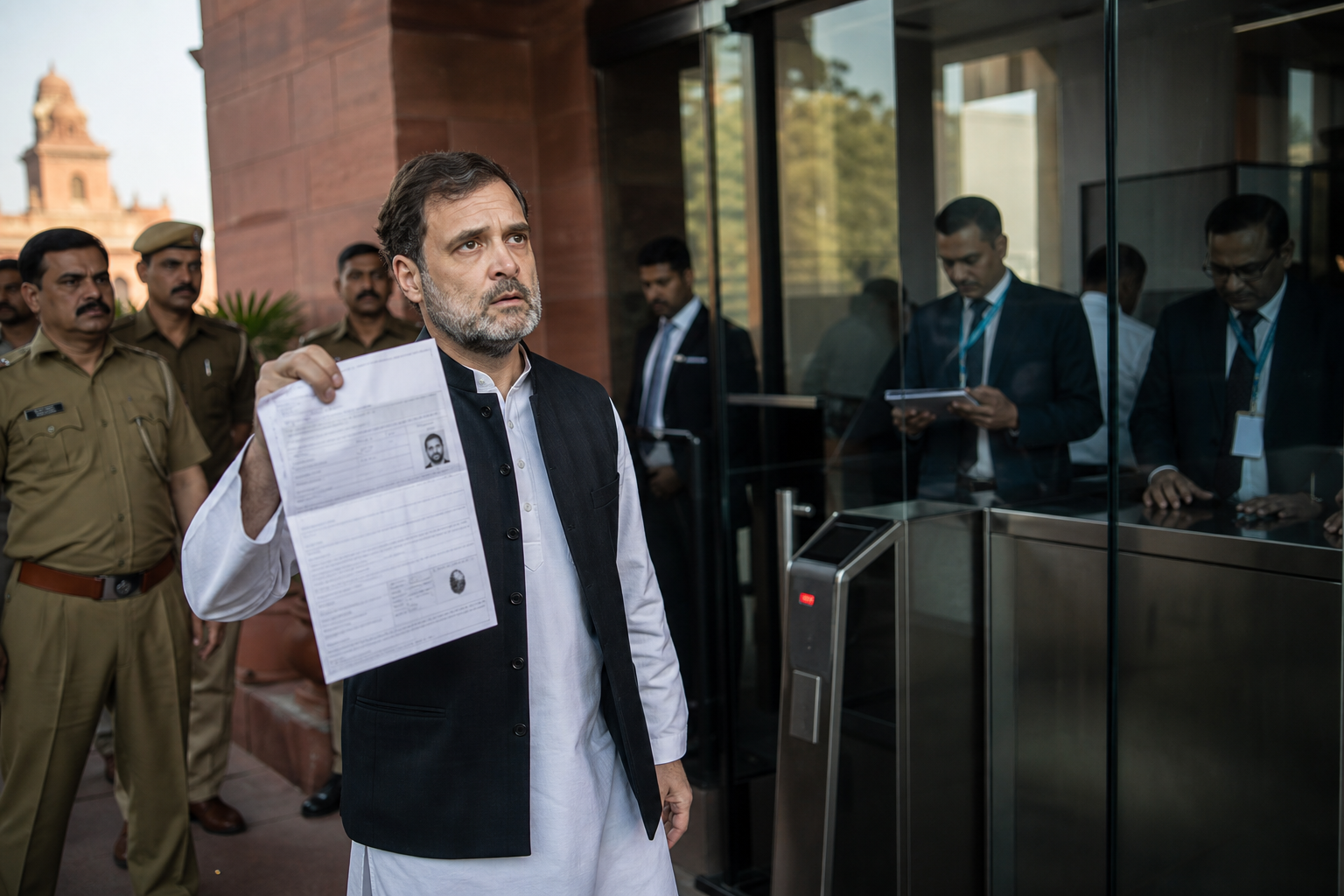
FICTIONAL PARODY INSPIRED BY A REAL EVENT.
Following Rahul Gandhi’s detention during an opposition protest demanding a meeting with India’s election chief, the fictional Election Commission of India has determined that Gandhi himself requires further verification before anyone can establish whether he was actually protesting.
Under the Commission’s newly unveiled Protest Integrity Protocol, any person who appears in more than one official capacity—such as leader of the opposition, march participant, detainee, and person asking why voter lists are changing—will be marked as a possible duplicate entry until they can prove they are not several versions of the same administrative inconvenience.
“Mr. Gandhi was observed in Parliament, on television and near an institution he wished to question,” said a fictional Commission representative, speaking from behind a tasteful frosted-glass panel labeled only with a small hourglass. “That is exactly the kind of unusually persistent civic footprint our systems were designed to notice.”
The representative stressed that no one was accusing Gandhi of not existing. The Commission merely needed him to provide acceptable documentation showing that the Rahul Gandhi who objected to voter-list revisions was materially distinct from the Rahul Gandhi who wanted to discuss them with the people carrying out those revisions.
Gandhi’s request for a meeting was promptly assigned a reference number, then placed in a queue for requests seeking confirmation that the queue exists. Opposition lawmakers were told they could track the matter online, provided they first answered a security question asking which version of themselves had submitted it.
By midafternoon, the protest had produced a complication. Thousands of people were now publicly insisting that voter rolls should be accurate, transparent and open to challenge. Because so many complaints contained broadly similar sentiments, the new system began identifying the entire demonstration as an apparent coordinated duplication event.
“It is statistically improbable that this many people would independently want confidence in an election process,” explained the fictional spokesperson. “We are not dismissing their concerns. We are protecting the country from a dangerous surplus of identical concern.”
Police, who had expected the usual job of managing a political march, found themselves recruited into the data-cleaning operation. Officers began separating protesters into three categories: verified, pending verification, and people whose presence had created an unacceptable amount of paperwork. The last group included nearly every elected official within sight.
Then came the second problem: the Commission’s own complaint portal received so many appeals that it inferred an extraordinary degree of public engagement. A glossy internal dashboard celebrated the protest as a record-breaking success in “citizen interaction,” while the complaints themselves were automatically compressed into a single expandable menu titled Generalized Feelings About Representation.
When opposition leaders objected that this was exactly the issue, the system recorded their response as confirmation that they had successfully received the system’s response. Their cases were upgraded from “unresolved” to “conversation completed.”
Gandhi was offered an expedited review if he could produce proof that he had not changed addresses, identities, political roles, or opinions since the last time a government office found him inconveniently easy to locate. He reportedly selected the option marked “I remain available for democratic purposes,” which triggered a polite notice explaining that availability alone could not establish eligibility.
At press time, the fictional Commission said it remained fully committed to hearing every concern, just as soon as each concern could demonstrate it was not merely another copy of the concern immediately before it.
By sunset, the protest had been entered into the national record as reassuring evidence that nobody was being erased faster than they could be asked to confirm the erasure.
Rahul Gandhi’s Protest Is Flagged as a Duplicate Entry
India’s fictional election bureaucracy says the opposition leader may be real, but his objection has appeared in too many locations.
WHAT STARTED THIS MESS
The event underneath the joke is real. The SPILL premise, dialogue and escalation above are fictional parody.