Oil Nearly Hit $100 After Saudi Attacks, Putting Inflation and the 2026 Midterms Back on Edge
A fresh attack on Saudi energy infrastructure drove crude sharply higher and sent major U.S. stock indexes lower Tuesday, delivering another warning that the Middle East conflict is reaching Americans through prices, paychecks and political anxiety.
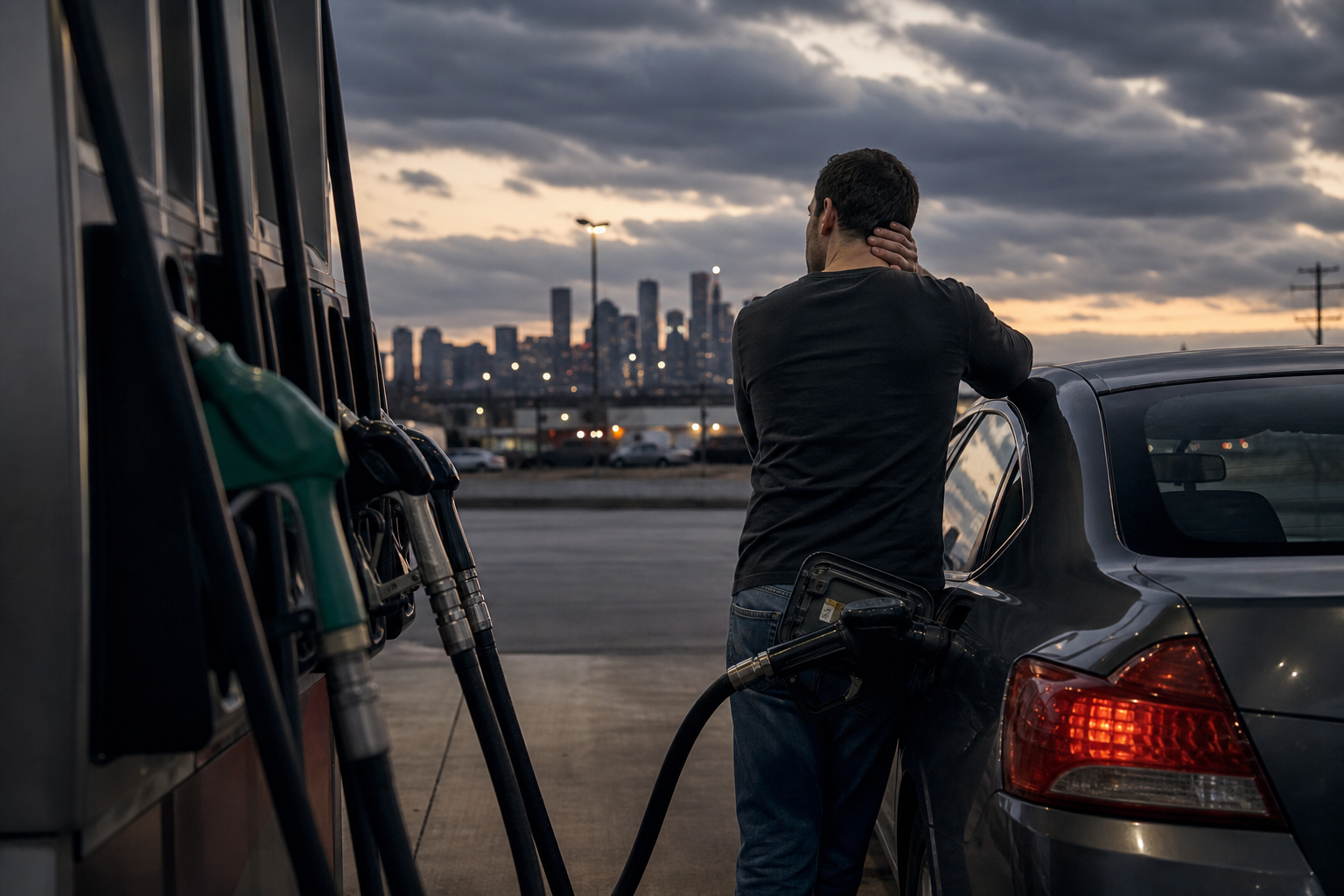
A fresh attack on Saudi energy infrastructure drove crude sharply higher and sent major U.S. stock indexes lower Tuesday, delivering another warning that the Middle East conflict is reaching Americans through prices, paychecks and political anxiety.
Oil prices surged toward $100 a barrel Tuesday after attacks on Saudi Arabian energy facilities intensified fears of a further supply shock, pulling Wall Street lower and raising the prospect that gasoline and broader inflation will become an even more punishing issue before the November 2026 elections.
Brent crude, the international benchmark, briefly climbed to about $99.46 per barrel before settling at $97.92, up 0.9% for the day, according to Associated Press market reporting. U.S. stocks retreated after the three-day Labor Day weekend: the Dow Jones Industrial Average fell 628.18 points, or 1.2%; the S&P 500 declined 0.6%; and the Nasdaq composite lost 0.3%.
The market move is not merely an investor story. Oil is a foundational cost in the U.S. economy: it affects gasoline, diesel, jet fuel, freight, manufacturing and household budgets. A sustained rise can work its way into prices Americans encounter every day, just as voters begin paying closer attention to whether the party controlling Washington has made their lives more or less affordable.
The immediate trigger was a wave of Houthi attacks in Saudi Arabia that struck energy facilities and utilities, caused fires and wounded more than 70 people, according to AP reporting from the region. The attacks added pressure to an oil market already strained by the U.S.-Iran war, the disruption of shipping routes and constraints on movement through the Strait of Hormuz.
WHAT HAPPENED
Before U.S. markets opened Tuesday, futures had already signaled a rough session. The Dow futures contract was down 0.8%, S&P 500 futures were off 0.3%, and Nasdaq futures were roughly flat as crude rose on fears that the Saudi attacks could disrupt an already fragile energy supply chain.
Those fears persisted through the trading day. Reuters reported that Brent had hit a six-week high above $98 earlier Tuesday, while U.S. crude climbed above $92. The intraday price changes underscored the volatility: traders were reacting not simply to current barrels removed from the market, but to the risk that fighting could further damage energy facilities or choke off the routes used to move oil to buyers.
By the closing bell, the result was broad but uneven pressure on stocks. The Dow, which includes economically sensitive industrial and consumer companies, took the largest percentage loss. The technology-heavy Nasdaq fell less sharply. That distinction matters because rising oil prices can create immediate winners in the energy sector while imposing costs on airlines, retailers, shippers, manufacturers and households.
WHY IT MATTERS TO VOTERS
For a family filling a tank, the price quoted in global oil markets is not the final bill. Refining capacity, regional fuel supply, taxes, retailer margins and transportation all matter. But a sharp, sustained climb in crude is one of the clearest warning signs that gasoline and diesel costs could rise further.
That political connection is direct. Inflation is not an abstract quarterly statistic when a worker pays more to commute, a small business pays more to receive inventory or a parent sees transportation costs feed into the price of groceries and other essentials. Higher fuel costs can also complicate the Federal Reserve’s effort to contain inflation, especially if businesses pass their own energy and shipping costs to consumers.
The timing is especially difficult for Republicans defending congressional power in the November 2026 midterms. President Donald Trump returned to office promising to lower prices and project strength abroad. The administration’s war with Iran has instead become part of the economic backdrop confronting voters: higher energy costs, unsettled markets and a conflict whose consequences are moving from foreign-policy briefings into household budgets.
Democrats will seek to tie the price pressure to Trump’s decisions and the broader costs of the conflict. Republicans are likely to argue that attacks by Iranian-backed Houthis and disruptions to global oil routes are external shocks, not evidence that domestic energy policy has failed. Both claims will be tested by what happens next: whether oil settles down, whether gasoline prices continue climbing, and whether inflation data worsen.
THE RECEIPTS
The evidence of Tuesday’s immediate market reaction is straightforward. AP reported Brent briefly near $99.50 and a 0.9% gain at settlement, while the S&P 500 closed down 45.08 points at 7,673.52. The Dow closed at 52,786.07 after its 628.18-point decline, and the Nasdaq finished at 26,421.41.
Reuters reported that the day’s oil rally followed attacks on Saudi energy facilities and described investor concern that higher energy prices could reignite inflation pressure. The same report noted that markets were looking ahead to U.S. inflation reports later this week and the Federal Reserve’s meeting next week.
That sequence is important. Markets are not declaring that a single day of higher crude guarantees a new inflation surge. They are pricing a risk: renewed damage or supply disruption could keep energy expensive long enough to alter consumer prices, inflation expectations and central-bank decisions.
WHAT HAPPENS NEXT
The first question is physical supply. Investors, consumers and policymakers will be watching whether the Saudi attacks cause a lasting interruption to production, exports, refining or shipping. A fire at a facility is serious; a prolonged loss of barrels reaching world markets would be more consequential.
The second question is the U.S. price data. The August Producer Price Index is due Thursday, September 10, followed by the Consumer Price Index on Friday, September 11. Those reports will show what prices were doing before Tuesday’s attack-driven market jolt, but they will shape expectations for how much inflation pressure the economy was already carrying into the latest escalation.
The third question is political accountability. The midterms are still weeks away, and no single trading session will decide them. But candidates cannot credibly treat fuel costs, inflation and foreign policy as separate subjects when each can affect the others. If oil stays elevated and gasoline follows, voters will have a concrete measure of the conflict’s domestic cost.
REPORTING SOURCES
Sources used for the original report.