Naftali Bennett’s Comeback Requires Israel to Call His References
A former prime minister can promise a new regional future, but first somebody has to confirm he answers emails.
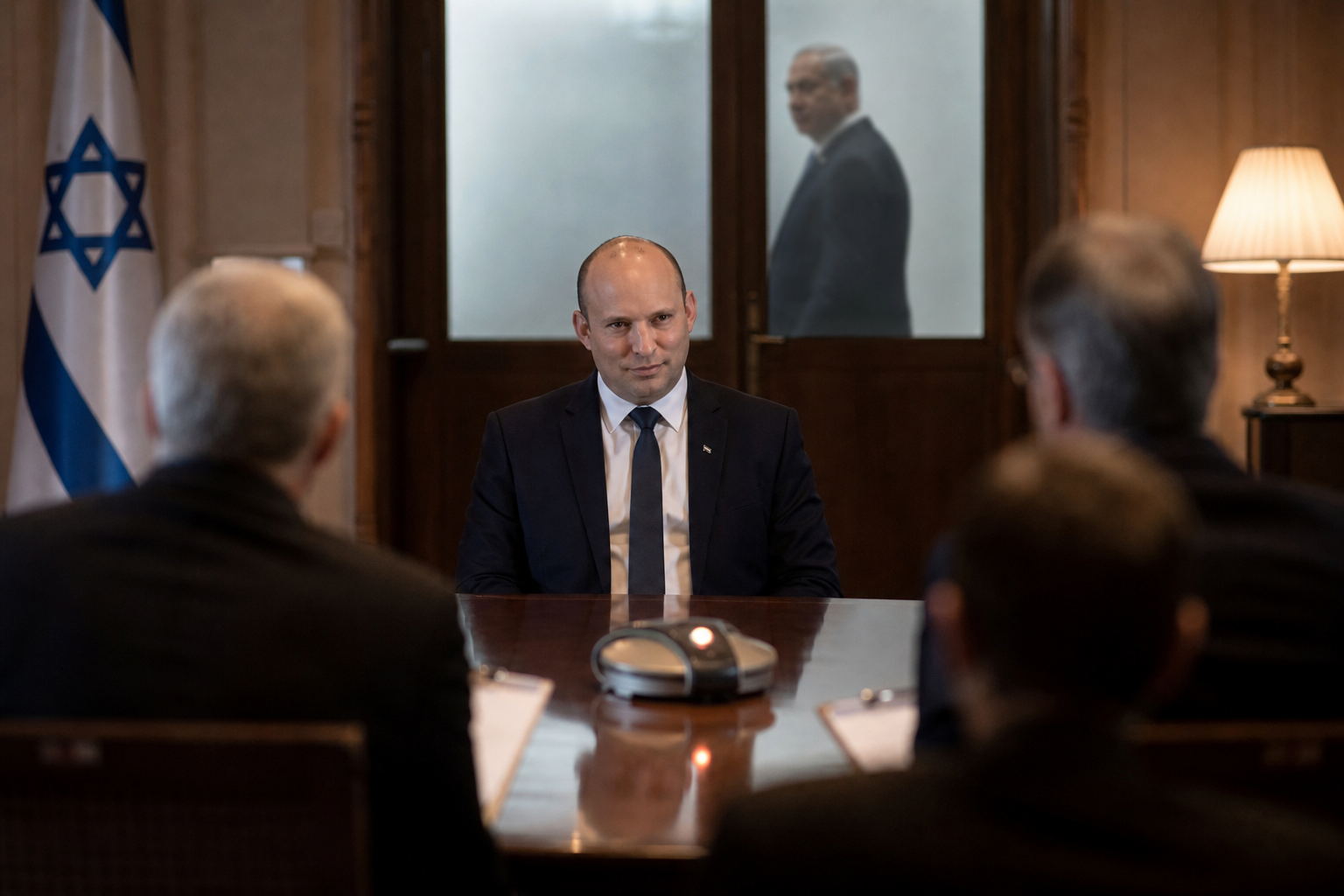
This is fictional political parody inspired by a real election.
Naftali Bennett’s return to Israeli politics hit an unexpected administrative delay Tuesday after his campaign was informed that any applicant seeking to manage a country, its coalition partners and a Middle East relationship portfolio would need to submit three professional references who had personally survived working with him.
The new requirement was imposed by the fictional National Office of Please Be Serious, which said Bennett’s plan to restore Israel’s international standing and revive regional diplomacy sounded promising but had raised a basic employment question: “Can he do the part after the launch event?”
Bennett, a former prime minister seeking a political comeback, reportedly arrived at campaign headquarters carrying a folder marked People Who Have Seen Me in a Meeting. Inside were the names of former coalition colleagues, regional leaders and one person from a 2021 unity government who had agreed to confirm that Bennett could, on occasion, sit in a room containing several ideologies without immediately demanding a new election.
“We are not questioning his qualifications,” said a fictional election official with the exhausted expression of someone who has watched a coalition agreement become a historical document before the coffee arrived. “We are simply asking whether the candidate’s previous teammates would rehire him, or whether they would stare into the middle distance and say, ‘Define hire.’”
The reference process immediately created complications. Former partners were asked to rate Bennett on leadership, diplomacy and ability to avoid turning a routine disagreement into a constitutional event. Several requested that the form include a box labeled “worked well under conditions no human-resources department could reasonably model.”
One former coalition figure reportedly spent forty minutes trying to answer the question, “Would this candidate bring people together?” before asking whether “together” meant in the legal sense, the parliamentary sense or the sense in which several adults share an elevator during an emergency.
Bennett’s campaign initially welcomed the scrutiny. A spokesman said the candidate had a proven record of assembling political arrangements that sounded impossible until they were briefly real, which is more than could be said for many promises made under professionally lit campaign banners.
Then the office expanded the program to every major contender.
Within hours, Israeli politics became the first democracy to discover that nobody running for national office enjoys being evaluated by people who have their direct number.
Campaigns that had spent months presenting their leaders as historic figures were suddenly asked to provide former colleagues capable of saying something warmer than “I acknowledge the person held that position.” One party submitted a former aide. The aide submitted a lawyer. The lawyer submitted a scheduling link.
Benjamin Netanyahu’s operation objected that a reference check was an insulting reduction of statesmanship to workplace culture. The Office of Please Be Serious replied that this was precisely the concern: workplace culture was the only culture in the country that still required people to explain why they had quit.
Netanyahu’s team then attempted to list “Israel” as a reference. The form rejected the entry on grounds that a country cannot be both the employer and the employee unless it has recently acquired a podcast microphone and a venture-capital round.
That was when the election’s entire tone changed. Bennett’s rivals had expected to debate security, diplomatic strategy, the ultra-Orthodox draft and the future of Israel’s place in the region. Instead, they found themselves being asked whether they could name one person from a previous governing arrangement who would describe them as “good in a shared document.”
The public-facing portion of the process was tense but polite. Candidates arrived in dark suits, delivered serious remarks about national destiny, then sat in a side room while a neutral administrator called former coalition partners and asked whether the applicant had ever said “we should keep talking” without meaning “until the cameras leave.”
Bennett’s file appeared unusually strong on the diplomatic section. His campaign pointed to relationships with regional leaders and an ambition to restore partnerships strained by years of war and political rupture. But the office flagged one remaining concern: a politician can build bridges abroad, it noted, only to discover that at home every bridge is already occupied by five parties demanding a different toll.
By late afternoon, the office had received so many cautious endorsements that it created a new rating: Would Work With Again, Provided Nobody Calls It a Coalition.
Bennett’s campaign called the result encouraging. Rivals called it a bureaucratic stunt. The Office of Please Be Serious called it an achievement in democratic transparency, then accidentally forwarded the full reference chain to the entire region.
Naftali Bennett’s Comeback Requires Israel to Call His References
A former prime minister can promise a new regional future, but first somebody has to confirm he answers emails.
WHAT STARTED THIS MESS
The event underneath the joke is real. The SPILL premise, dialogue and escalation above are fictional parody.
- AP Delegations meeting in Tehran with region on edge over potential for renewed fighting ↗
- NBC Delegations meet in Iran with Middle East on edge over potential for renewed fighting ↗
- FOX Former Israeli PM emerges as wildcard in high-stakes election with Middle East's future at stake ↗
- PBS NewsHour Delegations meet in Iran with the Middle East on edge over potential for renewed fighting - PBS ↗
- CBS At stake in the Israeli election: The ultra-Orthodox draft ↗
- POLITICO Netanyahu’s legacy is on the line as Israelis vote in the first elections since the Oct. 7 attack ↗
- Reuters Netanyahu faces reckoning for October 7 in Israel's first vote since attack ↗