Midwest Voters Put Every Campaign Promise Through the Price Scanner
The region’s new political checkout system has discovered that “kitchen-table issues” rarely arrive with a receipt.
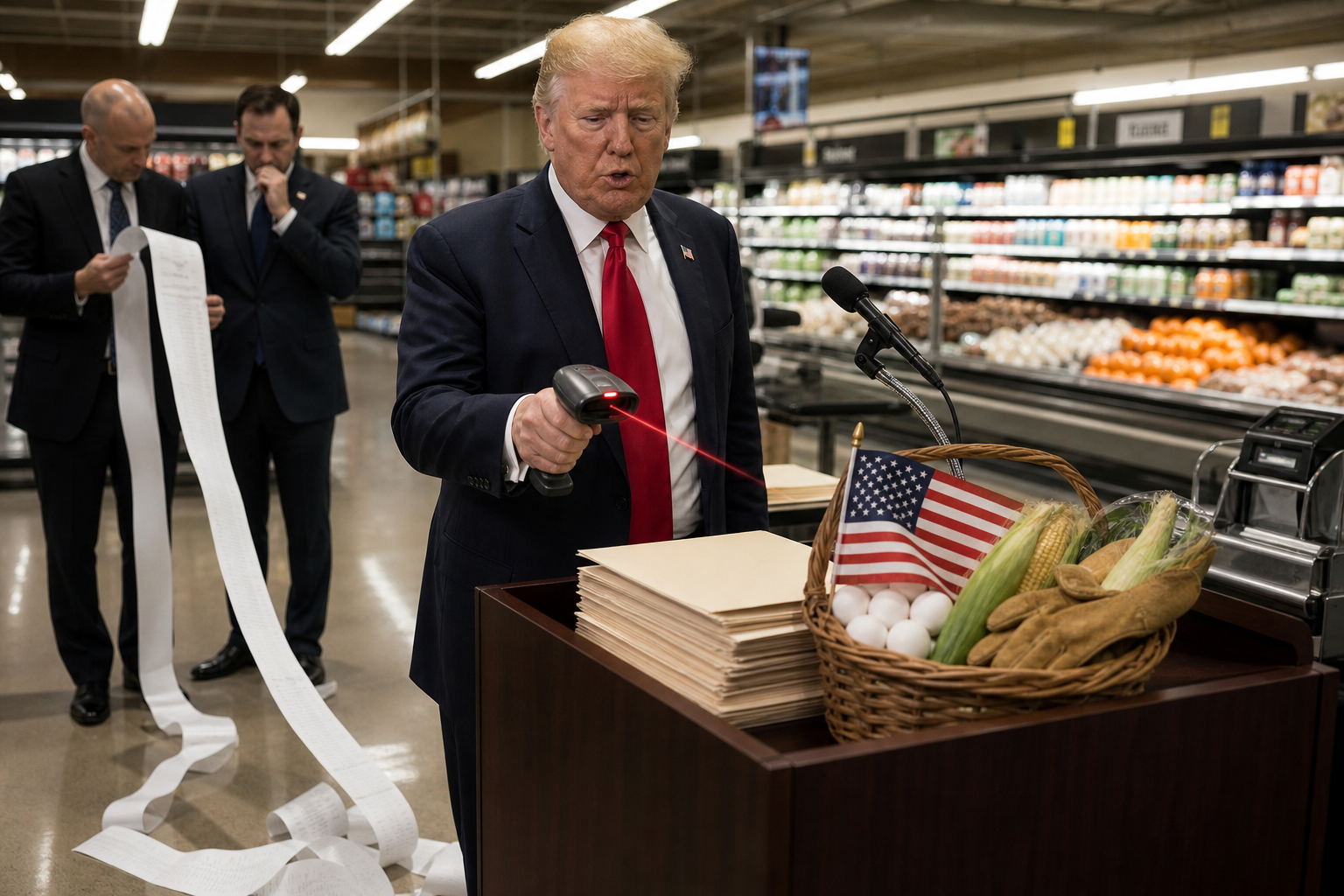
PARODY. With Midwestern voters increasingly preoccupied by grocery bills, fuel costs and the unsettling sensation that every errand now requires a financing plan, candidates across the region have been ordered to submit all campaign promises to a newly installed Price Scanner before delivering them in public.
The device, positioned beside every podium in Iowa, Ohio, Michigan, Nebraska and the parts of Wisconsin where a congressional race has become an ambient weather condition, is simple. A candidate says, “I will fight for working families.” The scanner emits a red light and asks: “Fight with what money.”
At first, both parties considered the system rude.
Then they tried to game it. Republicans began arriving with promises already wrapped in patriotic butcher paper. Democrats brought color-coded spreadsheets showing that their promise had technically begun lowering costs in a pilot program involving three left-handed municipal employees outside Eau Claire. The scanner accepted none of it. It was reportedly designed by a retired supermarket manager who had spent 31 years watching people abandon an item at checkout after discovering it had become aspirational.
“The public deserves clarity,” said a fictional regional campaign adviser, placing a hand over a cart containing four tax-cut proposals, two tariff explanations and a loose onion of cultural resentment. “Also, if the scanner says one more thing about diesel, I’m filing a complaint with the Constitution.”
The first casualty was the phrase “lower costs.” Candidates had used it freely for months, as though it were a throw pillow that could be placed on any policy until the room felt warm enough for television. Once scanned, however, the phrase produced a detailed receipt nearly six feet long. It listed imported inputs, retaliatory tariffs, interest rates, utility bills, insurance premiums, supply-chain disruptions and a line item reading: “UNSPECIFIED CONFIDENCE THAT THIS TIME WILL BE DIFFERENT.”
Several campaigns attempted to leave before the receipt finished printing. The scanner would not permit it. A freshman House candidate in a safe-looking district was reportedly trapped at a county fair for forty-seven minutes while it calculated the real-world cost of his promise to “unleash prosperity.” He eventually escaped by admitting that he had never personally unleashed anything larger than a foam finger.
President Trump’s Midwest campaign swing initially seemed tailor-made for the new system. His events came equipped with big-dollar pledges: aid for farmers, cheaper diesel, manufacturing projects, cash payments and an economy described with the confidence of a man unveiling a luxury hotel that exists mostly in the artist’s rendering.
But the Price Scanner treated each pledge as it treats a rotisserie chicken: respectfully, skeptically and with full awareness that somebody is making up the numbers.
When an aide scanned a promise of broad economic relief, the device flashed “PRICE MATCH REQUEST PENDING” and began comparing it against the price of fertilizer, farm equipment loans, gasoline and a carton of eggs in a town whose only remaining grocery store had recently added a locked case for deodorant. The rally paused. Even the campaign music seemed to understand it should not be playing during a calculation.
That was when the scanner revealed its second feature: it could scan complaints, too.
Campaigns had assumed affordability was merely a voter mood, like rain or the annual discovery that a senator owns several houses. But when party strategists scanned their preferred answers—immigration, elite universities, crime footage, activist judges, celebrity endorsements—the machine displayed their political value and their checkout value side by side.
“This message may generate applause,” it announced during one focus group. “It cannot be exchanged for groceries.”
The room went silent except for the soft crumpling of a consultant’s expense-account receipt.
By Friday, candidates were revising their stump speeches around the machine. They stopped promising to “restore the American Dream,” after the scanner asked whether that meant the version with employer-sponsored health insurance or the collectible commemorative version currently selling for $89.99 plus handling. They stopped saying “families are feeling optimistic,” after it asked whether they meant emotionally, financially or in the highly specific sense of hoping the transmission survives until spring.
One candidate tried a more modest approach. “I know things cost too much,” he said, looking directly into the scanner. “I don’t have a slogan that changes that by Tuesday, but I can tell you what I would actually do.”
The device paused. The crowd leaned in. Somewhere, a strategist fainted into a branded tote bag.
Then the scanner printed a coupon for 10% off a congressional majority, valid only if used before anyone says the words “kitchen-table issues” again.
Midwest Voters Put Every Campaign Promise Through the Price Scanner
The region’s new political checkout system has discovered that “kitchen-table issues” rarely arrive with a receipt.
WHAT STARTED THIS MESS
The event underneath the joke is real. The SPILL premise, dialogue and escalation above are fictional parody.