Midterm Candidates Scramble to Establish Where They Were When Data Centers Happened
Across the country, politicians who spent years courting AI investment now insist they merely knew the server farms professionally.
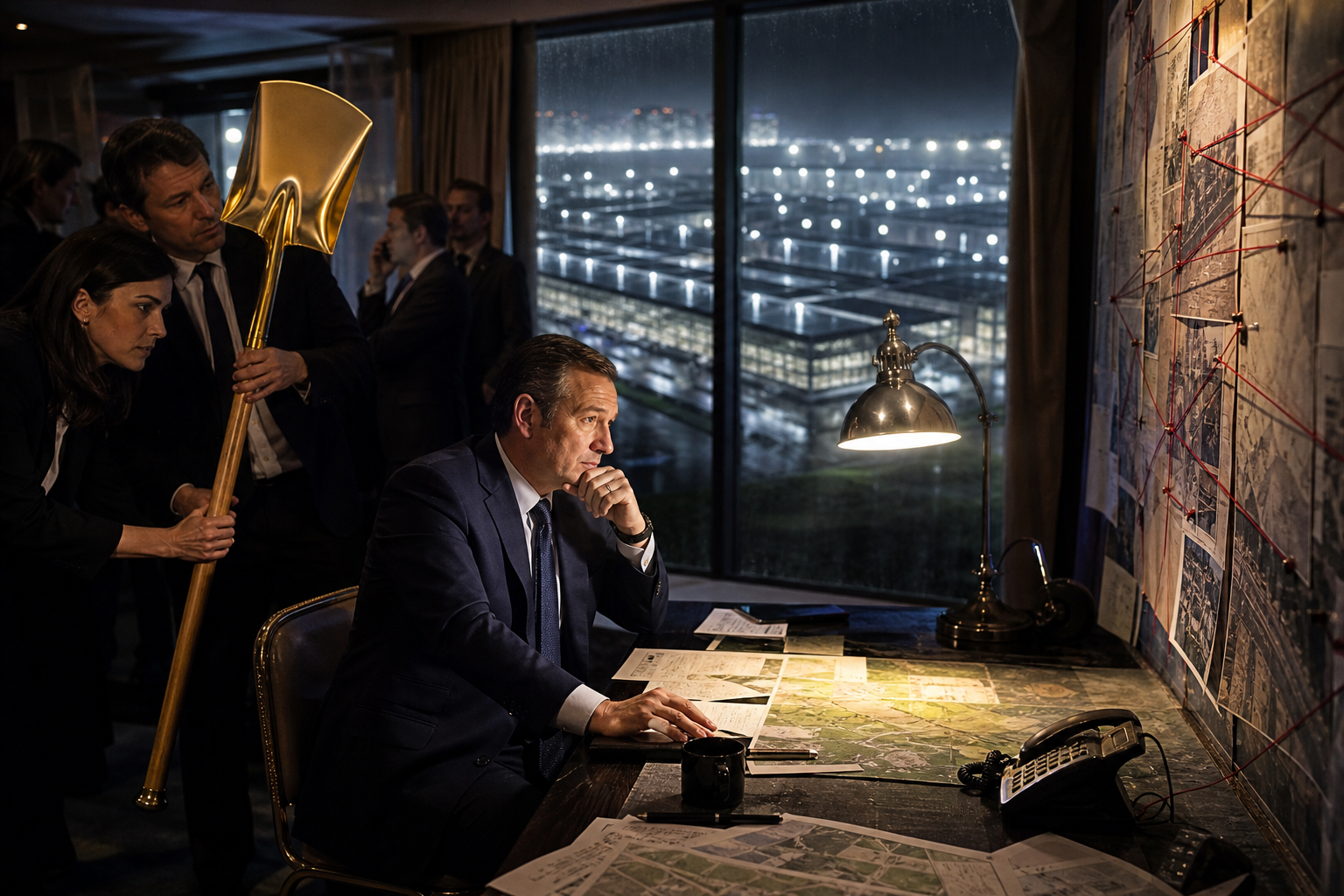
As voter anger over data centers barrels into the final stretch of the 2026 midterms, candidates in competitive races have begun taking the only politically responsible step left: establishing airtight alibis.
At campaign events this week, elected officials from both parties appeared before maps, meeting minutes and heavily annotated utility bills to explain that while a 2.4-million-square-foot windowless facility may now be drawing power like a minor moon, they personally were “not in the room” when anyone first suggested putting it beside a school, a creek or a town whose previous industrial controversy had involved a loud rooster.
“The public deserves answers,” said one fictional House incumbent, standing beside a timeline that placed him at a barbecue, a zoning breakfast and, crucially, “emotionally nowhere near” the 2023 infrastructure package that helped make the project possible. “I have always believed that innovation should occur somewhere else, ideally in a district represented by a person I do not know.”
The new campaign strategy, known internally as Strategic Non-Recognition, was developed after consultants discovered that voters did not care whether a candidate technically supported data centers, opposed data centers, welcomed data centers under a previous economic-development framework or attended a ceremonial shovel event while holding an oversized pair of scissors. They cared that a building with the temperament of a refrigerated casino had appeared near them and started requiring enough electricity to make every ceiling fan in three counties feel personally judged.
Campaigns initially attempted normal distancing language. Candidates said they favored “responsible growth,” “community input” and “a balanced approach to innovation.” But the phrases tested poorly after voters realized they had heard them before every object that eventually needed a special substation.
Now the candidates are going further. Several campaigns have hired former defense attorneys to conduct what they call Permit Presence Reviews, interviewing staff members about every interaction their candidate may have had with a developer, a utility executive or a phrase such as “once-in-a-generation opportunity.”
One Senate campaign released a 14-minute video titled My Client Has No Recollection of the Cloud. In it, the candidate walks solemnly through an empty field while a narrator explains that, at the exact time a data-center tax arrangement received preliminary approval, he was “fighting tirelessly for affordable energy,” a statement accompanied by archival footage of him applauding an energy-intensive manufacturing summit two years earlier.
The video was briefly pulled after viewers noticed the candidate was wearing the same tie in both appearances. Campaign aides said the tie had since been placed on administrative leave.
But the alibi race has created a new problem. Because data centers have become politically radioactive so quickly, nearly every candidate now claims to have opposed them long before anyone had heard of them. This has produced a growing number of improbable autobiographical disclosures.
A governor’s campaign announced that its candidate first became suspicious of hyperscale computing in 1998, after noticing that a desktop computer at a public library “seemed extremely confident for a machine.” A congressional challenger said she had spent her childhood warning adults that the internet would someday require “a series of unusually large rectangles.” A state legislator released handwritten notes from 2011 reading simply, “Ask questions about servers,” though the page also contained a grocery list and the words “perhaps learn tennis.”
The most aggressive candidates have begun treating old photos as hostile evidence. One campaign circulated a grainy image of its opponent smiling beside a ceremonial data-center rendering. The opponent’s team responded that the candidate had believed the rendering was “a regional aquarium with a very conservative architecture.”
For a few days, this appeared to be the standard of political accountability voters could expect: no one responsible, no one informed, and everyone tragically photographed near a concept they had privately feared since kindergarten.
Then utility executives began expressing concern that candidates were abandoning the industry too enthusiastically. Developers had expected the usual electoral ritual in which politicians denounce a project’s consequences while praising its jobs, its tax base and its ability to make a local economy sound futuristic in a PowerPoint. Instead, campaigns are now acting as though a data center arrived overnight, apologized to no one and left a large electrical bill under the county’s windshield wiper.
In response, a coalition of fictional developers has unveiled the Data Center Character Witness Program, allowing elected officials to testify that a facility is “actually very quiet once you accept that quiet now has a megawatt rating.” The program has so far attracted only one mayor, who appeared under an assumed name and left through a loading entrance.
By Election Day, strategists expect every close race to feature candidates solemnly pledging that future computing will be powered by consent, sunlight and whatever energy is produced when two consultants say “stakeholder engagement” at the exact same time.
Until then, the nation’s politicians will continue their search for the one thing more renewable than electricity: a past they were definitely not standing near when it got approved.
Midterm Candidates Scramble to Establish Where They Were When Data Centers Happened
Across the country, politicians who spent years courting AI investment now insist they merely knew the server farms professionally.
WHAT STARTED THIS MESS
The event underneath the joke is real. The SPILL premise, dialogue and escalation above are fictional parody.
- FOX How to watch critical 2026 midterm election races in TX, OH, MI, WI, GA, IA, NV, ME and FL ↗
- CBS How to watch live 2026 midterm election results on CBS News ↗
- NBC District of Columbia Midterm Elections 2026: Key Races, Candidates and Past Results ↗
- AP 2026 Midterm Election Results: Senate, House and Governor Races ↗
- MS NOW National: U.S. Senate Election Results 2026 ↗
- POLITICO How mad are voters about data centers? Watch these races. ↗