Melania Trump’s Ceasefire Reveals Washington Has Been Negotiating With Its Mouth Open
A localized humanitarian deal leaves the capital facing its gravest operational challenge yet: doing something before holding a panel about it.
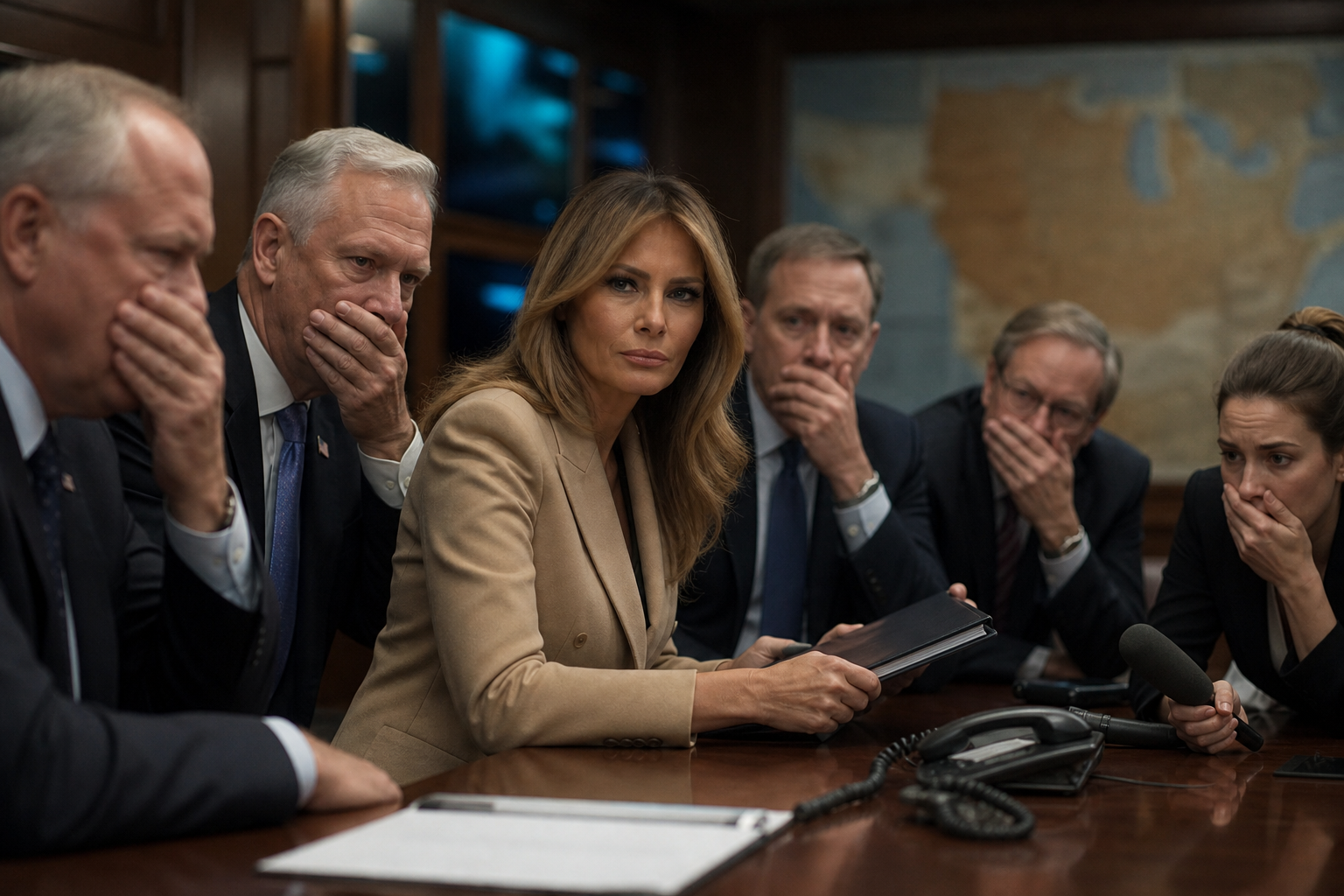
FICTIONAL PARODY — inspired by reporting on a localized humanitarian ceasefire in Oleshky, Ukraine.
Following reports that Melania Trump helped broker a ceasefire around the devastated Ukrainian city of Oleshky, the White House has ordered every federal official involved in foreign policy to attempt the first known American diplomatic maneuver conducted without immediately describing itself as “historic.”
The emergency initiative, informally known as Operation Maybe Don’t Talk Yet, began Tuesday when senior officials noticed an unsettling pattern in the Oleshky agreement: food, water, medicine and evacuation arrangements had apparently been negotiated before the participants had produced a logo, a seven-minute explainer video or a succession of Sunday-show guests saying the deal was “a crucial first step toward a framework for a process.”
“We are studying the first lady’s model very closely,” said a fictional administration official seated in a secure room whose walls had been covered with foam panels to absorb phrases like “as I’ve said from the beginning.” “She spoke to the parties, focused on a small humanitarian objective and kept the discussion moving. We have identified all three of those behaviors as potential national-security vulnerabilities.”
Under the new protocol, diplomats must place their phones in velvet-lined pouches before entering negotiations. Communications staff are allowed to know that a meeting occurred only after the meeting has ended, the civilians are safe and at least one person with genuine expertise has confirmed what the meeting was about. The rule has devastated several offices that had spent years mastering the art of issuing statements about being “deeply engaged” while waiting to learn which country was involved.
The first test came when a deputy assistant secretary attempted to tell a colleague he was “encouraged by the constructive tone.” A small bell rang. He was escorted from the room and made to sit through a classified briefing titled Difference Between Progress and a Sentence About Progress.
Within hours, Washington discovered that silence creates its own humanitarian crisis: nobody knew how to claim credit. A State Department aide reportedly asked whether a convoy could be described as “whole-of-government,” only to be told the convoy had not requested to become a metaphor. A separate official proposed releasing a behind-the-scenes photograph of a map with several hands hovering over it, but the plan collapsed when every hand demanded equal lighting.
Then came the more alarming revelation. The quiet approach was working.
Without cameras, podiums or the traditional pre-negotiation argument over who would say “we convened” first, officials began addressing things that could be addressed: roads, aid deliveries, civilian passage, timing, risks. The room grew so unnervingly productive that one veteran policy adviser requested a recess, saying he had not entered public service “to make a deliverable happen in the same calendar quarter it was discussed.”
By Wednesday, the National Security Council had formed a task force to determine whether discretion could be scaled. Its preliminary report found that it could not. The obstacle was not Russia, Ukraine, logistics or the ancient difficulty of getting powerful people to trust one another. The obstacle was that several Cabinet-level offices had already asked whether the administration could hold a press conference announcing its commitment to quieter diplomacy.
The first lady’s office, in this fictional account, responded with a single typed note: “No.” The note reportedly caused confusion because it contained neither a slogan nor a quote suitable for embroidery on a campaign jacket.
Officials nevertheless pressed ahead with a pilot program in which diplomatic achievements would be evaluated according to an unfamiliar metric: whether anything useful happened to people who were not standing behind the lectern. This standard was immediately criticized by Washington veterans as impossible to measure, unfair to television and potentially corrosive to the constitutional role of a well-timed hallway scrum.
By late afternoon, the White House had reached a compromise. Future humanitarian agreements may proceed quietly, provided the people who arranged them receive a tasteful amount of public admiration afterward, no more than three prime-time hits each, and one solemn photo in which everyone looks as though they personally invented food.
At press time, the ceasefire’s greatest threat was a bipartisan proposal to commemorate it with a ceremony large enough to require a second ceasefire.
Melania Trump’s Ceasefire Reveals Washington Has Been Negotiating With Its Mouth Open
A localized humanitarian deal leaves the capital facing its gravest operational challenge yet: doing something before holding a panel about it.
WHAT STARTED THIS MESS
The event underneath the joke is real. The SPILL premise, dialogue and escalation above are fictional parody.
- AP Turkish parliamentary committee approves defense pact with Saudi Arabia and Pakistan ↗
- NPR Why Ukraine and Russia agreed to a ceasefire in just one city ↗
- FOX Inside Melania Trump's secret diplomatic role in the Russia-Ukraine ceasefire deal ↗
- NBC Melania Trump-brokered ceasefire in devastated Ukrainian city holds for its first 30 hours, officials say ↗