Mark Lamb Campaign Starts Moral Offset Market for Family Values
Arizona’s most endangered political resource has entered the unregulated credit market.
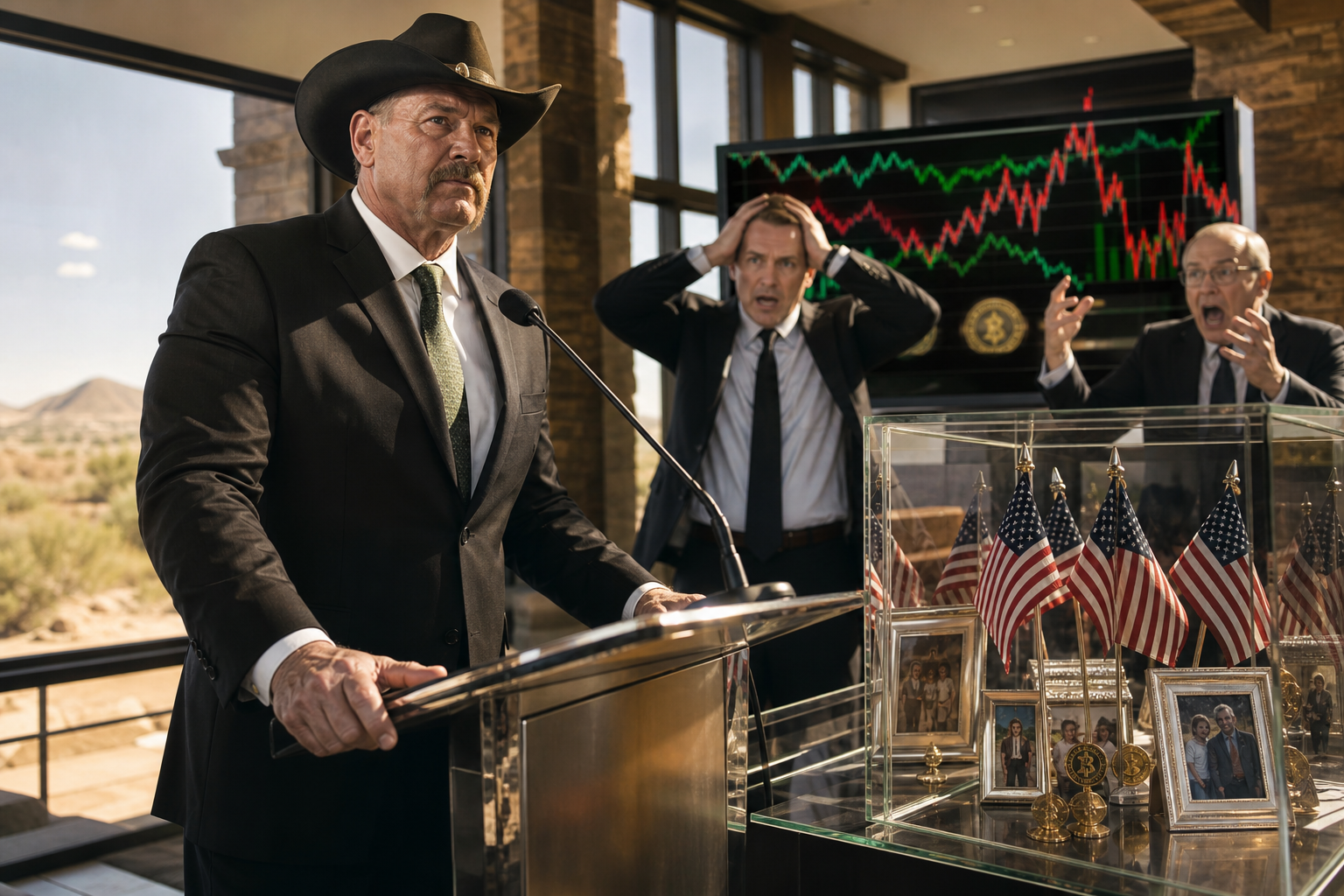
PARODY — inspired by a real Arizona congressional campaign.
Facing the unsettling possibility that voters may expect a candidate running on “God, Family, Freedom” to possess at least a working relationship with all three, the fictional Mark Lamb campaign on Sunday unveiled the nation’s first Moral Offset Exchange, allowing political candidates to neutralize character concerns by purchasing certified units of public virtue.
“No campaign is completely values-neutral,” explained a consultant standing before a handsome market ticker that rose every time somebody said “faith, family and freedom” without checking whether the phrase applied to anything currently happening. “The important thing is not whether a candidate has generated moral emissions. It’s whether he has the resources to offset them with enough flag pins, testimonials from cousins and tasteful photographs near a fence.”
The exchange, known as MOME, will reportedly issue tradable credits for qualifying acts of campaign righteousness. A candidate earns one Family Value Credit for appearing beside a pickup truck, two for describing his childhood church attendance as “the bedrock,” and five for telling an audience that Washington has lost touch with ordinary people while arriving at the event through the donor entrance.
Premium credits may be purchased in bulk through the campaign’s new “Restored Trust Portfolio,” a diversified package of scripture references, black-and-white family photos and a professionally distressed denim jacket. The portfolio comes with a certificate stating that any resemblance between a campaign’s stated values and its candidate’s actual conduct has been “responsibly accounted for.”
At first, the system appeared to delight the people who invented it. Consultants gathered around tablets, cheering as a single mention of “traditional values” briefly added $14 million in theoretical integrity to the campaign balance sheet. One adviser reportedly proposed hedging against future disclosures by locking in a long-term supply of grandchildren waving from parade floats.
Then the market encountered an obstacle for which no one had prepared: voters who regarded character not as an atmospheric pollutant, but as the product.
Women in the district—particularly Latter-day Saint voters who had been expected to respond warmly to shared religious affiliation—began declining to accept moral offsets at face value. Rather than being persuaded by the campaign’s newly minted Virtue Futures, they asked the sort of questions financial regulators traditionally reserve for cryptocurrency exchanges and congressional candidates traditionally reserve for their opponents.
“They keep requesting underlying assets,” a visibly exhausted campaign economist said. “They want to know what, exactly, backs the credits. We told them the credits are backed by confidence, freedom and a very robust emotional attachment to the word ‘God.’ Apparently that was not sufficient disclosure.”
By Monday morning, the campaign had downgraded several of its own assets. A “Strong Father Figure” bond was moved from stable to speculative after focus groups asked whether fatherhood could be used as a campaign aesthetic without also functioning as a responsibility. Shares in “Personal Redemption Narrative” fell sharply when investors noticed no redemption narrative had been supplied, only the word “narrative” printed in a serif font.
The real crisis came when the exchange’s compliance office—three women with folders, long memories and no interest in being managed by a message consultant—announced that moral credits could not be self-certified.
This represented an alarming innovation in modern politics. For decades, campaigns have operated under the assumption that values are what candidates say they cherish while supporters admire the confidence it takes to say it under a banner. Now, in Arizona, a small but stubborn bloc was treating values as a performance review.
Campaign officials attempted to calm donors by promising a “full values audit,” then immediately clarified that the audit would be conducted internally, confidentially and only after the election, when its findings could no longer create market volatility. The plan was abandoned after someone pointed out that an audit designed to protect a candidate from accountability was not technically an audit but a scented candle labeled “accountability.”
Late Sunday, the Moral Offset Exchange suspended trading after a voter asked why a campaign built around character required an entire derivatives desk to explain what character was.
Mark Lamb Campaign Starts Moral Offset Market for Family Values
Arizona’s most endangered political resource has entered the unregulated credit market.
WHAT STARTED THIS MESS
The event underneath the joke is real. The SPILL premise, dialogue and escalation above are fictional parody.