Mamdani Backlash Gives Democrats a Seven-Second Delay for Human Sorrow
The party’s new grief-control booth can bleep a controversial phrase, but not the part where everyone knows why it was bleeped.
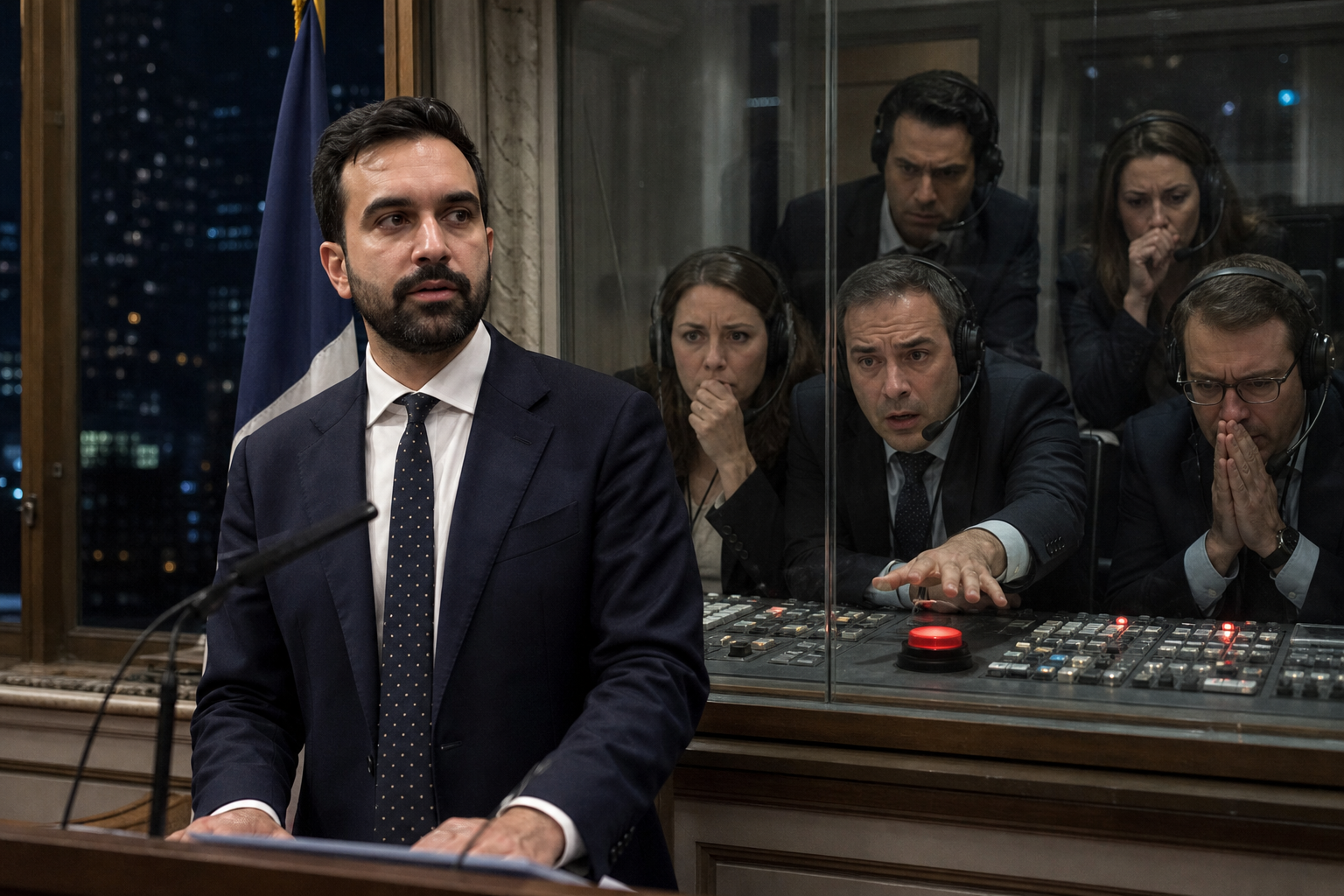
NEW YORK— In response to the backlash over Mayor Zohran Mamdani’s Oct. 7 statement, Democratic leaders unveiled a seven-second delay for all public mourning Wednesday, allowing a trained team of communications professionals to remove any unauthorized policy implications before they reach grieving human ears.
The system, called Pause Before You Care, will be used at vigils, press conferences, synagogue visits, mosque visits, hospital remarks, anniversaries, town halls and any fundraiser where a candidate notices a tragedy has happened within driving distance.
“We have learned that condolences are simply too dangerous to broadcast live,” said fictional Democratic Message Integrity Director Celia Brant, standing behind a dark curtain beside a console with one enormous red button. “A public official may begin with a sincere recognition of pain, then suddenly mention history, power, military aid, civilian suffering, hostages, security, occupation, antisemitism, Islamophobia, responsibility or literally any noun with an editorial aftertaste. We cannot take that chance.”
Under the new protocol, a mayor may say, “Today, we mourn—” before the audio is briefly replaced by a smooth orchestral tone. When the sound returns, the official can continue with an approved emotional noun such as “loss,” “horror,” “community,” or “the kind of sadness that has no implications whatsoever.”
The program was tested during a closed-door rehearsal in which three elected officials attempted to offer condolences for a hypothetical catastrophe involving no country, ideology, institution, armed group, historical context or surviving relatives. The first speaker was removed after saying “innocent.” The second made it eleven seconds before using the word “people.” The third successfully completed a statement by staring at a candle for forty-four minutes.
Party leaders initially hailed the pilot as a breakthrough. One consultant said the delay would restore “the sacred American tradition of treating mourning as a neutral zone, like airport carpeting or a pharmaceutical commercial.”
Then came the complication: the delay itself began acquiring political meaning.
Every time the tone sounded, viewers assumed the speaker had said something inflammatory, morally clarifying or, worst of all, specific. Online detectives began slowing down condolence videos, reading lips, consulting former debate coaches and claiming that a council member’s visible use of the word “and” proved she had smuggled in an entire foreign-policy doctrine.
By Thursday morning, the red button had become New York’s most scrutinized public official. A panel of veteran operatives gathered around it, arguing whether a pause after “we remember the victims” signaled excessive empathy, insufficient empathy, strategic empathy or an unacceptable attempt to make empathy itself seem bipartisan.
Mamdani’s fictional communications staff, eager to comply, submitted a revised statement consisting entirely of breathing. The draft was rejected after one Democratic consultant warned that a pause between inhales could be interpreted as “both-sidesing oxygen.”
That forced the party to issue its second guidance memo of the day. Speakers are now encouraged to mourn in a tone that is unmistakably profound but cannot be mistaken for grief over any particular person, event or consequence. They may also acknowledge pain, provided they do not indicate where the pain occurred, who experienced it, what caused it, or whether it was painful in a politically exploitable way.
“There is a responsible way to express solidarity,” Brant explained. “You begin by affirming that every life matters, then you stop just short of making anyone wonder whether their life mattered in a way that might require a response.”
The policy reached its breaking point at an evening vigil, when the master control operator accidentally delayed a moment of silence. For seven seconds, the crowd waited quietly for the absence of words to clear editorial review. Then the operator, overwhelmed by the possibility that silence might contain context, hit the button again.
By nightfall, Democrats had announced that future statements would be released only after the underlying conflict had been resolved, all affected communities had agreed on the correct adjective, and the red button had finished its exploratory campaign for mayor.
Mamdani Backlash Gives Democrats a Seven-Second Delay for Human Sorrow
The party’s new grief-control booth can bleep a controversial phrase, but not the part where everyone knows why it was bleeped.
WHAT STARTED THIS MESS
The event underneath the joke is real. The SPILL premise, dialogue and escalation above are fictional parody.
- CBS Mamdani criticized by fellow Democrats for statement mourning Oct. 7 attacks while condemning Israel ↗
- NPR U.S. moves long-range bombers from U.K. And, Israel allegedly warned before Oct. 7 ↗
- POLITICO Mamdani draws bipartisan backlash for criticizing Israel on Oct. 7 anniversary ↗
- AP Mamdani’s Oct. 7 commemoration outrages supporters and critics of Israel ↗
- FOX Mamdani doubles down on anti-Israel Oct 7 statement after backlash ↗
- CNN The states that aren’t cooperating with Democrats’ Senate majority hopes ↗