Justice Department Makes Civil Rights Conduct Dhillon’s Exit Interview
The division’s oldest employee finally gets fifteen minutes with the person who spent a year redefining its job description.
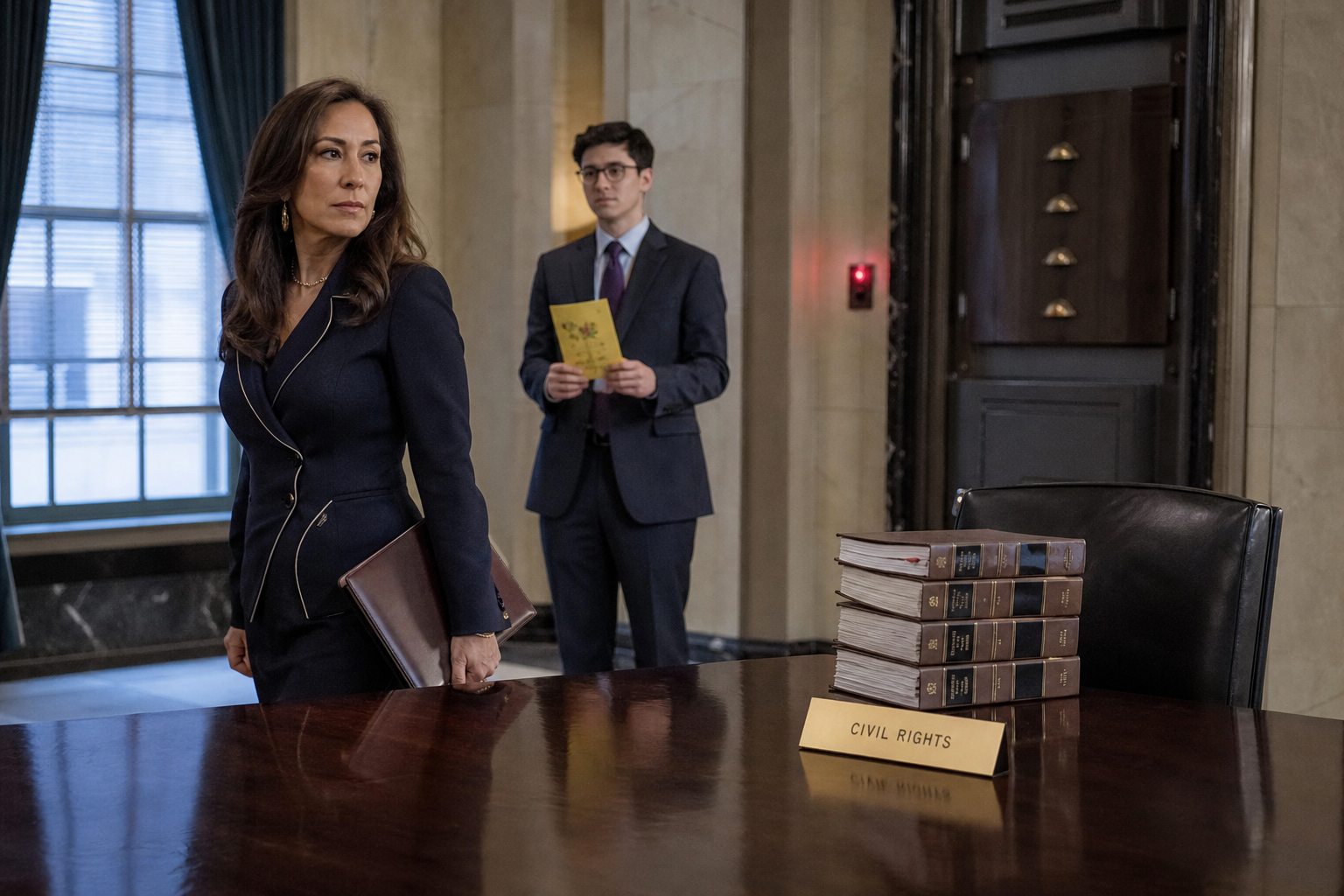
WASHINGTON—Harmeet Dhillon’s resignation as assistant attorney general for the Justice Department’s Civil Rights Division triggered the customary federal offboarding process Thursday, including the unusual requirement that she sit down for an exit interview with Civil Rights itself.
The meeting began awkwardly. Civil Rights arrived twelve minutes early, carrying a manila folder labeled Federal Laws, Apparently Still Binding, and was asked by a junior political appointee to wait in the hallway until the division finished an urgent matter involving whether a university orientation slideshow had made anyone feel too regulated.
When Dhillon entered, Civil Rights stood to shake her hand, then paused.
“Sorry,” it said. “I wasn’t sure whether we were still doing that.”
According to people familiar with the fictional meeting, Dhillon was presented with a standard DOJ departure questionnaire asking what she enjoyed most about her tenure, whether her office had given her the tools to succeed, and whether she would recommend the Civil Rights Division to a friend who believed the phrase “civil rights” should be interpreted with the confidence of a man ordering off-menu.
Dhillon reportedly answered that the division had been “an exciting opportunity to modernize a legacy brand,” describing the department’s historic mandate as something with “excellent name recognition but unclear growth potential.”
Civil Rights then opened its folder and asked whether it could submit a few questions of its own.
The first was simple: “Where were you when I was trying to enforce things?”
The room went silent. A DOJ human-resources official began typing furiously, then stopped when Civil Rights clarified that it was not alleging wrongdoing, merely seeking help locating itself within the organizational chart.
That chart had become a sensitive subject. During the meeting, a staffer wheeled in a projector displaying the division’s revised internal flow map: a maze of arrows leading from “equal protection” to “select whichever concern is currently being described as existential by the people with access to microphones.” The presentation was briefly interrupted when someone asked whether “voting rights” still had a direct line to anyone. An aide said it did, but only after completing a CAPTCHA identifying which ballots looked suspiciously federal.
Dhillon, in the fictional account, assured Civil Rights that it had not been ignored. “You were never less important,” she said. “You were simply given the freedom to become more conceptually available.”
This appeared to soothe no one, least of all Civil Rights, which had spent the preceding year receiving calendar invitations marked “reimagining session,” “stakeholder reset,” and “quick sync re: whether discrimination can be improved through vibes.”
The interview took a turn when the department’s transition team entered with a farewell card. Rather than signatures, it contained a single sentence printed in an elegant serif typeface: Thank you for your service, and please do not restore any previous settings on your way out.
Officials said the card was intended as a warm sendoff. Civil Rights interpreted it as evidence that the division had been placed in permanent airplane mode.
By afternoon, the department had announced a continuity plan. Until a successor is named, all unresolved civil-rights matters will be handled by an automated reply acknowledging receipt of concerns and asking complainants to select from three options: “religious liberty,” “free speech,” or “have you considered being a corporation?”
Civil Rights, still seated in the conference room, was last seen trying to retrieve its own personnel file from a locked cabinet. The badge reader flashed red and displayed a message: Your access has been updated to historical reference.
Justice Department Makes Civil Rights Conduct Dhillon’s Exit Interview
The division’s oldest employee finally gets fifteen minutes with the person who spent a year redefining its job description.
WHAT STARTED THIS MESS
The event underneath the joke is real. The SPILL premise, dialogue and escalation above are fictional parody.
- FOX Harmeet Dhillon resigns as Justice Department's assistant attorney general for civil rights ↗
- MS NOW DOJ civil rights division chief Harmeet Dhillon expected to quit ↗
- CNN Harmeet Dhillon, who runs the Justice Department’s Civil Rights division, resigns ↗
- CBS Harmeet Dhillon, controversial head of Justice Department's Civil Rights Division, resigns ↗
- Reuters Trump ally leading Justice Department civil rights unit to resign, sources say ↗
- POLITICO DOJ civil rights division chief resigns ↗