Iran and Trump Administration Enter Escalation’s Most Polite Phase
With missile limits lifted and “minor strikes” underway, the region’s most active battlefield may now be the adjective.
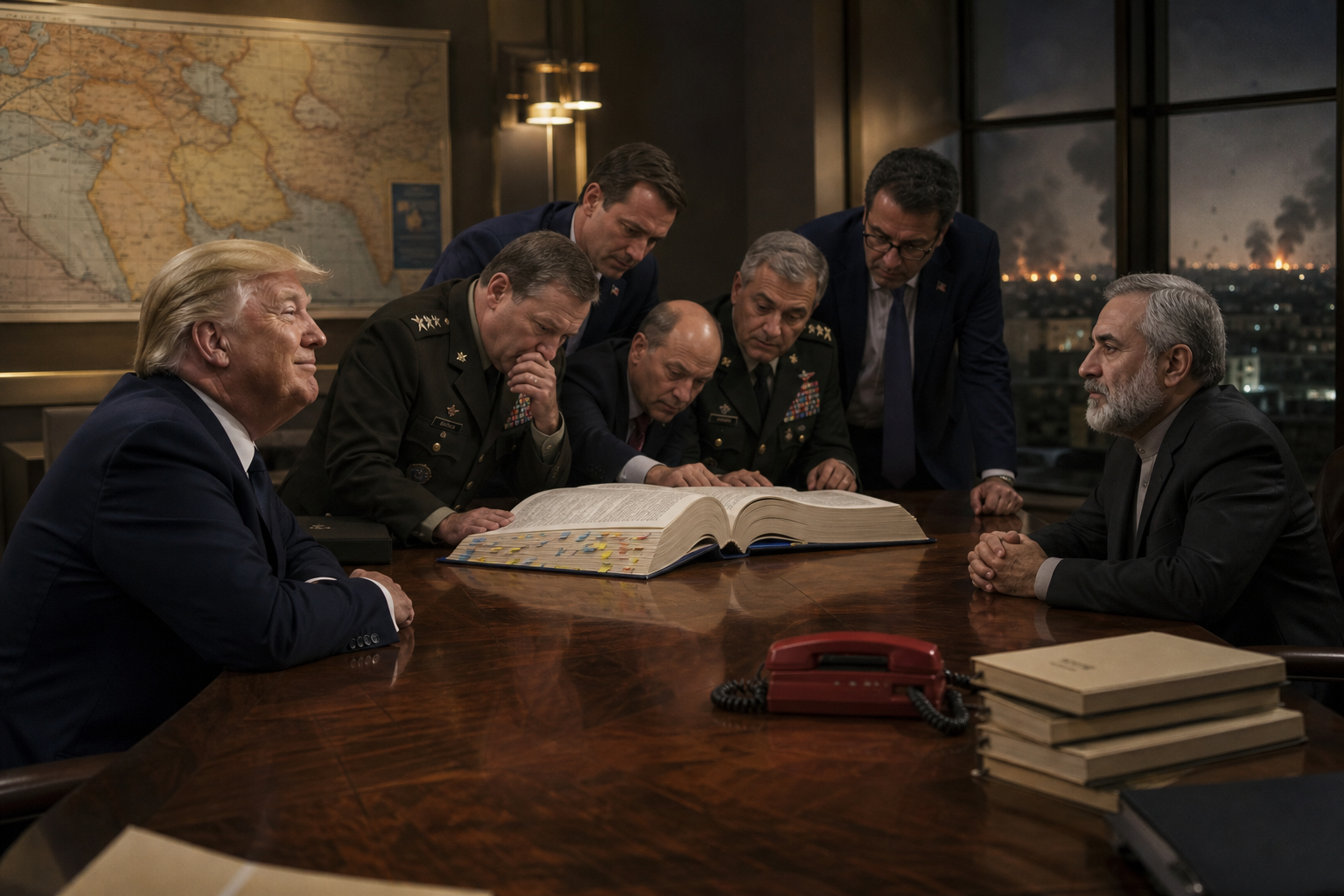
PARODY — In response to Iran lifting its self-imposed limit on missile ranges and the United States carrying out what President Trump described as “minor strikes,” both governments have agreed to protect regional stability by describing everything with the emotional intensity of a hotel invoice.
Under a fictional new understanding reached somewhere between a secure facility and a television chyron, Iranian officials will no longer say their missiles can reach farther. They will say the country has “expanded its options for long-distance engagement.” The Trump administration, meanwhile, will replace “military escalation” with “a contained demonstration of American follow-through.”
The arrangement is expected to lower temperatures immediately, provided nobody checks a map.
“Words matter,” said one imaginary senior official, carefully carrying a folder labeled Nothing Here Should Alarm You Unless You Understand Geography. “For too long, international relations has been trapped in the outdated assumption that an action’s seriousness is determined by what it does. We now understand seriousness is determined by whether the speaker says it in a calm enough voice.”
The breakthrough began after Iran announced it was no longer observing the missile-range restraint it had imposed on itself. American officials responded with fresh strikes characterized as limited, a word that in Washington has the same constitutional status as “brief,” “surgical,” and “we have the situation exactly where we want it, pending several developments.”
Within hours, the two sides had independently arrived at the same central insight: it is much easier to manage a crisis when every verb arrives wearing business-casual clothing.
Iran’s state media has reportedly begun testing alternatives to “retaliation,” including “a geographically expressive reply” and “a confidence-building reminder of national capability.” At the Pentagon, planners are considering whether “minor strike” can be upgraded to “selective atmosphere adjustment,” though aides worry that phrase may accidentally require congressional approval from a wellness committee.
The first problem emerged when the adjective systems collided. Iranian officials objected that calling a longer-range missile program “defensive” was a sovereign matter. U.S. officials countered that calling a strike “minor” was also a sovereign matter. For forty-five tense minutes, each side accused the other of minimizing something that had been very specifically minimized.
“This is the danger of unregulated language,” said an imaginary regional diplomat who has now been asked to initial every adjective before breakfast. “You begin with ‘limited,’ then someone says ‘measured,’ then suddenly an aircraft carrier is being described as a listening exercise.”
To prevent misunderstanding, the fictional agreement creates a Joint Euphemism Verification Mechanism. Before any government can announce a new military action, it must submit the statement to a rotating panel of communications consultants, former cable-news bookers and one exhausted sixth-grade English teacher from Ohio.
The teacher’s role is to ask whether the sentence would still sound reassuring if read aloud by someone who knows what “range” means.
That safeguard briefly stalled the process Tuesday when an Iranian representative submitted the phrase “nonlinear deterrence posture” and the teacher wrote, in red pen, “This is not a sentence. This is what a sentence becomes after a defense expo sponsors it.”
The new diplomacy has also imposed unexpected burdens on allies. European leaders had hoped to issue their traditional appeal for de-escalation, but discovered the term has been temporarily retired because both sides consider it too judgmental. They are now drafting a statement urging “a shared reduction in unscheduled strategic enthusiasm.”
Markets, meanwhile, have welcomed the clarity. Oil prices moved sharply after traders learned the phrase “expanded options for long-distance engagement” did not technically require anyone to say whether those options had already left the ground. Analysts called the reaction “volatile but responsibly phrased.”
At the White House, aides have begun privately pushing for a tiered vocabulary system. A strike would be “minor” if it lasts less than a news cycle, “discreet” if no official has to explain it on Sunday television, and “historic” if it produces a photograph the president likes.
Iranian officials are said to be interested in the model but insist their own terminology must preserve national dignity. Their preferred scale begins with “restrained response,” moves to “necessary response,” and ends with “please consult the earlier statement in which we were being extremely restrained.”
For now, both governments remain publicly committed to avoiding a wider conflict, which under the new framework means neither side plans to use the word “wider” until after it has happened.
Iran and Trump Administration Enter Escalation’s Most Polite Phase
With missile limits lifted and “minor strikes” underway, the region’s most active battlefield may now be the adjective.
WHAT STARTED THIS MESS
The event underneath the joke is real. The SPILL premise, dialogue and escalation above are fictional parody.