Ilhan Omar’s Hasan Piker Event Sends Minnesota Politics to Brand Safety
The review was meant to determine whether Hasan Piker was safe for public association; it accidentally evaluated the rest of government.
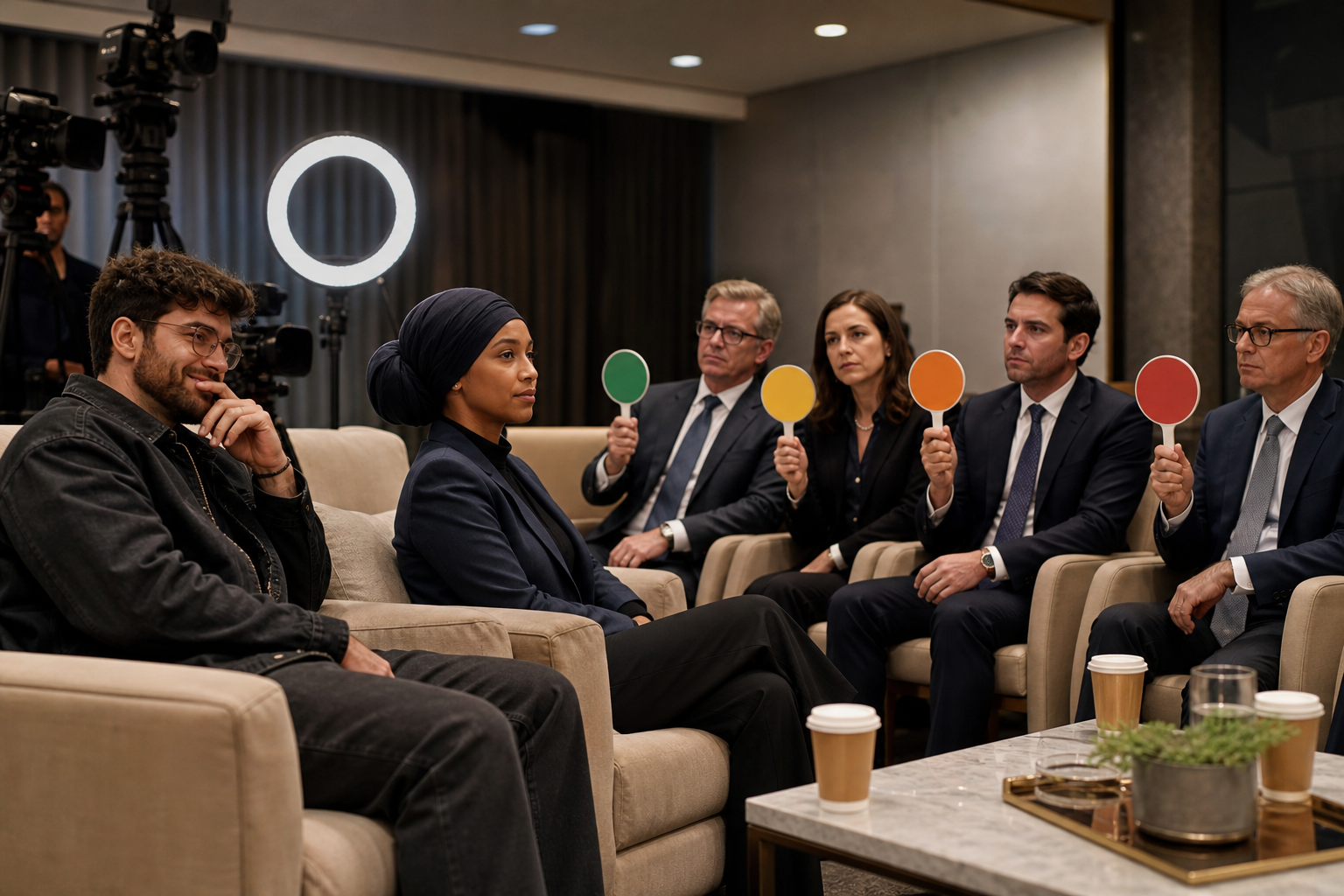
MINNEAPOLIS — This is a fictional parody. Following Rep. Ilhan Omar’s appearance with streamer Hasan Piker, Minnesota political leaders have submitted the entire state to a mandatory Brand Safety Review, a process previously reserved for sneaker companies deciding whether a podcaster may say the word “protein” near their logo.
The emergency review began Monday night, when several officeholders realized they had spent the day demanding that other officeholders explain why they had appeared near a controversial internet personality. By Tuesday morning, the state had hired a team of former advertising executives to determine whether democracy itself could be shown before a family-friendly pre-roll ad.
“We’re not here to judge anyone’s beliefs,” said Brand Safety Director Celeste Morrow, standing beside a velvet rope and a large, softly glowing ring light. “We’re simply asking whether this political moment is compatible with national advertisers, regional banks, or a meal-kit company that has chosen not to have opinions.”
Piker was assigned a preliminary rating of “High Engagement, Limited Monetization,” which means he may be discussed by elected officials only in a room with no visible beverages, no children’s programming, and at least one consultant saying the phrase “this is not an endorsement.” Omar received a separate notice advising that she may continue campaigning, provided every conversation is followed by a 14-second disclaimer explaining that proximity is not contagious.
The system initially delighted Minnesota politicians. For years, they had been forced to issue statements with agonizingly vague phrases like “deeply concerned” and “troubled by comments.” Brand Safety finally gave them a measurable standard. A candidate’s statement could now be labeled “Suitable for Daytime,” “Requires Context,” or “May Cause a Major Donor to Remember a Vacation Home.”
Then the reviewers reached the rest of the political class.
The governor’s office was flagged for “repeated references to kitchen-table issues without showing an actual kitchen.” A congressional candidate received a yellow warning for posting a video in front of a gas pump while clearly having never paid for gas there. One state legislator was temporarily demonetized after the panel determined that his apology video contained a second, smaller campaign announcement hiding inside the apology.
Things became difficult when the review team applied the same standards to politicians criticizing Omar’s appearance. Under the rules, outrage was permitted only if it appeared organic. That eliminated nearly every statement released within twelve minutes of the event, especially those containing the words “deeply,” “disturbing,” and “our children.”
“The concern is that viewers might mistake a prewritten political reaction for spontaneous moral alarm,” Morrow explained. “We call that undisclosed sponsorship.”
By Wednesday, the review had expanded into a full Minnesota political content audit. Staffers were instructed to submit every old tweet, podcast clip, college-panel appearance, fundraiser selfie, debate zinger, and photo in which a politician looked slightly too pleased to be holding a hard seltzer. The state’s most ambitious elected officials spent the afternoon asking interns whether a 2017 Facebook Live counted as “legacy content” or “a cry for help.”
The process took an unexpected turn when the reviewers discovered that traditional politics had an even worse record than streaming culture. Unlike influencers, politicians often make statements with no clear sponsor, no posting schedule, no visible apology strategy, and no reliable way to tell whether they are being sincere or simply auditioning for cable news.
“At least the streamer understands the camera is on,” said one reviewer, who asked not to be named because her employer had just learned she once retweeted a county commissioner. “These people will say something inflammatory in a hearing room lit like an aquarium, then act shocked when it travels.”
By late afternoon, the board issued its final decision: Hasan Piker’s Minnesota visit could remain online with limited ads, but the state’s political ecosystem had failed monetization review entirely. Candidates were instructed to replace all future appearances with calming footage of unopened folders, bipartisan handshakes, and a single golden retriever walking past the Capitol without seeking office.
At press time, Minnesota politics had been placed behind a content warning: “May include strong opinions, implied endorsements, and adults discovering that every microphone is now a receipt.”
Ilhan Omar’s Hasan Piker Event Sends Minnesota Politics to Brand Safety
The review was meant to determine whether Hasan Piker was safe for public association; it accidentally evaluated the rest of government.
WHAT STARTED THIS MESS
The event underneath the joke is real. The SPILL premise, dialogue and escalation above are fictional parody.
- CNN Ilhan Omar campaigns with Hasan Piker despite controversy ↗
- CBS Hasan Piker speaks with Rep. Omar, state Sen. Omar Fateh in Minneapolis after criticism over visit ↗
- FOX Hasan Piker lashes out at Republicans, calls them 'terrorists' in event with Ilhan Omar ↗
- NPR Republicans are spending millions and still may not win districts drawn to favor them ↗