Houthis Take Mokha, Raising the Stakes at the Red Sea’s Southern Gateway
The Iran-aligned group’s reported seizure of Yemen’s Mokha port city puts it closer to the Bab el-Mandeb Strait, a chokepoint already strained by attacks, detours and a wider regional war.
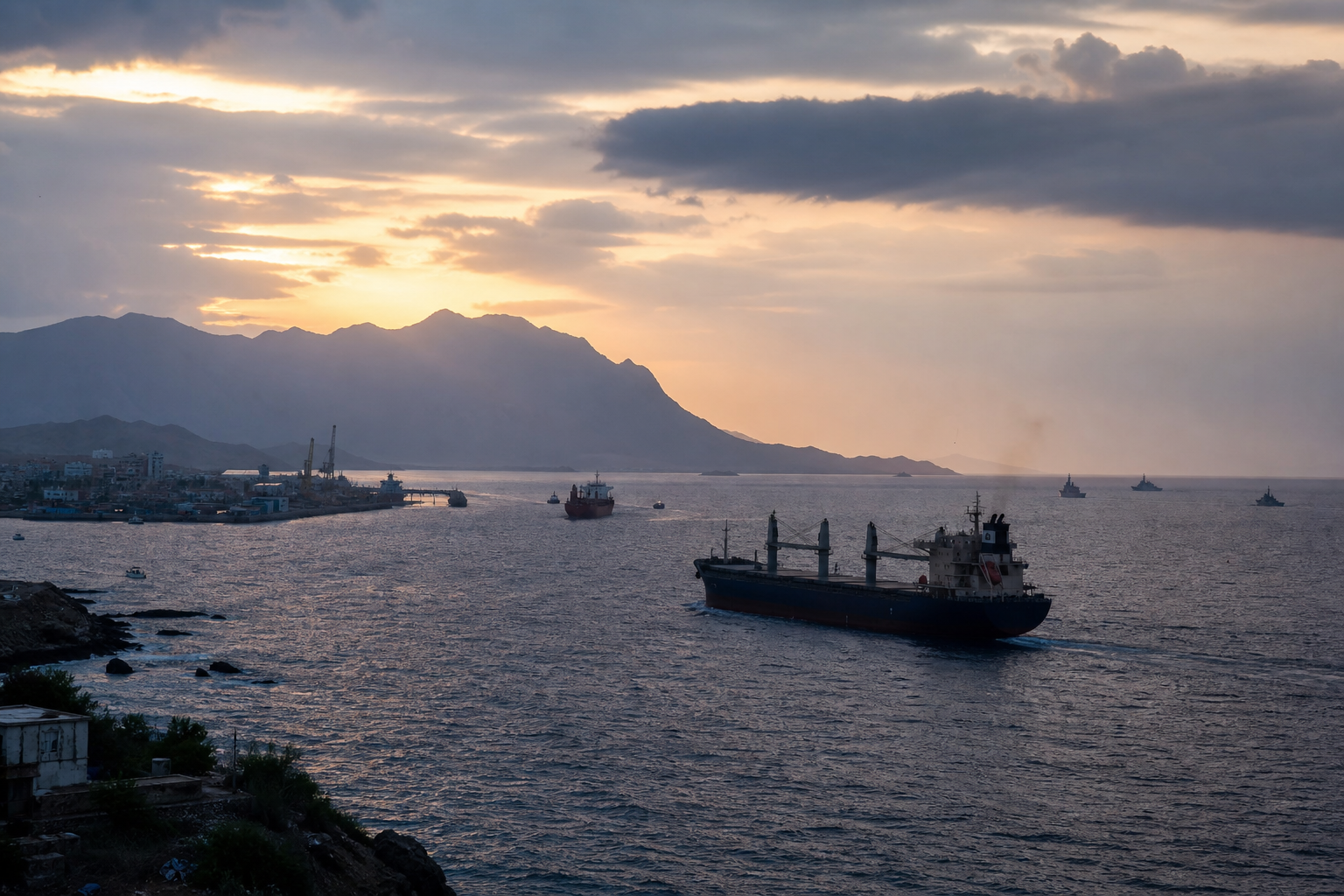
The Iran-aligned group’s reported seizure of Yemen’s Mokha port city puts it closer to the Bab el-Mandeb Strait, a chokepoint already strained by attacks, detours and a wider regional war.
Iran-aligned Houthi forces have taken control of Mokha, the Yemeni port city on the Red Sea coast that sits roughly 50 miles from the Bab el-Mandeb Strait, according to reporting Thursday from The Associated Press and Reuters citing Yemeni, Houthi and military sources.
The immediate significance is not that Mokha itself can close one of the world’s most important waterways. It cannot. The larger danger is military geography: the Houthi advance gives the group a stronger position on Yemen’s southwestern coast as it pursues a campaign that has already made commercial transit through the Red Sea more dangerous, more expensive and less predictable.
Bab el-Mandeb is the narrow southern entrance to the Red Sea, linking it to the Gulf of Aden and the Arabian Sea. Ships traveling between Asia and Europe use the route to reach the Suez Canal. A force that expands its presence along Yemen’s coast does not gain automatic control over that international passage. But it can gain more locations from which to surveil, threaten or attack vessels, and can complicate the military response of governments trying to protect maritime traffic.
What happened
AP reported that Houthi fighters entered and took over Mokha on Thursday, September 10, citing Houthi and Yemeni officials. Reuters, citing four Yemeni government military sources, reported that the group had seized the city and was also launching attacks involving the strategically located Hanish islands in the Red Sea.
Mokha had been held by forces aligned with Yemen’s internationally recognized government. Its loss is a battlefield setback for that government and for Saudi Arabia, which supports it. It is also a reminder that Yemen’s long civil war cannot be separated from the regional confrontation involving Iran, Saudi Arabia, Israel and the United States.
The reports describe a fast-moving military situation. Independent confirmation of exact lines of control, the condition of port facilities and the number of civilians harmed was not available in the initial dispatches. Those distinctions matter. A reported takeover of a city is consequential; claims of total command over the strait or of an immediate shutdown of all shipping would go beyond the evidence now available.
Why Mokha matters
The Bab el-Mandeb has long been a strategic chokepoint, but the stakes are higher because recent attacks and threats in the Red Sea have already reshaped shipping patterns. The U.S. Energy Information Administration says the waterway is a major route for oil and petroleum shipments, and that vessels avoiding the Red Sea must often sail around the Cape of Good Hope instead. That alternative can add time, fuel costs and pressure on global shipping capacity.
Those effects are not theoretical. The EIA found that Houthi attacks beginning in late 2023 led many commercial operators to avoid the Bab el-Mandeb and Red Sea. Oil and liquids flows through the strait fell sharply in 2024 compared with the prior year. More recently, Saudi crude shipments have been rerouted toward Red Sea export facilities as the wider conflict has disrupted the Strait of Hormuz, placing more strategic weight on the route past Yemen.
That makes the Houthi move toward Mokha important beyond Yemen. The group’s coastal reach affects shipping insurers, cargo operators, oil producers and governments that have committed naval resources to defend freedom of navigation. It also increases the danger faced by civilian mariners, who bear the physical risk when armed groups turn commercial sea lanes into a theater of war.
The receipts
AP’s reporting attributes the takeover to Houthi and Yemeni officials and says Mokha’s location could bring the Houthis closer to threatening traffic through the critical waterway. Reuters separately reported the capture based on four Yemeni government military sources and described the advance as adding leverage near the Bab el-Mandeb Strait.
The International Maritime Organization identifies the Red Sea corridor from the Suez Canal through Bab el-Mandeb to the Gulf of Aden as a critical route connecting Europe and Asia. Its recent statements on regional maritime insecurity have stressed that attacks and threats to international navigation put crews and commerce at risk.
There is an important limit to what those facts prove. The takeover of Mokha does not mean the Houthis have sealed the strait, acquired an uncontested ability to halt every vessel, or won Yemen’s war. The strait is international water bordered by Yemen, Djibouti and Eritrea; its security depends on military capabilities, shipping decisions, naval deployments and the course of fighting on land and at sea. But the advance gives the Houthis another strategic foothold near a route where even limited attacks can produce global economic consequences.
What this says about the conflict
The capture is evidence that the current escalation is not confined to missile launches, drones or distant naval interceptions. It is also a ground war for Yemen’s coastline. That matters because control of coastal towns can strengthen supply lines, launch options and political leverage even when it does not create formal control over an international shipping lane.
The Houthis have framed their regional military activity as part of a broader confrontation with Israel and its allies. Their opponents, including Yemen’s government and Saudi-backed forces, describe the group’s offensive as supported by Iran and as a threat to Yemen’s sovereignty and maritime security. Iran’s relationship with the Houthis is substantial, but public reporting on a specific attack or ground maneuver should not be used to assume direct Iranian command absent evidence.
For Yemenis, the most immediate consequences may be local: further displacement, disrupted access to food and fuel, airstrikes and the prospect that a conflict largely frozen by a 2022 truce will return to broader warfare. For the rest of the world, the consequences travel through supply chains. Longer voyages and higher insurance premiums can eventually affect the price and availability of goods far from the Red Sea.
What happens next
The next test is whether the Houthis can consolidate Mokha and advance farther toward the Bab el-Mandeb, or whether government-aligned and Saudi-backed forces can mount a counteroffensive. Shipping companies will also be watching for any new attacks, attempted interdictions or credible threats connected to the city’s capture.
Washington and its allies face a familiar problem: naval power can help defend ships at sea, but it cannot by itself settle the political and military struggle on Yemen’s coast. The fall of Mokha, if sustained, makes that unresolved conflict more dangerous for a trade route the world still depends on.
REPORTING SOURCES
Sources used for the original report.