Georgia’s Record Turnout Traps Campaigns in an All-Day Performance Review
Nearly 189,000 Georgians showed up early, leaving every consultant to explain a number with no facial expression.
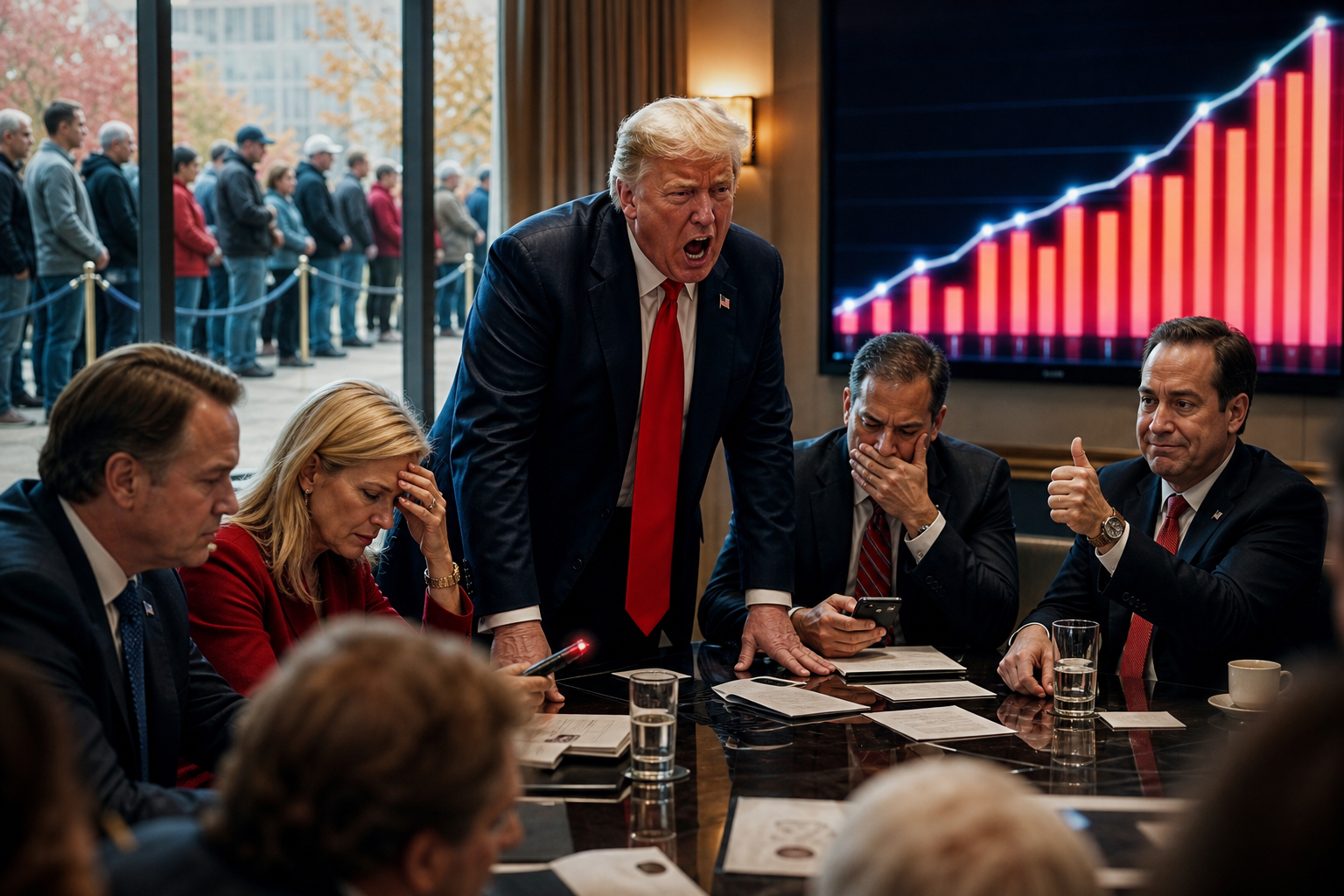
PARODY — Atlanta — Georgia’s record-breaking first day of early voting has triggered the state’s rarely invoked Campaign Performance Review, a fictional corporate ritual in which candidates, consultants and donor-class adults are required to sit in a windowless hotel ballroom while a giant screen displays one devastating fact: people came.
More than 188,600 ballots were cast on the first day of early voting, according to the real Georgia secretary of state’s office. Under the parody review protocol, that number is not allowed to mean anything specific until every campaign has first explained why it definitely means something specific.
By 9:15 a.m., the ballroom had divided into its traditional departments: candidates pretending to be relaxed, pollsters holding tablets as if they had recently received difficult medical imaging, and senior operatives saying “interesting” with the flatness of people watching a raccoon operate a vending machine.
“This is an engagement success,” announced one consultant, pointing at the turnout graph with the authority of a man who had just learned the graph existed. “The question is whether it is an engagement success for us, for them, or for a previously unknown group of Georgians who have made voting their whole personality.”
The room fell silent when an analyst asked whether the turnout could reflect simple civic participation. A campaign attorney immediately requested that the phrase be removed from the minutes because it “introduced an unmanageable amount of democracy into the model.”
For years, campaign professionals have endured voters as an abstraction: a tasteful sequence of bars, dots and phrases like soft suburban concern. Georgia’s early-voting surge had now forced them to confront the unpleasant possibility that the electorate may be composed of actual people with schedules, motives and the legal ability to disregard a consultant’s preferred narrative.
Each campaign was given eight minutes to present its theory of the turnout. One blamed grocery prices. Another blamed national politics. A third, representing a candidate who had recently spent forty minutes discussing rural broadband in a hangar, blamed “an awakened hunger for infrastructure specifics.”
“We are seeing strong enthusiasm among voters who are especially energized by the candidate’s plan to establish a task force that can examine whether another task force has delivered sufficient accountability,” said that campaign’s communications director, who had arrived carrying a pie chart entitled People Who May Have Heard of the Plan.
Then came the direction change nobody in the ballroom had prepared for. At noon, the fictional review committee revealed that turnout would not be assigned to either party, any candidate, or any cable-news panel until someone could explain why voters had chosen to appear before the campaigns had finished delivering their final six weeks of panic.
This was received as a direct attack on the modern political economy. Several strategists objected that voters were supposed to wait until campaigns had spent enough money to discover what they cared about. One donor asked whether the state could slow down the electorate until after a fundraiser in Buckhead. Another wondered whether early voters could be categorized as “pre-disappointed” and safely ignored.
The campaigns attempted to regain control through language. Turnout was recast as “ballot-adjacent customer activity.” Voters became “high-intent civic consumers.” One candidate’s team circulated a memo arguing that a person who voted early was essentially attending a campaign event without the costly burden of applause.
But the review worsened when staffers began receiving anonymous feedback cards, allegedly from the electorate. One read, “Please stop interpreting my existence in public.” Another simply said, “We know you can see us.”
By late afternoon, the candidates themselves were summoned before the screen and asked to describe a time they had successfully handled unexpected participation. One offered a story about a town hall where someone asked a question not contained in the briefing book. Another said he had once survived a county fair after the microphone cut out. A third began thanking the room for its confidence, though no confidence had been expressed.
In the end, the committee issued no verdict. It merely placed a small brass plaque beside the turnout monitor reading: THE VOTERS HAVE LOGGED ON.
At press time, every Georgia campaign had claimed the number proved its message was working, while privately refreshing the same dashboard hard enough to qualify for workers’ compensation.
Georgia’s Record Turnout Traps Campaigns in an All-Day Performance Review
Nearly 189,000 Georgians showed up early, leaving every consultant to explain a number with no facial expression.
WHAT STARTED THIS MESS
The event underneath the joke is real. The SPILL premise, dialogue and escalation above are fictional parody.