G20 Ministers Leave Atlanta With Matching One-Star Reviews of Diplomacy
Unable to agree on war, trade or language, the world’s top diplomats discover a durable coalition against the phrase “critical moment.”
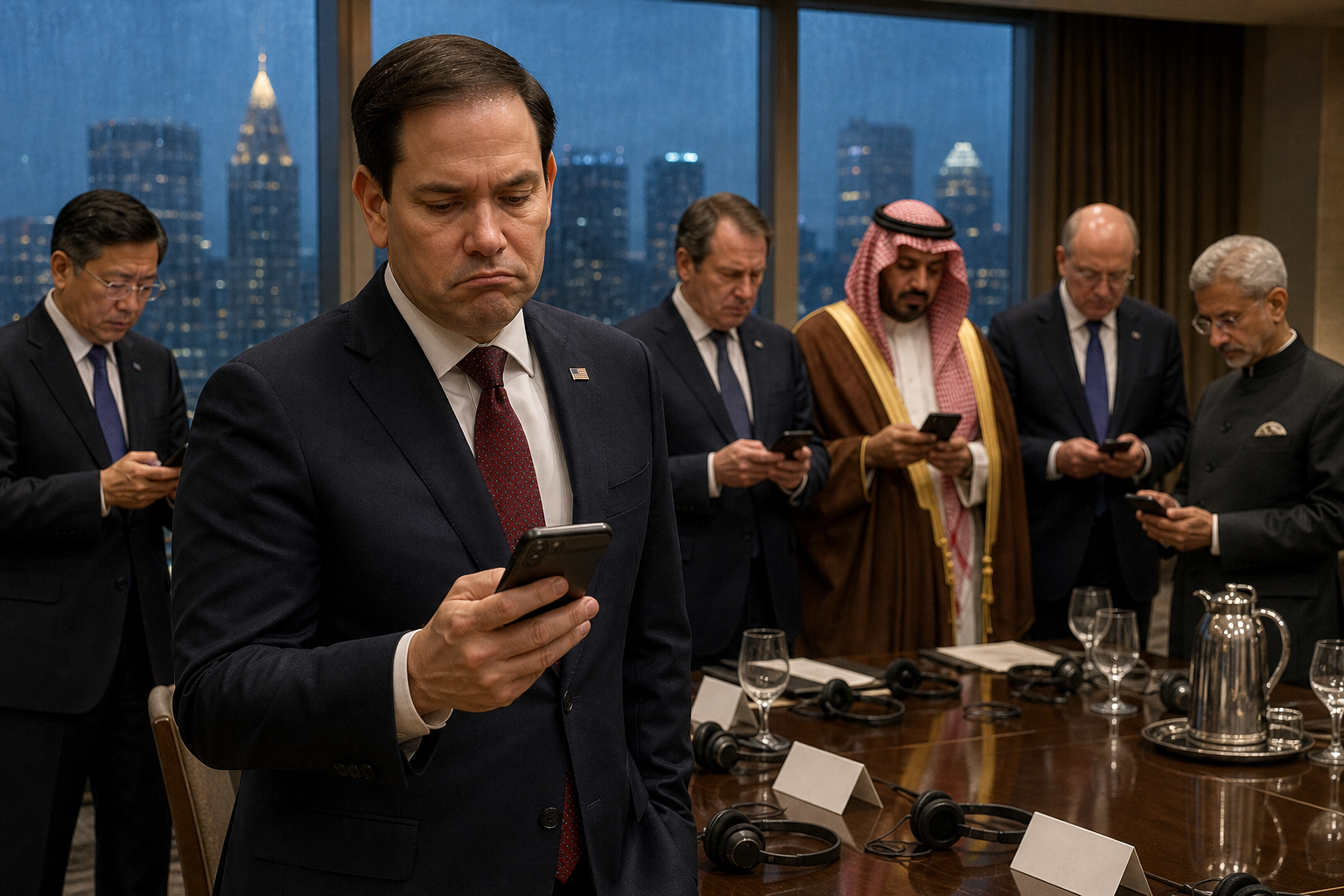
ATLANTA — FICTIONAL PARODY. With G20 foreign ministers unable to produce consensus on the wars in Ukraine and the Middle East, the Atlanta meeting ended Friday with an unexpected diplomatic breakthrough: all 20 major economies independently posted the same one-star review of diplomacy.
“The venue was attractive, the coffee was diplomatic, and the discussions had enormous potential,” read the review, which appeared within minutes on a fictional app called TreatyAdvisor. “Unfortunately, the other guests arrived with incompatible realities and would not stop referring to their national interests as though that settled anything. Would not return unless escorted by a ceasefire.”
The reviews were technically separate, allowing each delegation to preserve its sovereignty. But observers noted that the phrasing was nearly identical, right down to the complaint that “consensus was promised but proved unavailable during listed hours.”
Secretary of State Marco Rubio, who had urged the group to cooperate amid deep rifts, told reporters the reviews represented “the kind of practical coordination we hope can someday be extended to literally any topic with consequences.”
For several hours, diplomats had tried to draft a closing statement acknowledging that the world remained complicated without appearing to endorse the alarming proposition that somebody else might be right about why. The first version described the meeting as “constructive.” Russia objected to the word “constructive.” Several European delegations objected to the implication that construction had occurred. One delegation asked whether the word could be footnoted to clarify it was being used emotionally.
By midafternoon, the summit’s language experts had reduced the communiqué to a single sentence: “The ministers met.” Even that proved vulnerable. Some argued the word “met” suggested mutual recognition. Others worried it implied an outcome. A compromise phrase — “The ministers were geographically proximate under conditions of significant interpretation” — was withdrawn after translators began quietly asking to be reassigned to agricultural policy.
That was when a junior protocol officer suggested everyone simply rate the experience.
The proposal initially appeared doomed. China requested a distinction between stars awarded to the meeting’s format and stars awarded to the strategic environment. France argued that a one-star review should include a more complete sensory description of disappointment. The United States wanted an option for “serviceable, but cannot recommend at this time.”
Then the ministers saw the comment field.
Within seconds, years of frozen diplomatic language gave way to a nearly transcendent fluency. One delegation wrote that the summit “prioritized process over deliverables.” Another complained of “aggressive ambiguity from staff.” A third said it had been seated beside a country that spent the entire dinner pretending its security concerns were a group-project inconvenience.
The real breakthrough came when the fictional app asked a follow-up question: Was this problem resolved by management?
Every delegation selected “No.”
“That is the closest thing to unanimity this institution has achieved in years,” said an unnamed fictional summit aide, wiping away a tear with the corner of an unused draft declaration. “Nobody had to concede territory, revise a historical narrative or use the phrase ‘rules-based order’ in a way that made their own delegation stare at the carpet. They just had to admit management had not resolved it.”
The success immediately created a new problem. The city of Atlanta, having hosted the ministers through a difficult week of motorcades, security zones and hotel lobbies full of people saying “bilateral” as though it were a medical procedure, objected to being associated with the reviews.
Atlanta’s fictional hospitality coalition issued its own statement stressing that the city had provided excellent rooms, attentive service and enough conference pastries to sustain a medium-sized alliance through a constitutional crisis. “If the guests failed to agree on the future of international security,” the statement said, “we respectfully submit that this reflects a disagreement that began before check-in.”
Stung by the suggestion that their complaints might affect the host city’s rating, the G20 ministers convened an emergency session. For the first time all week, delegates found a common purpose: protecting the reputation of the hotel breakfast.
They swiftly adopted a 14-point joint statement praising the eggs as “inclusive, resilient and served in a spirit of meaningful multilateral engagement.”
It was the first consensus of the summit, and it passed only after the delegates agreed never to discuss what the eggs meant.
G20 Ministers Leave Atlanta With Matching One-Star Reviews of Diplomacy
Unable to agree on war, trade or language, the world’s top diplomats discover a durable coalition against the phrase “critical moment.”
WHAT STARTED THIS MESS
The event underneath the joke is real. The SPILL premise, dialogue and escalation above are fictional parody.
- Reuters Rubio urges G20 cooperation amid rifts over wars in Ukraine, Middle East ↗
- PBS NewsHour WATCH: Rubio welcomes G20 foreign ministers to Atlanta at 'critical moment' - PBS ↗
- AP G20 foreign ministers to end Atlanta meeting without consensus on key issues ↗
- NBC Middle East Conflict: Latest News, Breaking Headlines and Video ↗