Finstad and Johnson Turn Minnesota Debate Into a School-Bus Primary
With tariffs dividing them and childhood transit uniting them, outside groups rush to locate the only swing voters who remember the seating chart.
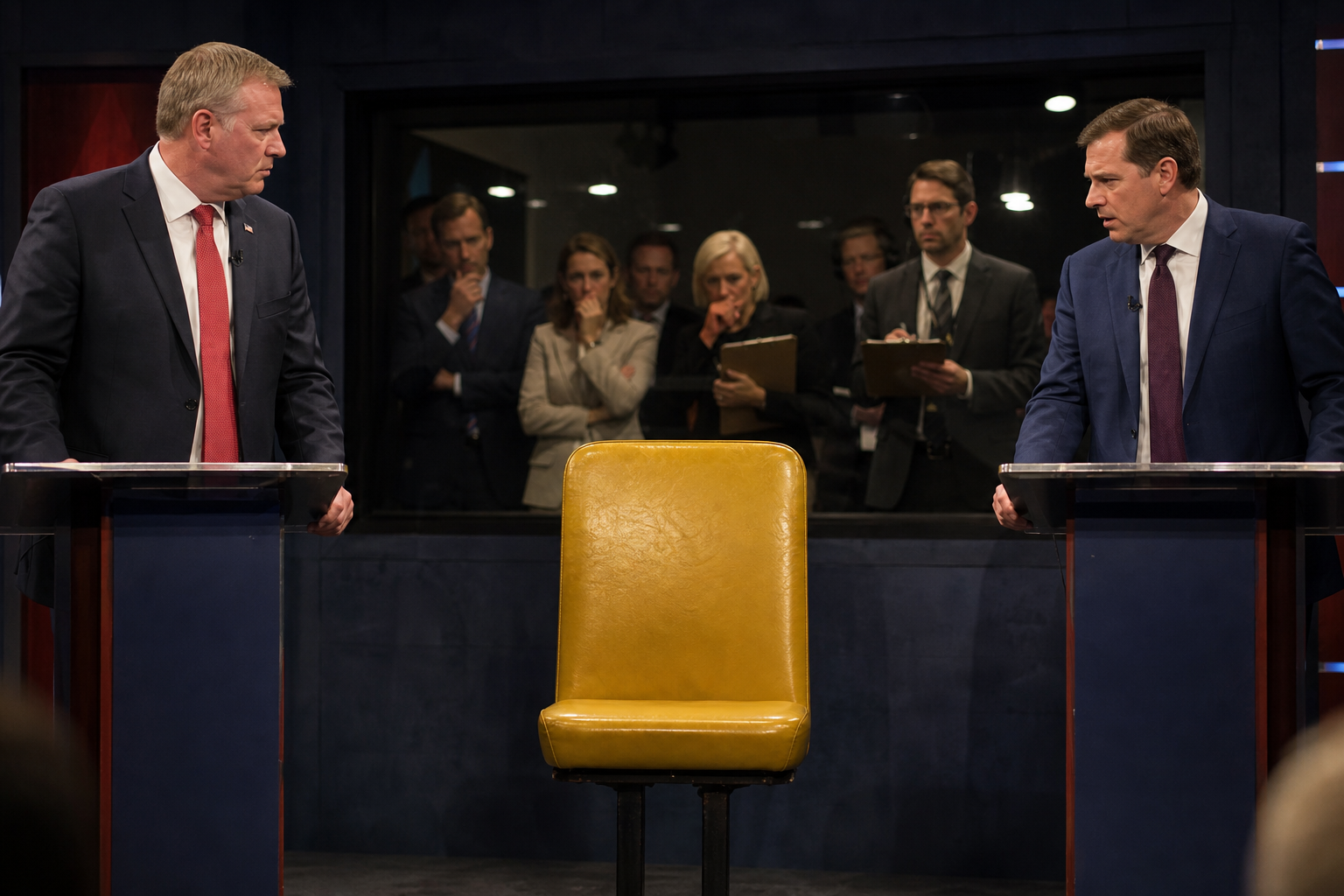
PARODY. In the fictional aftermath of Thursday’s southern Minnesota congressional debate, Republican Rep. Brad Finstad and DFL challenger Jake Johnson have agreed to suspend all discussion of tariffs until the district can determine which man had the more constitutionally meaningful elementary-school bus experience.
The emergency agreement followed a moment of rare bipartisan alarm: both candidates revealed that they met their wives while riding the bus to school, Finstad in second grade and Johnson in third. Within minutes, campaign operatives realized the race’s most dangerous issue was no longer trade policy, health care or immigration. It was that two grown men seeking Congress had independently stumbled into the exact same heartland-origin story, differing only by one grade level and whatever happened behind the driver’s seat.
“Voters are exhausted by candidates claiming they understand rural Minnesota because they own a fleece vest,” said a fictional consultant familiar with the panic. “Now we have verifiable bus-based intimacy. This is the kind of authenticity money cannot buy, except that money has already begun buying it at approximately $4,800 per recollection.”
The first attack ads arrived before breakfast. A pro-Finstad group released a somber thirty-second spot asking whether a third-grader can truly appreciate the economic anxiety of a second-grader watching a future spouse board the bus with a lunchbox. A Johnson-aligned group countered with grainy footage of an empty school aisle and the line: “Brad Finstad had an entire extra year to prepare his answer.”
Neither campaign initially intended to discuss the bus revelation again. That became impossible after outside spending in the race, already substantial enough to make local television resemble a pharmaceutical market for men who are disappointed in Washington, discovered a narrative with no complicated policy nouns in it.
By Friday afternoon, a super PAC had commissioned a focus group of former substitute teachers to assess whether meeting one’s spouse in second grade communicates “leadership,” “premature coalition-building” or “a troubling willingness to commit before committee assignments are available.” Another group began surveying Minnesotans on the decisive question: should a candidate who met his wife in third grade be considered more relatable because he had to wait longer for love, or less prepared because he spent an additional year allowing the seat next to him to remain politically uncontested?
The campaigns then made the mistake of trying to clarify.
Finstad’s team stressed that the school-bus anecdote was a personal detail, not a governing platform. Johnson’s campaign responded that it also believed the anecdote should not become a governing platform, before adding that the public deserved “a full accounting of which route fostered the stronger lifelong commitment to southern Minnesota.” The sentence was intended to shut down the controversy. Instead, it activated every consultant in a hundred-mile radius who has ever described a candidate as “rooted.”
At a hastily arranged press availability, reporters asked both candidates whether their respective childhood bus routes had any bearing on their views of Trump’s tariffs. Finstad said tariffs are a tool to improve America’s trading position. Johnson said tariffs are a tax that has raised costs for families. Then a reporter asked whether either man had ever switched seats for political advantage.
For twelve full seconds, the district experienced what one local anchor called “the closest thing to a clean answer this campaign has seen.”
That silence was quickly filled by the Minnesota First District Childhood Transit Accountability Project, a fictional bipartisan nonprofit founded by people who had previously spent forty years saying Washington had lost touch with ordinary Americans. The group demanded both candidates release contemporaneous seating charts, disciplinary records and sworn testimony from anyone who remembers whether either future congressional hopeful ever claimed the back of the bus while publicly presenting himself as a front-row kid.
Johnson’s team condemned the demand as an invasion of childhood privacy. Finstad’s campaign called it a distraction manufactured by people unwilling to debate trade. Both statements were instantly interpreted as evidence that the seating charts contained something.
The real winner, analysts said, may be the local television stations hosting the next debate. Producers have reportedly replaced the final closing-statement segment with a single yellow vinyl bus seat placed between the candidates. Each man will be given ninety seconds to explain what he learned there about government, marriage and the price of soybean oil.
Then the moderators will ask who had the window.
Finstad and Johnson Turn Minnesota Debate Into a School-Bus Primary
With tariffs dividing them and childhood transit uniting them, outside groups rush to locate the only swing voters who remember the seating chart.
WHAT STARTED THIS MESS
The event underneath the joke is real. The SPILL premise, dialogue and escalation above are fictional parody.
- NPR Republican Congressman Brad Finstad faces off against DFL challenger Jake Johnson in debate : Minnesota Today ↗
- POLITICO Wall Street and Big Tech’s blue wave nightmare: Elizabeth Warren working with Republicans ↗
- Reuters Wall Street set for weekly gains with earnings, inflation data on tap ↗
- AP Wall Street finishes its record-setting week with gains ↗