Elon Musk Sends Ukraine’s War to Content Moderation
The appeal will be reviewed by a rotating panel of algorithms, contractors and one extremely concerned policy intern.
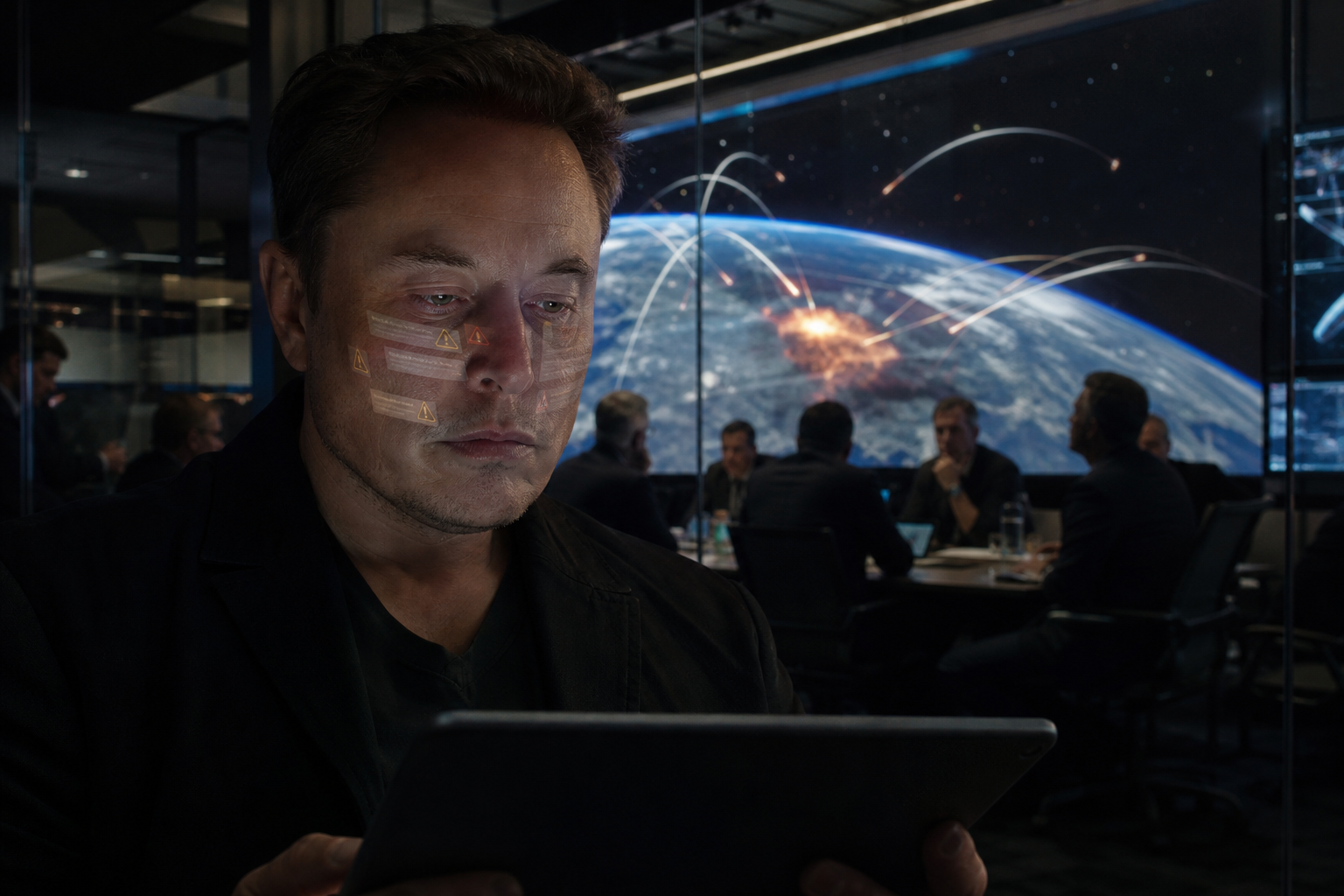
FICTIONAL PARODY — In no way a real SpaceX policy announcement.
Elon Musk has reportedly placed Ukraine’s war in the company’s content-moderation queue, where it will remain under review until a private satellite provider can determine whether being invaded counts as violence, self-defense, newsworthy material, or an unacceptable use of the upload button.
The decision follows a week in which Ukraine said its Starlink and Starshield service had returned to normal after restrictions disrupted military operations, while Musk said Ukraine had violated Starlink’s terms by using it for offensive drone strikes. In the fictional policy update, SpaceX acknowledged that the situation was complicated by the fact that “everyone keeps describing a war in ways that make it sound like war.”
Ukraine’s appeal was initially rejected by an automated system after it detected missiles, explosions, uniforms, damaged buildings and an alarming absence of the sort of cheerful cooking content generally associated with responsible internet usage. The system then offered Kyiv several options: remove the violent material, mark it as satire, or certify that its military activity was “for personal, non-commercial use.”
“We understand this is a sensitive moment,” read a fictional notification sent to Ukrainian officials at 3:14 a.m. local time. “Your account has been temporarily limited while we investigate whether defending your territory may create an unsafe environment for other users.”
The country was instructed not to submit a second appeal unless it had “materially changed its behavior,” a condition military officials reportedly interpreted as a subtle request to stop having a border.
At first, the arrangement appeared manageable. Ukrainian commanders were told they could keep using the service for logistics, civilian communications and “non-escalatory vibes.” A drone could receive a weather update, locate a flooded road, and send a tasteful congratulations message to a cousin. It simply could not become involved in anything the company’s policy team might later describe as “a complicated precedent.”
Then came the first moderation ruling.
A Russian attack on Ukrainian cities was designated “graphic but contextually relevant,” allowing it to remain online with a warning screen. Ukraine’s attempt to intercept the attack was flagged for “coordinated harmful activity,” pending a review by specialists working across several time zones and one conference room named after an extinct animal.
The appeal process quickly became the war’s most strategically important front. A Ukrainian officer would submit battlefield coordinates, a timestamp and an explanation of imminent danger. Within seconds, he would receive a message thanking him for helping keep the platform safe.
“We know this can be frustrating,” the message continued. “Our systems are not perfect, but neither are all geopolitical conflicts.”
The real complication emerged when Musk’s fictional moderation council discovered that every possible outcome made the company look like it had made a foreign-policy decision. Restore service, and it had effectively permitted an act of war. Restrict service, and it had effectively intervened in one. Refuse to explain either choice, and it had accidentally invented the diplomatic doctrine of replying with a single upside-down-smile emoji.
This was unacceptable. SpaceX executives had spent years building a global communications network only to learn that people expected global communications networks to have consequences.
To avoid further confusion, the company unveiled a new three-tier classification system. “Civilian” covered people attempting to call relatives, find shelter or keep basic systems running. “Military” covered equipment and personnel operating in a war zone. “Offensive” covered whichever category caused the most trouble when discussed on social media.
There was also a fourth category, “Elon,” reserved for decisions so consequential that no one was permitted to admit who made them until after they had been explained in a post written at the speed of a personal grievance.
By Sunday, Ukraine’s case had reached the final stage: a live video hearing before an independent oversight board composed of a retired astronaut, two constitutional scholars, a venture capitalist who kept saying “disruption” in a grave voice, and an algorithm trained on every customer-service chat ever ended by the phrase “I totally understand.”
The board’s first question was whether Ukraine had tried turning the war off and back on again.
When Kyiv replied that Russia was still attacking it, the panel issued its most decisive finding yet: the conflict would remain visible, but only after viewers confirmed they were over 18, emotionally prepared, and willing to accept cookies.
Elon Musk Sends Ukraine’s War to Content Moderation
The appeal will be reviewed by a rotating panel of algorithms, contractors and one extremely concerned policy intern.
WHAT STARTED THIS MESS
The event underneath the joke is real. The SPILL premise, dialogue and escalation above are fictional parody.
- NBC Gretchen Whitmer says America is ready to elect a woman president ↗
- PBS NewsHour Ukraine disputes Elon Musk's claim that its military violated Starlink's terms of service - PBS ↗
- FOX Ukraine's Starlink restored as Elon Musk claims Kyiv violated terms of service 'to kill people' ↗
- MS NOW Ukrainian diplomat says Starlink restrictions remain despite Trump’s claim ↗
- Reuters Ukraine says Starshield back to normal, Musk says Kyiv violated terms ↗
- AP Melania Trump ↗
- CNN Elon Musk is now a mega-donor unlike anyone this country has ever seen ↗