Democrats Beg Voters to Stop Treating ‘Midterm’ Like an Elective
After months of warning that everything is on the line, party strategists discover they named the emergency after a test people traditionally ignore until midnight.
This is a work of parody.
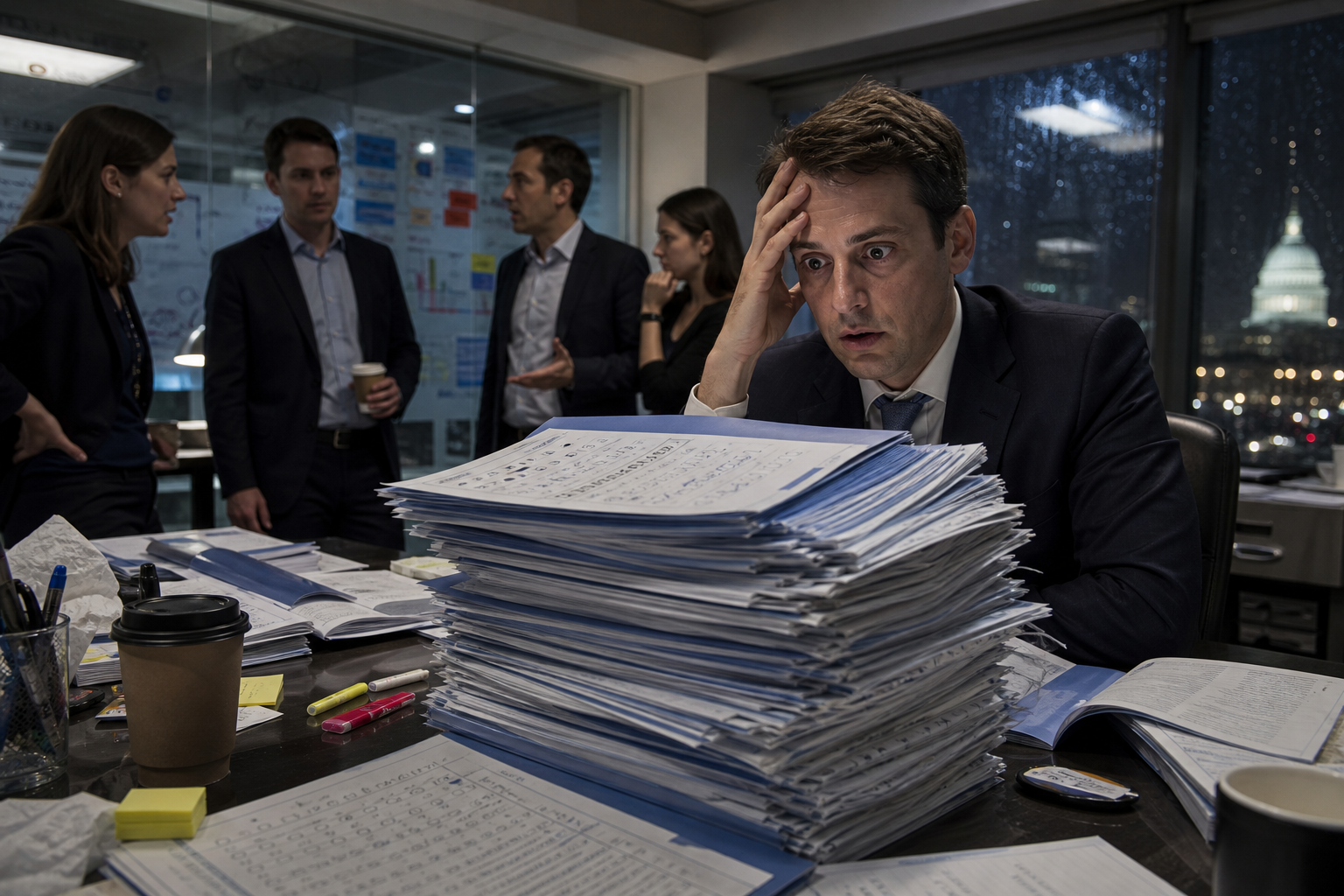
Democratic leaders, facing the final stretch of a midterm campaign defined by increasingly urgent pleas for turnout, have identified the true enemy: the phrase midterm election.
“We keep saying democracy is in peril, and voters keep hearing ‘a moderately important quiz worth 20 percent of the grade,’” said one fictional party strategist, standing before an emergency whiteboard labeled with every synonym for catastrophe that can be mailed at bulk rate. “No civilization has ever survived a sentence beginning, ‘Hey, quick reminder about your midterm.’”
The party’s messaging operation reportedly convened a late-night linguistic summit after focus groups reacted to the phrase “midterm turnout” with the same facial expression normally reserved for a syllabus attachment. Consultants had spent months describing the election as a hinge point for the country, an existential test of power, rights and institutional restraint. Then, at the bottom of every ad, came the fatal little word suggesting people should maybe skim the chapter headings and see how they feel.
“A general election sounds like a national event,” said a fictional Democratic consultant who had arrived carrying three cold coffees and an unopened voter file. “A midterm sounds like something a professor gives you because they need one more thing to grade before spring break. We have accidentally branded democratic participation as a scantron-based inconvenience.”
The first solution was a rebrand. Campaign staff briefly floated “The National Final,” before constitutional scholars noted that it sounded alarmingly definitive. “Democracy: The Group Project” tested well with people who enjoy anger, but collapsed after participants asked which member of the group would disappear for six weeks and reappear with a Canva slide. “Mandatory Capstone in Self-Government” drew strong approval among donors and immediate hostility from anyone who had ever attended college.
For forty-eight hours, the preferred replacement was simply “The Consequences.” It had gravity. It had menace. It also sounded like a limited series about a beachfront family discovering a body in the marina.
By Thursday, the campaign had shifted to a more direct approach: every speechwriter was instructed to remove the word midterm from candidate remarks and replace it with a phrase that conveyed “historic democratic decision” without sounding like a man in a fleece vest asking alumni to attend a webinar. The approved language included “the election currently happening in the middle of an extremely strange national chapter,” “the ballot with real-life downstream effects,” and, in one unreleased draft, “the thing you will be discussing furiously at Thanksgiving whether you participate or not.”
Then came the bad news from the research department. Voters did not actually dislike the word midterm. They disliked being informed by strangers with lapel pins that they were personally responsible for stopping history from becoming a cautionary PowerPoint.
This created a second emergency. Democrats had built a vast urgency apparatus capable of turning any policy speech into the final ten minutes of a disaster movie, only to discover that the public has developed what one internal memo called “all-caps fatigue.” Every message now arrived with the emotional temperature of a smoke alarm whose battery was replaced by a campaign consultant.
In response, the party unveiled a fictional pilot program called Calmly, Seriously, Please. Candidates were asked to speak in normal human voices about what governing decisions affect, rather than performing verbal CPR on the electorate. One candidate reportedly attempted the new style at a rally, saying, “This election matters because public policy matters,” before aides rushed onstage and wrapped the sentence in six blinking urgency graphics.
The program lasted nine minutes.
Still, senior Democrats insist the language problem can be solved. A task force has been assigned to investigate why “closing argument” makes voters picture a courtroom, “ground game” makes them picture a football loss, and “turnout operation” makes democracy sound like a municipal recycling contract. Early findings suggest politics has spent so long speaking in its own private dialect that it now requires a translator just to ask the public to care.
At press time, strategists were considering one final title for the election: That Thing You’ll Wish You Had Taken Seriously While Reading the Results at 1:14 A.M. It polled terribly, but everyone agreed it finally sounded like a midterm.
Democrats Beg Voters to Stop Treating ‘Midterm’ Like an Elective
After months of warning that everything is on the line, party strategists discover they named the emergency after a test people traditionally ignore until midnight.
WHAT STARTED THIS MESS
The event underneath the joke is real. The SPILL premise, dialogue and escalation above are fictional parody.