Data Centers Begin Campaigning as Republicans Discover They’re the Incumbents
The servers have been advised to stop discussing megawatts and start talking about the summer they spent detasseling corn.
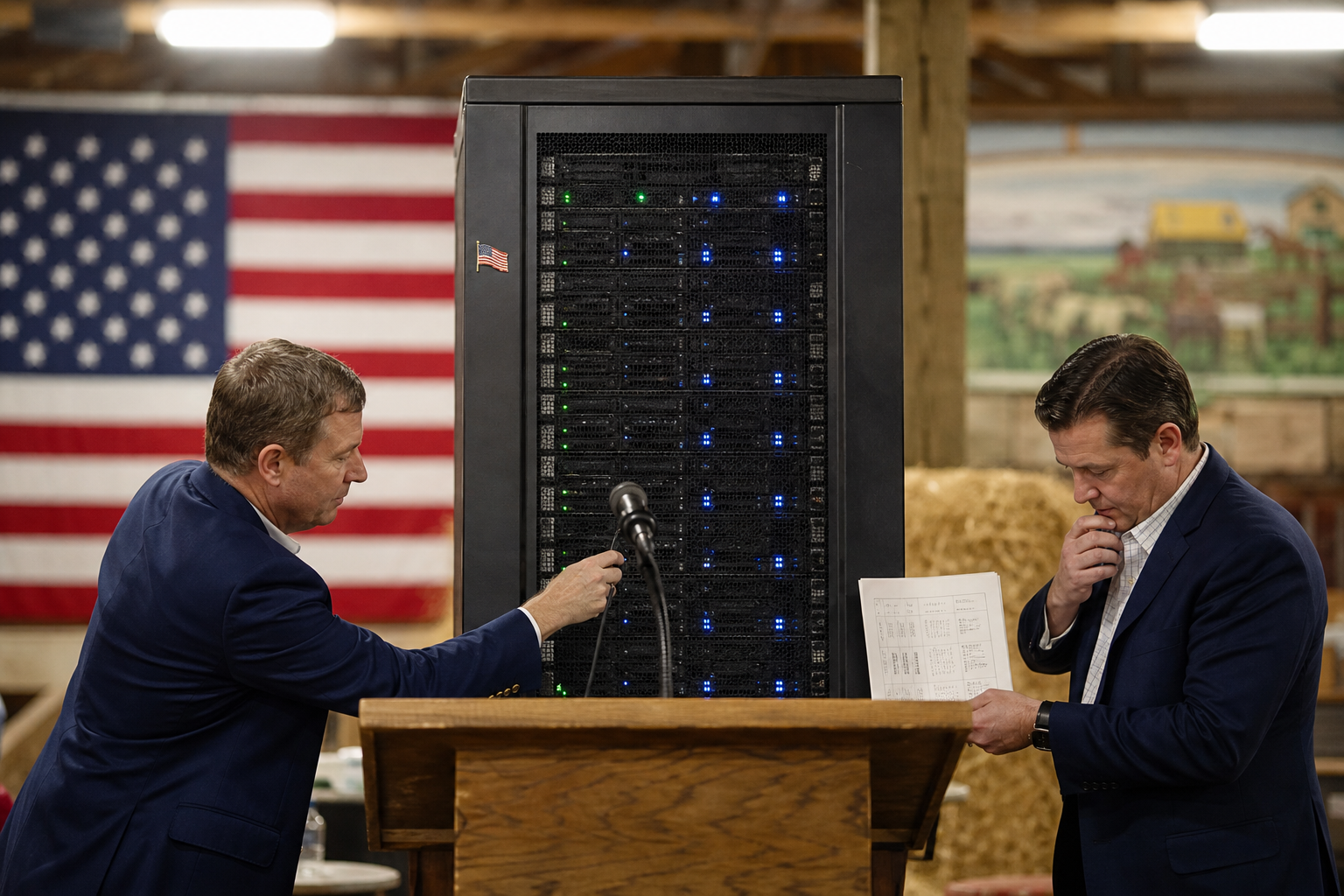
WASHINGTON—Alarmed by a new analysis suggesting that deep-red counties hosting major data-center projects drifted away from Republicans in last week’s midterms, GOP strategists have ordered America’s largest server farms to begin running for office immediately.
The move comes after party officials reached the grim conclusion that voters did not sufficiently appreciate being represented by a windowless industrial complex that uses enough electricity to make every ceiling fan in three counties feel personally judged.
“The data center has a story to tell,” said one Republican consultant, standing before a 40-foot rendering of a server campus wearing a flag lapel pin. “Sure, it arrived through an LLC nobody could identify, negotiated a tax package in a conference room marked ‘private,’ and now requires its own relationship with the regional grid. But have voters heard about its values?”
Under the new strategy, data centers will no longer appear at county meetings as projects. They will appear as candidates: humble, persecuted, and somehow always one zoning vote away from losing their constitutional right to process everybody’s vacation photos.
Each facility has been assigned a campaign manager, a local-radio consultant and a former congressional aide responsible for teaching the buildings how to seem less like a deal that happened to a community and more like a neighbor who briefly borrowed several billion gallons of water.
The first wave of campaign materials avoids technical language such as “substation expansion,” “tax abatement” and “non-disclosure agreement.” Instead, voters will receive glossy mailers featuring an immaculate row of cooling towers against a sunset, beneath the slogan: IT KNOWS WHAT MATTERS HERE.
One proposed campus in a rural county has already released a biographical video tracing its roots to “a proud American cloud,” with soft-focus footage of a maintenance road, a pickup truck driving past a soybean field and a narrator noting that the facility “never forgot where it was permitted.”
Strategists initially worried that the candidate could not shake hands, attend fish fries or answer questions about household electric bills. Those concerns were addressed by assigning every data center a folksy holographic spokesperson named either Beau, Clay or Missy, depending on the county’s median age and whether a diner still has a pie case.
“I was skeptical at first,” said a consultant overseeing message discipline for several hyperscale campuses. “But then the model answered a question about water use by saying, ‘Folks, I’m listening.’ That is honestly more responsive than most state parties.”
The program hit an early snag when a data center’s campaign team scheduled its first town hall. Residents arrived with questions about land, rates, noise and the terms under which their local government had promised public resources to a company whose final name might not be available until after construction.
Rather than answer, the facility’s newly hired communications director declared the event a “listening tour” and placed a bowl of peppermints near the exit. The decision was praised across the consulting class as a disciplined refusal to let policy distract from outreach.
But the strategy took a more ambitious turn this week after several Republican operatives noticed that data centers possess a political advantage unavailable to ordinary candidates: they can analyze every message test before it has finished being misunderstood.
Campaign teams are now feeding public comments directly into the facilities, which will generate customized local appeals in milliseconds. A resident concerned about utility costs may receive an ad about “energy abundance.” A resident worried about water may receive a video of an AI-generated creek saying it supports innovation. Anyone who asks what happened to the promised jobs will be routed to a cheerful page explaining that the campus has created “an ecosystem of opportunity,” which appears to consist mostly of security badges.
By Friday, several facilities had adopted a more aggressive posture, accusing their critics of wanting to “take the cloud away from hardworking families.” One server farm briefly considered announcing a kitchen-table tour before advisers reminded it that it has never encountered a kitchen table except as a high-resolution image file.
The Republican National Committee has not formally endorsed the plan, though aides say party leaders are encouraged by the results of an early focus group in which voters described one data center as “less terrifying once it admitted it had made mistakes.”
That message may prove difficult to sustain. During a rehearsal for a campaign stop, one facility was asked whether it would support a binding local referendum on its expansion. After a brief pause, every light in the building began blinking at once, which consultants called “a strong visual commitment to transparency.”
Data Centers Begin Campaigning as Republicans Discover They’re the Incumbents
The servers have been advised to stop discussing megawatts and start talking about the summer they spent detasseling corn.
WHAT STARTED THIS MESS
The event underneath the joke is real. The SPILL premise, dialogue and escalation above are fictional parody.
- FOX Red counties with data center projects swung away from GOP in midterms, analysis finds ↗
- MS NOW Jong-Fast slams GOP handling of Hegseth: 'They don't understand the lessons from the midterms' ↗
- CNN Pete Hegseth’s impeachment: How each House member voted ↗
- Reuters What are the impeachment articles facing Pete Hegseth? ↗