Congress Adds Hazardous Mail to Election Workers’ Expanding Job Description
Having already made them referees, archivists and conspiracy-theory customer service, Washington discovers one more responsibility it can call local control.
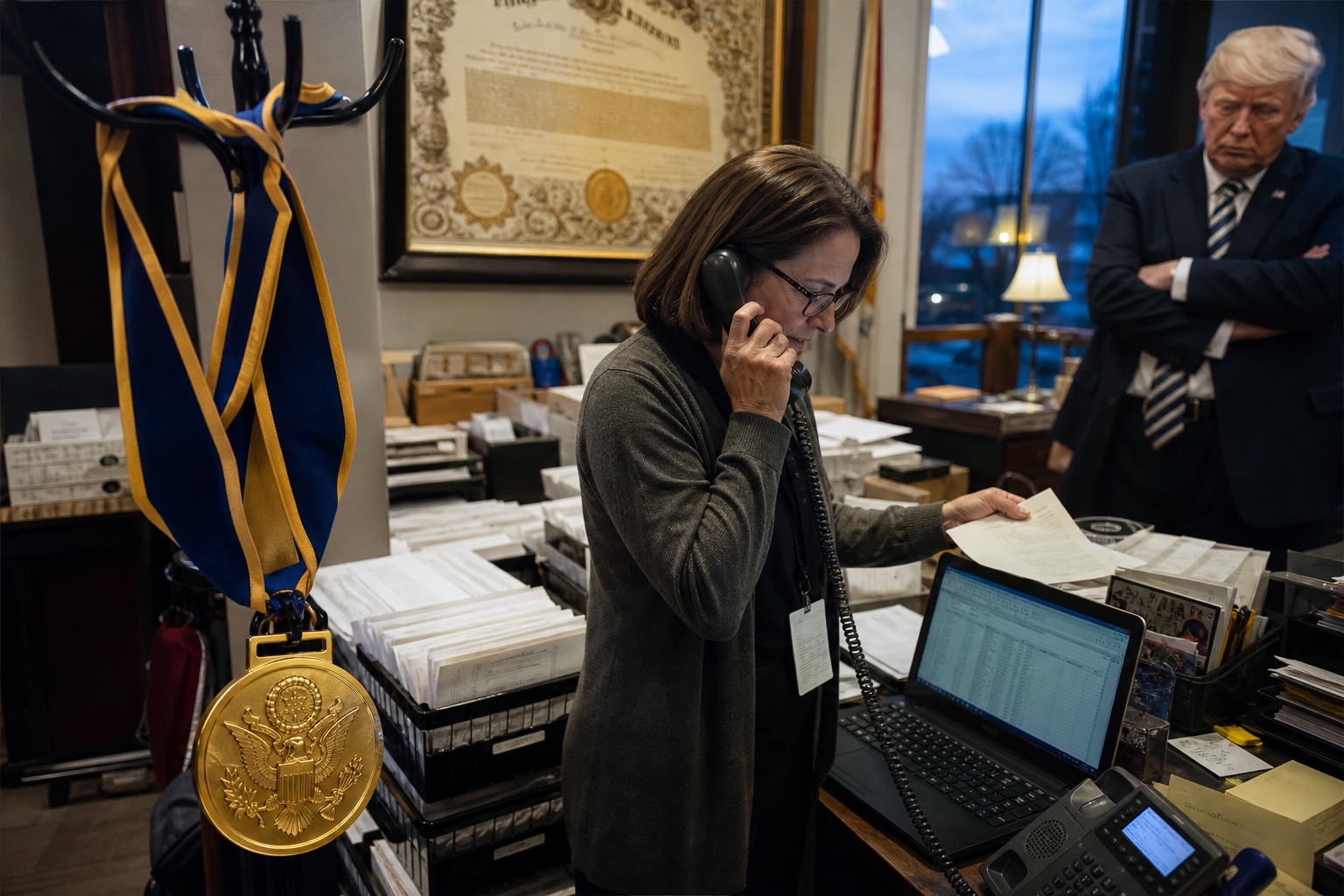
This is a work of parody inspired by a real investigation into suspicious mailings.
WASHINGTON—Following reports of suspicious mail sent to election offices and congressional offices, Congress on Friday announced that America’s election workers would be receiving a revised job description reflecting their “vital role in the modern democratic experience.”
The update, delivered in a 94-page PDF titled Serving Voters in a Dynamic Threat Environment, confirms that local election administrators are no longer merely responsible for staffing polling places, maintaining voter rolls, securing ballots, training volunteers, answering public-records requests, surviving recounts, explaining basic civics to men filming them vertically, and politely refusing to reveal where the “real ballots” are stored.
They are now also expected to possess “foundational awareness of incoming-envelope complexity.”
“Election officials have always been the front line of democracy,” said a fictional congressional spokesperson standing before a slide labeled FRONT LINE, SOMEHOW. “And as every member of Congress knows, when somebody says ‘front line,’ the appropriate response is to send a heartfelt letter of support from several states away.”
The new guidance assures county clerks that they will not be asked to become law-enforcement professionals. Instead, they will become something more familiar to Washington: professionals who are instructed to remain calm during law-enforcement situations while continuing to process paperwork by 5 p.m.
Under the fictional framework, election offices will receive a digital badge reading “DEMOCRACY GENERALIST,” alongside optional webinar modules including De-Escalating a Man Who Says He Has Seen a Spreadsheet, Why the Constitution Does Not Have a Customer-Service Line, and Recognizing When an Elected Official Has Turned Your Routine Task Into Content.
Congressional leaders praised the program as a major investment in election security, noting that its first year will be funded by repurposing money originally intended for a bipartisan commission that never met because its members could not agree whether chairs were politically neutral.
“We are finally treating these public servants with the seriousness they deserve,” said another fictional lawmaker. “That is why the training comes with a lanyard.”
A Career Path With No Ceiling, Mostly Because the Ceiling Is Gone
The announcement immediately raised concerns among election administrators, who had assumed their profession’s more unusual demands had reached a natural limit somewhere around being publicly accused of international treason by a podcast host whose microphone was plugged into a gaming chair.
“I got into this work because I care about orderly elections,” said a fictional county official, looking over a checklist that now included ballot reconciliation, public confidence, emergency continuity, media relations, cybersecurity, physical security, and a box marked MAIL: BE AWARE OF IT. “Apparently I have also been accepted into a graduate program in absorbing the national nervous system.”
But the revised job description contains an unexpected benefit: election officials will now be eligible for “cross-sector recognition” from other public servants whose jobs have similarly expanded to include cleaning up after political adults hold a press conference.
School superintendents, librarians, public-health directors and airport gate agents have reportedly offered to form a peer-support network called People Who Just Wanted a Normal Government Job. The group’s first meeting was delayed after members spent forty minutes debating whether the meeting itself could be secretly rigged.
The real complication emerged when congressional offices asked whether the new program could be extended to lawmakers themselves, many of whom expressed concern that receiving mail had become “a surprisingly hands-on aspect of representative government.”
A pilot program at the Capitol briefly assigned members of Congress a simple exercise: identify which employee in their office is responsible for opening incoming correspondence. The exercise was suspended after several members discovered the answer was “a 22-year-old staff assistant who is also arranging a cable-news hit and returning a donor’s miniature umbrella.”
By afternoon, lawmakers had reached a bipartisan compromise. Election officials will continue handling the actual difficult parts of democracy, while Congress will establish a Select Committee on Appreciating That They Do.
The committee is expected to hold its first hearing as soon as members determine whether appreciating someone requires a subpoena.
Congress Adds Hazardous Mail to Election Workers’ Expanding Job Description
Having already made them referees, archivists and conspiracy-theory customer service, Washington discovers one more responsibility it can call local control.
WHAT STARTED THIS MESS
The event underneath the joke is real. The SPILL premise, dialogue and escalation above are fictional parody.
- FOX 'Suspicious' mail with DSA-linked return address triggers FBI, Capitol Hill investigation ↗
- Reuters FBI, US Postal Service investigate suspicious mailings to election officials, lawmakers ↗
- CBS Maryland elections board targeted in suspicious mailings under FBI investigation ↗
- NPR Suspicious mailings to election officials, congressional offices under investigation ↗
- NBC Suspicious white powder sent to election offices in 3 states ↗