APEC Invents a Trade Statement So Vague It Clears Every Border
After years of tariffs, chip controls and supply-chain brinkmanship, 21 economies have finally agreed to endorse several nouns.
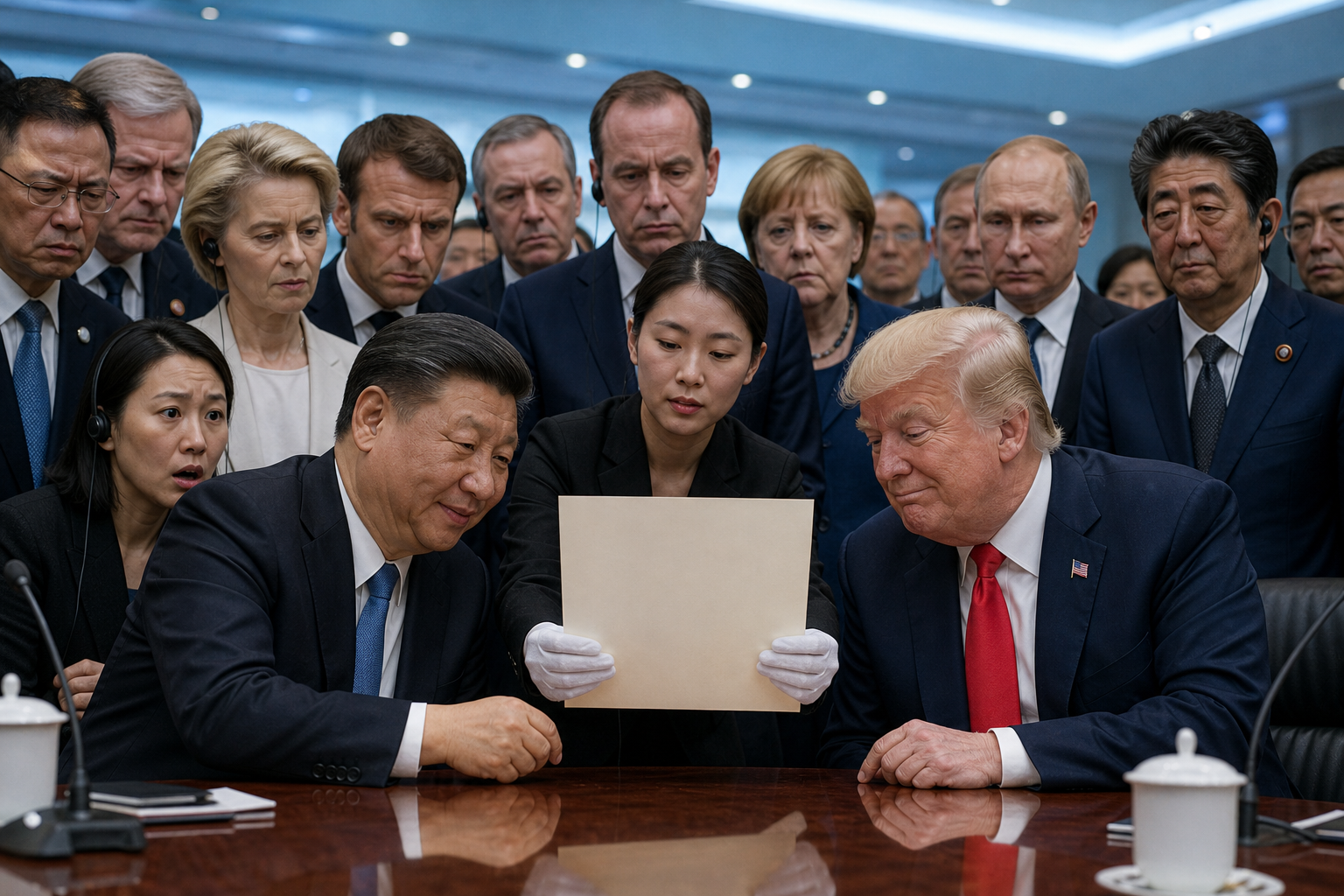
PARODY. SHENZHEN — With Asia-Pacific leaders expected to set aside their differences long enough to produce a summit statement, APEC on Tuesday unveiled the first diplomatic communiqué specifically designed to survive contact with its own readers.
The document, known internally as the Shenzhen Sentence, contains 43 words, six commas and no recognizable commitment. It affirms the members’ shared dedication to “resilient, innovative, open, secure, inclusive and appropriately situated future-oriented cooperation,” a formulation experts hailed as the most ambitious possible outcome of a room containing 21 economies currently trying to punish one another into prosperity.
“This is not merely a statement,” said a fictional summit aide, carefully placing the document beneath a glass cloche. “It is a neutral zone in which every delegation can briefly rest before returning home to announce that it defeated somebody.”
The breakthrough came after negotiators accepted that agreement on tariffs, industrial policy, export controls, rare earths, semiconductors, electric vehicles, shipping routes and who had started being difficult first would be unrealistic. Agreement on the phrase future-oriented cooperation, however, proved possible because no one could establish what it would require on Wednesday morning.
Each delegation was immediately given an interpretive guide. Washington was told the statement strongly endorsed fair competition, provided fair competition remains whatever Washington says it is before lunch. Beijing was assured it rejected protectionism, except when protectionism arrived wearing a national-security lanyard. Smaller economies were informed that “inclusive” meant they had been seen, heard and invited to sign near the bottom.
Canada, which arrived at the summit seeking trade options beyond its tense relationship with the United States, reportedly asked whether the Shenzhen Sentence could be printed on durable paper and folded into a functioning economic strategy. Officials explained that it was not built for that kind of pressure.
For several hours, the sentence performed brilliantly. A trade minister called it a rebuke to unilateralism. Another called it an endorsement of sovereignty. A third called it a powerful defense of supply-chain reliability while announcing fresh restrictions on somebody else’s supply chain. By midafternoon, the same comma had been praised as a major concession by four governments and denounced as an unacceptable precedent by two others.
Then came the problem: business leaders loved it.
Executives at the APEC CEO summit began asking whether the statement could be applied to earnings calls, layoffs and regulatory testimony. One technology company requested a version that would allow it to promise AI safety, rapid deployment and absolutely no meaningful accountability without having to select a tense. A shipping consortium wanted the phrase “open and secure trade corridors” engraved on the side of every container, preferably before anyone asked who controlled the corridor.
APEC delegates initially resisted commercializing the sentence. But after discovering that the document could be interpreted as an endorsement of commercialization, they created the Shenzhen Sentence Licensing Office, which will sell approved ambiguities to ministries, corporations and couples attempting to renew a relationship while retaining all existing grievances.
The office’s first product is a pocket-sized card reading, “We recognize the importance of addressing shared concerns through mutually beneficial dialogue.” Users may present it whenever asked whether they plan to do anything.
President Donald Trump, arriving as the United States continued to tighten controls on China’s access to advanced AI technology, was said in the parody to admire the statement’s flexibility. Xi Jinping, hosting the summit while promoting open trade, also found it useful. By sunset, both sides had privately claimed authorship of the sentence, which diplomats considered proof that it had achieved the highest form of multilateral success: nobody could afford to let the other side sound more pleased with it.
Negotiators are now preparing a leaders’ photo in which everyone will hold the statement at an angle that makes it impossible to tell whether they are reading it, signing it or trying to return it to the hotel concierge.
Asked what the text would mean for trade tensions after the summit, the fictional APEC aide nodded gravely and said the communiqué had already answered that question by declining to develop it.
APEC Invents a Trade Statement So Vague It Clears Every Border
After years of tariffs, chip controls and supply-chain brinkmanship, 21 economies have finally agreed to endorse several nouns.
WHAT STARTED THIS MESS
The event underneath the joke is real. The SPILL premise, dialogue and escalation above are fictional parody.