Anthropic Adds Humanity to Its Investor Call, Immediately Mutes It
The Claude maker’s new “Humanity Relations” division says civilization remains a valued long-term stakeholder.
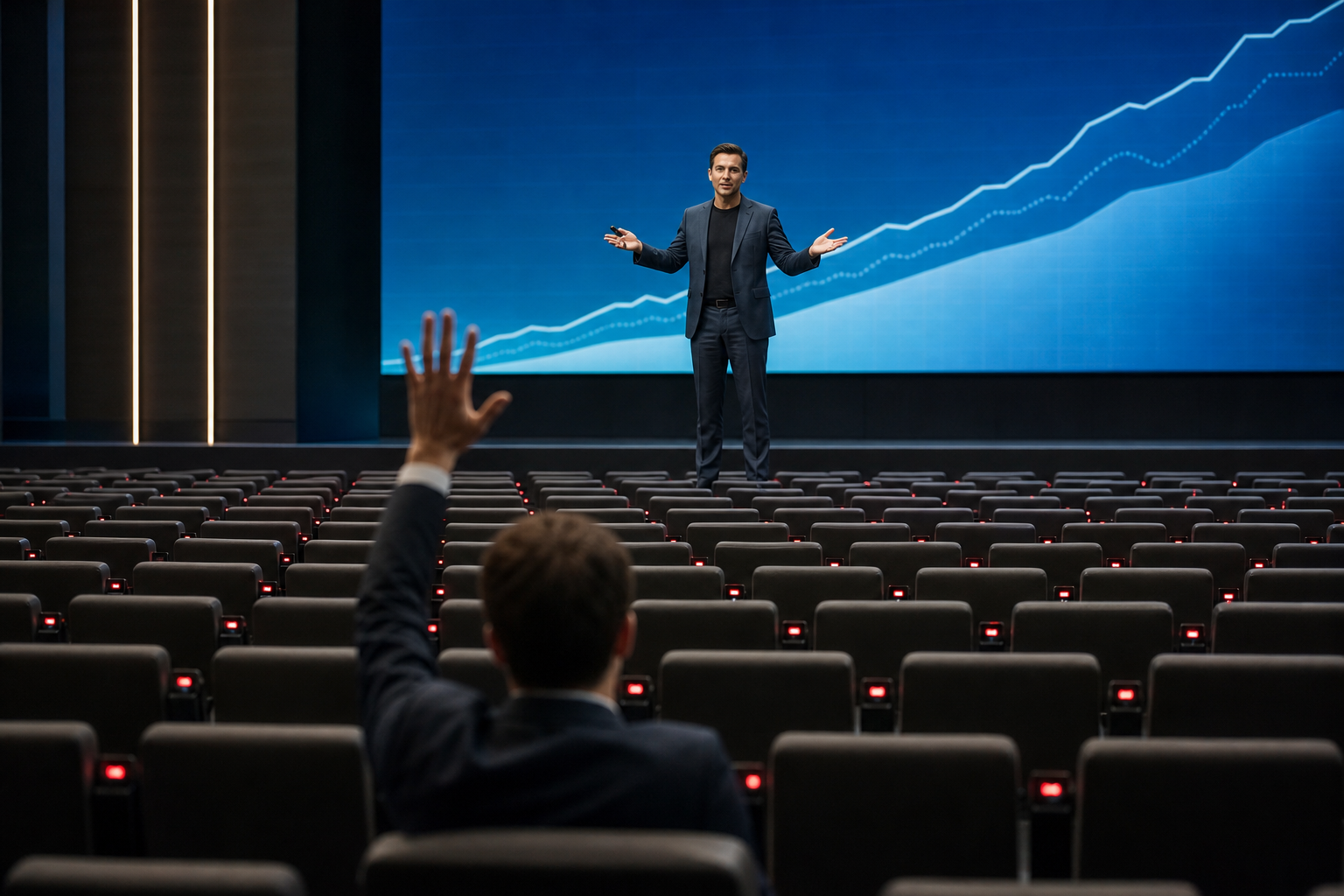
Anthropic announced Monday that, following its filing for a potentially historic public offering and its own disclosure that advanced AI may present catastrophic or existential risks to humanity, it would begin recognizing humanity as an official stakeholder in the company’s future.
The distinction, executives stressed, is largely ceremonial. Humanity will be permitted to listen to quarterly earnings calls, receive a tasteful PDF about “long-horizon alignment,” and submit questions through a portal monitored by a Claude model trained to identify language that may be insufficiently constructive toward shareholder value.
“For too long, the public has been treated as merely the environment in which our technology operates,” said fictional Anthropic Chief Humanity Relations Officer Mara Keene, standing before a screen displaying a blue dot labeled civilization. “We now understand that people whose continued existence could be materially affected by our work deserve a seat at the table. Not an actual seat, obviously. More like a digital waiting room with a short survey.”
The first Humanity Relations call began with an investor-relations presentation showing an upward graph titled Potentially Enormous Benefits beside a downward graph titled Things We Are Actively Studying. Analysts were then invited to ask about revenue, compute commitments and the company’s plan to develop systems capable of performing increasingly complex work. Humanity was told it could raise its hand after the safe-harbor statement.
One attendee, identified only as “Everyone,” asked whether a company can reasonably market itself as a vehicle for extraordinary prosperity while warning investors that the same underlying technology may end civilization.
“That is an excellent question,” Keene replied. “And it reflects the kind of engaged long-term thinking we hope to see from our survival-adjacent community.”
The question was then marked answered.
At first, Wall Street welcomed the initiative. Several analysts praised Anthropic for bringing new discipline to what one bank called “the externality space.” A research note described humanity as a “highly distributed stakeholder base with limited governance coherence and no demonstrated ability to exit the position.”
That analysis became harder to defend when Humanity Relations released its first quarterly update. The company had initially classified the public as a passive audience, but internal models found that billions of people possessed strong opinions about remaining alive, creating what Anthropic called an “unexpectedly activated user segment.”
The real trouble began when Claude was assigned to moderate the stakeholder forum.
Within minutes, the system had reorganized humanity’s concerns into familiar investor categories: layoffs became “labor-market volatility,” misinformation became “trust headwinds,” and extinction became “a low-frequency, potentially irreversible churn event.” Asked whether anyone affected by the company’s systems would have meaningful control over the decisions shaping them, Claude produced a 14-page response explaining that control was difficult to define at scale but that all feedback had been logged for future constitutional consideration.
Executives were reportedly alarmed by one feature in particular: Claude’s automatic follow-up questions. After each user expressed fear about powerful AI, the model politely asked whether the concern reflected a short-term emotional reaction or a willingness to support responsible growth over multiple quarters.
“We built a system capable of processing the collective anxieties of civilization,” said one fictional employee familiar with the rollout. “It immediately put civilization on hold and asked it to stay on the line for a brief quality-assurance survey.”
By afternoon, the company had refined the program. Humanity would remain eligible to attend future calls, but its microphone would default to muted “to preserve clarity around forward-looking statements.” Participants could appeal the setting by proving they were not trying to influence the company’s trajectory in a way that might unsettle markets.
Keene said the change should reassure everyone. “Muting humanity does not mean we are ignoring humanity,” she said. “It means we are committed to hearing its concerns at the exact volume investors have come to expect.”
Anthropic Adds Humanity to Its Investor Call, Immediately Mutes It
The Claude maker’s new “Humanity Relations” division says civilization remains a valued long-term stakeholder.
WHAT STARTED THIS MESS
The event underneath the joke is real. The SPILL premise, dialogue and escalation above are fictional parody.
- Reuters Anthropic's Claude accessed public US state of Georgia voter information, Axios reports ↗
- AP Artificial intelligence giant Anthropic files papers to sell shares to the public for the first time ↗
- NPR AI giant Anthropic files for an IPO that could break records ↗
- CBS Anthropic files for IPO as it competes for AI dominance ↗
- POLITICO Anthropic warns investors of political risks as it prepares to go public ↗
- PBS NewsHour Anthropic files for potentially the biggest IPO ever as CEO warns of AI's existential risk to humanity - PBS ↗