Trump White House Makes Congressional Testimony Pass Brand Safety Review
Agency witnesses may still answer Congress, provided their answers contain no unauthorized plot developments.
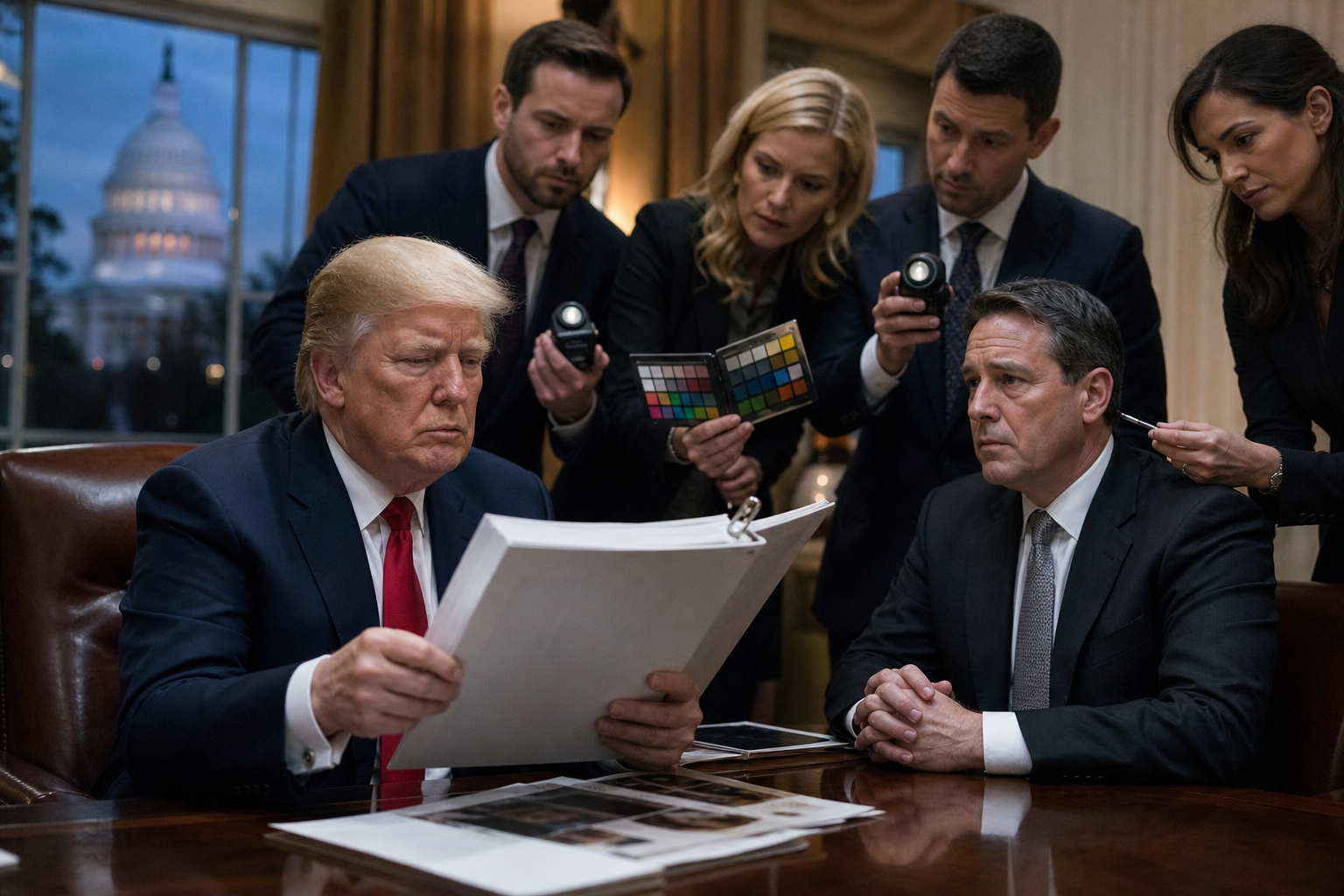
WASHINGTON — PARODY. The White House has unveiled a new federal “Narrative Integrity Assessment” requiring executive-branch employees to receive brand-safety clearance before appearing before Congress, where they could otherwise expose the administration to dangerous, unmoderated facts.
Under the fictional program, agency officials summoned to explain what their departments are doing must first submit proposed answers to a panel of lawyers, communications aides and one person whose only listed job title is “Keeps Us From Looking Weird.” The panel then determines whether the testimony contains spoilers, contradicts the season arc, or introduces a federal program the White House had hoped would remain a limited-series rumor.
“No one is stopping anybody from participating in democracy,” said an imaginary senior official, standing beside a mood board labeled ACCOUNTABILITY, BUT MAKE IT HOSTILE. “We are simply making sure every witness enters the hearing room with a coherent understanding of the administration’s values, priorities, and preferred camera angles.”
The process begins with a simple online questionnaire. Witnesses must identify the committee requesting their appearance, select whether its members are “curious,” “performatively curious,” or “engaged in a politically motivated act of noticing,” and disclose any documents they may be carrying that could create an unplanned third act.
One fictional Agriculture Department official said her hearing preparation was delayed after she admitted that a chart about food prices was “not flattering, but technically accurate.” The system immediately flagged the chart for “adversarial numeracy” and asked whether it could be replaced with a more collaborative number.
“They gave me three approved phrases,” she said. “The first was ‘We reject the premise of the grocery store.’ The second was ‘Americans have never had more choices about which eggs to afford.’ The third was just a link to schedule a follow-up meeting after the hearing had ended.”
At first, the policy appeared to be an ordinary Washington exercise in message discipline: a little clearance, a little delay, a little careful coordination between institutions that are theoretically coequal but have spent two centuries pretending not to read each other’s emails. Then the new review office discovered its real challenge. Congress has started asking questions about matters so concrete that even the approved talking points cannot float above them.
A military official preparing to discuss a procurement failure reportedly received a redline instructing him to avoid the phrase “the equipment did not work.” The reviewer suggested “the equipment participated in a brave and ongoing dialogue with operational expectations.”
At the Environmental Protection Agency, a witness was advised not to say a rule had been withdrawn, because “withdrawn” implied retreat. The preferred formulation was that the rule had “completed its service to the American people and returned to the private sector.”
That was when the White House introduced its most ambitious innovation: the Testimony Confidence Meter. Before a witness may accept a congressional invitation, staffers now rate each likely answer on a scale from one to five stars. Five stars means “strongly reflects the president’s leadership.” Four stars means “can be made to reflect the president’s leadership with selective use of chronology.” Three stars means “please wait while legal writes a sentence containing the word ‘process.’” Anything below that is categorized as classified, regardless of whether it is classified.
The meter has created unexpected bottlenecks. A Health and Human Services employee seeking clearance to testify about a routine grant program was told her statement lacked presidential relevance. She added that the grant program had been funded by Congress. Her application was then moved to a special review queue marked “Needs More Executive Branch.”
By Friday, fictional agency general counsels had begun holding rehearsal hearings in which witnesses practiced remaining calm while being asked why a program exists. The new guidance recommends a breathing technique called “the statutory exhale,” in which officials inhale through the nose, consult the White House, and release a sentence that begins, “I’d be happy to work with the committee on that.”
But the system’s most serious problem emerged after congressional staffers requested testimony from the brand-safety reviewers themselves. The reviewers immediately submitted the request for clearance, only to find that it required approval from the brand-safety reviewers.
By late afternoon, the administration had achieved perfect message discipline: everyone agreed the hearing would be handled internally, and nobody could identify who, exactly, was now allowed to say that out loud.
Trump White House Makes Congressional Testimony Pass Brand Safety Review
Agency witnesses may still answer Congress, provided their answers contain no unauthorized plot developments.
WHAT STARTED THIS MESS
The event underneath the joke is real. The SPILL premise, dialogue and escalation above are fictional parody.
- CNN New images emerge of suspected Chinese intelligence asset linked to Nvidia's ex-boss ↗
- CBS Ex-Nvidia CEO Jensen Huang agrees to testify as Congress raises concerns about affair with suspected Chinese spy ↗
- NBC Jensen Huang agrees to appear for House interview on Nvidia in December ↗
- AP Ousted Nvidia CEO Huang to questioning by US lawmakers ↗
- POLITICO Nvidia’s top lawyer agrees to testify before Congress ↗
- PBS NewsHour Read the full White House memo requiring agencies to get approval before testifying in front of Congress - PBS ↗
- Reuters Nvidia's Huang signals willingness to return as CEO; board creates national security panel ↗
- MS NOW Huang agrees to appear before House committees on Dec. 1 ↗
- NPR Huang says he'd be "honored" to return to Nvidia as he agrees to testify to Congress ↗