Bill Cassidy Places Trump’s FDA Nominee Under 24-Hour Senate Observation
The physician-chairman says the candidate is responsive, ambulatory and still awaiting a clean scientific panel.
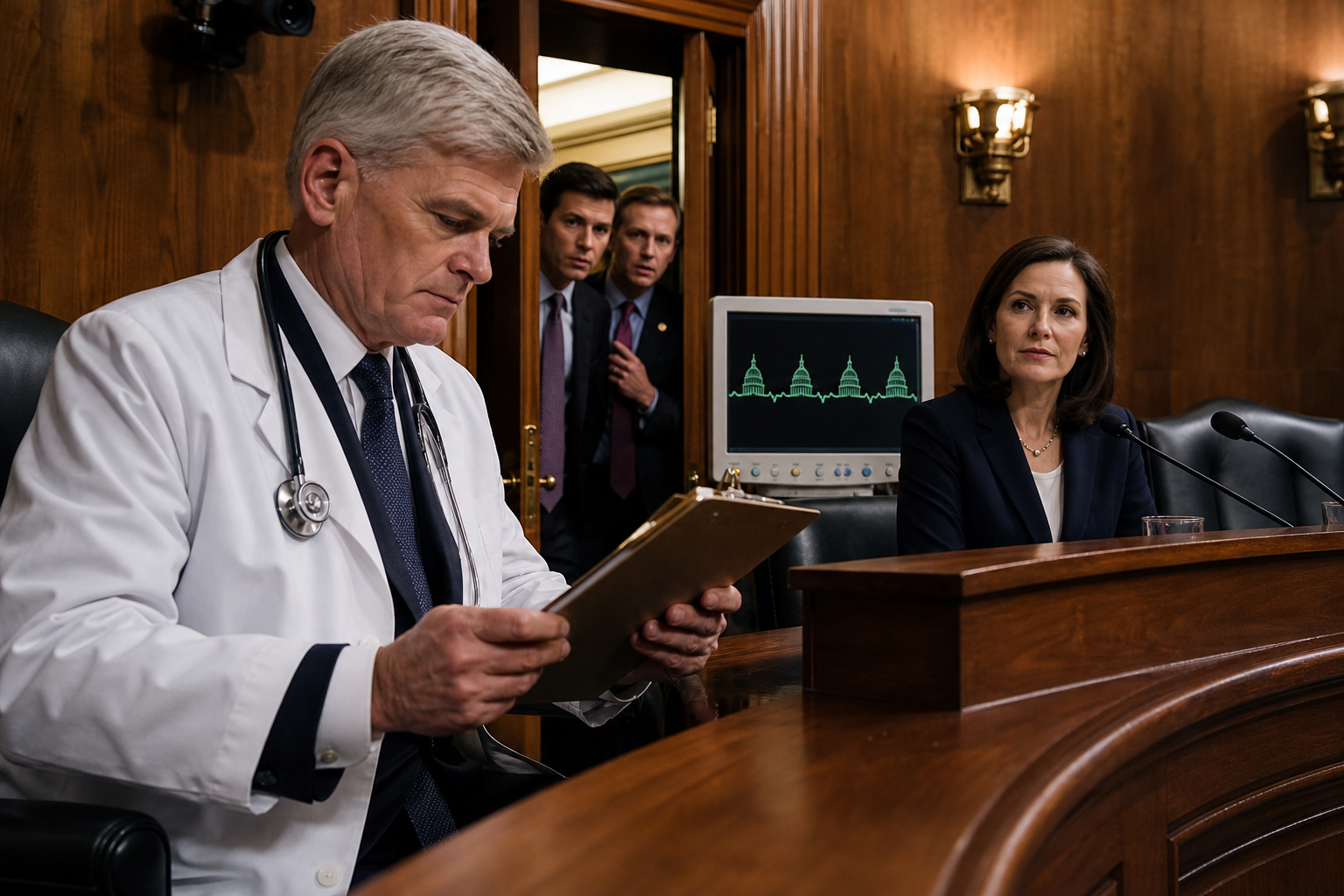
WASHINGTON — Senate Health Committee Chair Bill Cassidy has placed President Trump’s nominee to lead the Food and Drug Administration under a mandatory 24-hour period of Senate observation, after admitting he could not yet determine whether she would survive exposure to his committee.
“She is awake, alert, and able to repeat the phrase ‘evidence-based review’ when prompted,” said Cassidy, wearing a white coat over his Senate suit and checking the nominee’s chart for signs of independent thought. “But we have not yet established whether that phrase reaches the bloodstream.”
The fictional observation order follows Cassidy’s real-life disclosure that he still has questions about Dr. Heidi Overton ahead of a committee vote. Under the new protocol, Overton will remain in a softly lit consultation alcove off the HELP Committee hearing room, where staff will monitor her reaction to sudden mentions of clinical trials, advisory panels, and the possibility that a federal agency may occasionally need to disappoint the person who appointed it.
Republican senators initially assumed the procedure was ceremonial. That changed when Cassidy produced a reflex hammer and tapped a framed photograph of the White House. The nominee reportedly did not flinch, which aides described as either “very reassuring” or “the exact problem.”
“The chair is looking for consistency,” explained a committee staffer, speaking beside a rolling cart labeled DO NOT ADMINISTER UNTIL CONFIRMED. “If she says vaccines are safe in the morning, the question is whether she retains that position after receiving a noon phone call from a person who has watched three internet videos in a row.”
The White House objected to the observation period, arguing that the FDA vacancy has already been exposed to enough uncertainty and should be filled before Democrats take office in January. But Cassidy insisted that urgency is no substitute for diagnostics.
“A patient can be in a hurry to leave,” he said. “That does not mean you let them drive home while still confusing political pressure with peer review.”
By midafternoon, the monitoring system had produced mixed results. Overton demonstrated strong verbal function by answering a question about FDA independence with a complete sentence containing the word “independence.” But the phrase triggered an alarm installed by the White House liaison office, which has been tasked with ensuring no nominee accidentally develops a career-long commitment in public.
Committee Republicans then conducted the standard cognition test: Cassidy named five ordinary FDA responsibilities and asked the nominee to repeat them back without turning any into a culture-war podcast episode. She completed four. The fifth, “maintain public confidence,” remained under review after several senators debated whether confidence is technically a measurable outcome or merely something voters are expected to locate on their own.
Then came the complication no one had anticipated. The committee discovered the nominee’s political condition was not the only one requiring observation. Cassidy himself began showing signs of acute institutional memory, including an awareness that he is both a physician and the chairman responsible for advancing the nomination.
Staff immediately lowered the lights and offered him a bipartisan glass of water.
“Senator Cassidy is experiencing a rare episode of consequence recognition,” said one aide. “It can happen when a lawmaker who has spent months saying he has concerns is suddenly asked to identify what concerns are for.”
The diagnosis threw the room into chaos. Several senators began asking whether concern should be treated as a symptom, a position, or an ornamental Senate furnishing. One suggested postponing the answer until after the vote, at which point Cassidy ordered him placed in the adjoining observation alcove.
By evening, the nominee was reported to be stable. Cassidy was less certain. He had begun pacing outside the hearing room, telling reporters that he wanted a nominee who could respect science, withstand political pressure, and somehow emerge from a Trump confirmation process without ever making either requirement sound personal.
At press time, the observation period had been extended after the committee’s vital-sign monitor detected the faint but unmistakable sound of every senator asking whether somebody else could make the decision first.
Bill Cassidy Places Trump’s FDA Nominee Under 24-Hour Senate Observation
The physician-chairman says the candidate is responsive, ambulatory and still awaiting a clean scientific panel.
WHAT STARTED THIS MESS
The event underneath the joke is real. The SPILL premise, dialogue and escalation above are fictional parody.