Congress Finds Its Most Stable National Institution Beneath the SS United States
Lawmakers are studying the ship’s controlled descent, upright landing and total lack of elected officials on board.
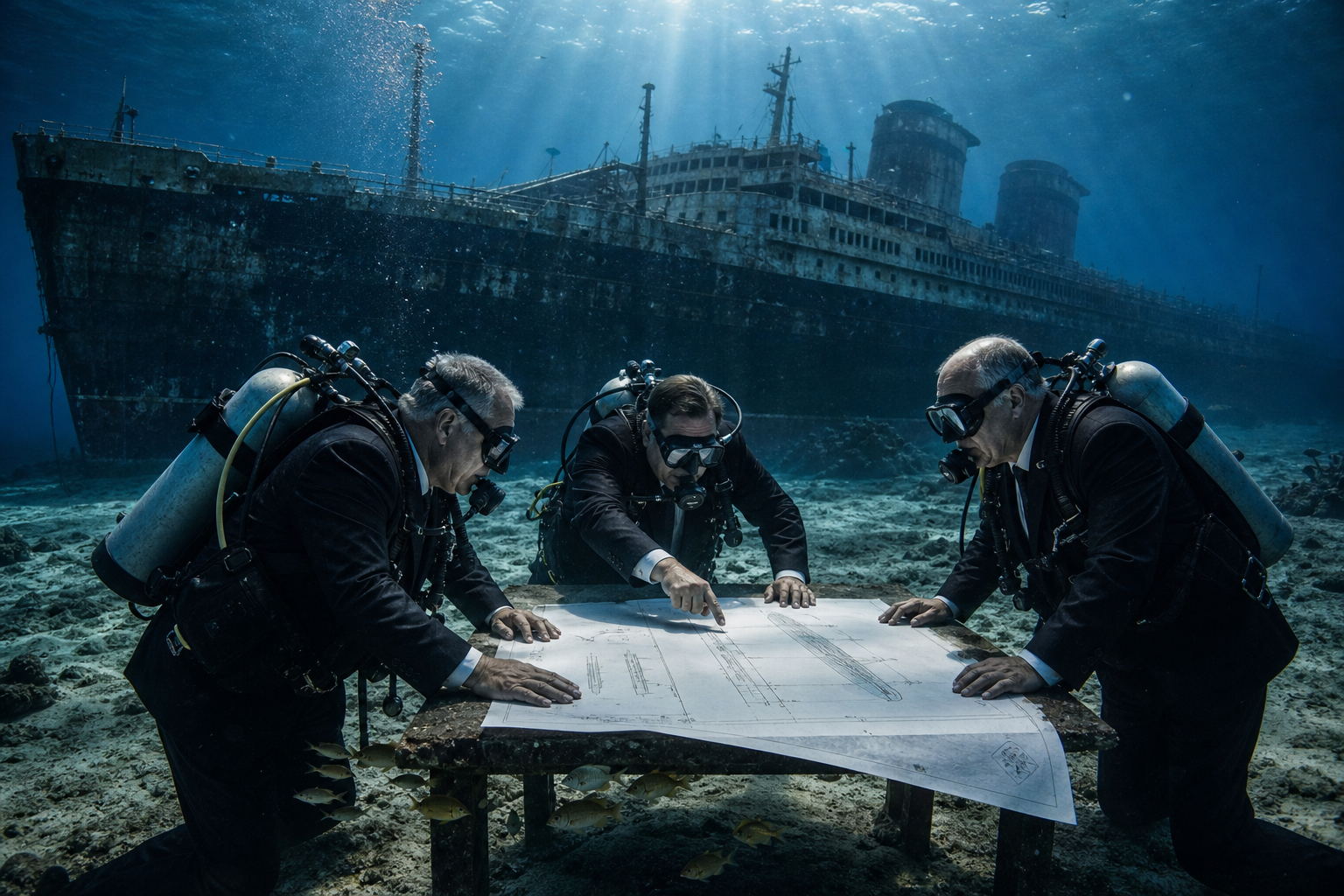
WASHINGTON—Congress on Sunday hailed the newly submerged SS United States as “a breathtaking demonstration of national stability,” after the historic ocean liner completed a controlled sinking in the Gulf of Mexico, landed upright, and immediately achieved a level of institutional coherence not seen in Washington since somebody accidentally adjourned on time.
The ship, now resting beneath the surface as the world’s largest artificial reef, has become an urgent object of bipartisan study. Within hours of first divers exploring its decks, House and Senate leaders announced a joint fact-finding mission to determine how a 990-foot vessel deliberately sent to the ocean floor managed to arrive with more dignity, structural integrity and forward planning than most federal agencies after lunch.
“The SS United States knew it was going down, prepared for it, removed its hazards, chose a landing site, and settled upright,” said a fictional congressional aide standing beside a foam-core diagram of the wreck. “We are not saying that should be the benchmark for the United States government. We are saying it is currently the benchmark.”
The first phase of the congressional review will focus on what maritime engineers call a controlled deployment and what lawmakers have begun calling “the dream.” Members will attend a closed-door briefing on ballast, buoyancy and the revolutionary concept of deciding what a structure is for before it begins taking on water.
Several committee chairs reportedly became emotional upon learning that the vessel’s final voyage had involved a plan with an actual destination. One senator asked whether the ship’s “upright posture” had required a bipartisan amendment. Another requested that the Navy confirm whether it could be replicated in a continuing resolution without “getting all nautical about it.”
But the project took an unexpected turn when staffers learned that divers visiting the SS United States must receive proper training, respect depth limits and avoid entering parts of the ship they are not qualified to navigate.
“That is where we may have lost the caucus,” said the aide.
By Monday morning, a coalition of lawmakers had introduced the Responsible Entry Into Complex Systems Act, requiring all federal legislation to carry a warning label stating which provisions its authors should not enter without a guide, a flashlight and a written acknowledgment that the floor may not be where they remember leaving it.
The bill quickly stalled after members objected to a proposed certification requirement. “Congress cannot permit an elite class of people who understand the conditions before making decisions,” one fictional floor statement read. “That would destroy the entire democratic tradition of discovering the pressure only after the hatch opens.”
The SS United States, meanwhile, has already developed the beginnings of a marine ecosystem around its hull, a development lawmakers described as “encouraging but politically concerning.” A Senate working group warned that if fish, coral and other sea life begin forming a functioning community around an abandoned piece of national infrastructure, voters may start asking why the same arrangement remains unavailable on land.
To prevent harmful comparisons, congressional leaders are considering a rebrand. Under the proposal, the wreck would no longer be called an artificial reef, but a “subsurface public-private resilience campus,” allowing Washington to praise its success without admitting that the ship was intentionally sunk because nobody could figure out what else to do with it.
The plan briefly united both parties until a dispute arose over whether the ship’s reef status constituted government-funded housing, environmental regulation, tourism, military history, or an unacceptable example of something becoming useful after its official purpose ended.
At press time, the House had scheduled six hearings into how the SS United States pulled off the one maneuver Congress has spent decades trying to perfect: hitting bottom without immediately blaming the ocean.
Congress Finds Its Most Stable National Institution Beneath the SS United States
Lawmakers are studying the ship’s controlled descent, upright landing and total lack of elected officials on board.
WHAT STARTED THIS MESS
The event underneath the joke is real. The SPILL premise, dialogue and escalation above are fictional parody.