Trump’s Spy Chiefs Ask Republicans to Pre-Approve Their Future Outrage
The new surveillance push comes with a simple condition: any objection filed after January must include a receipt proving you did not vote for it in November.
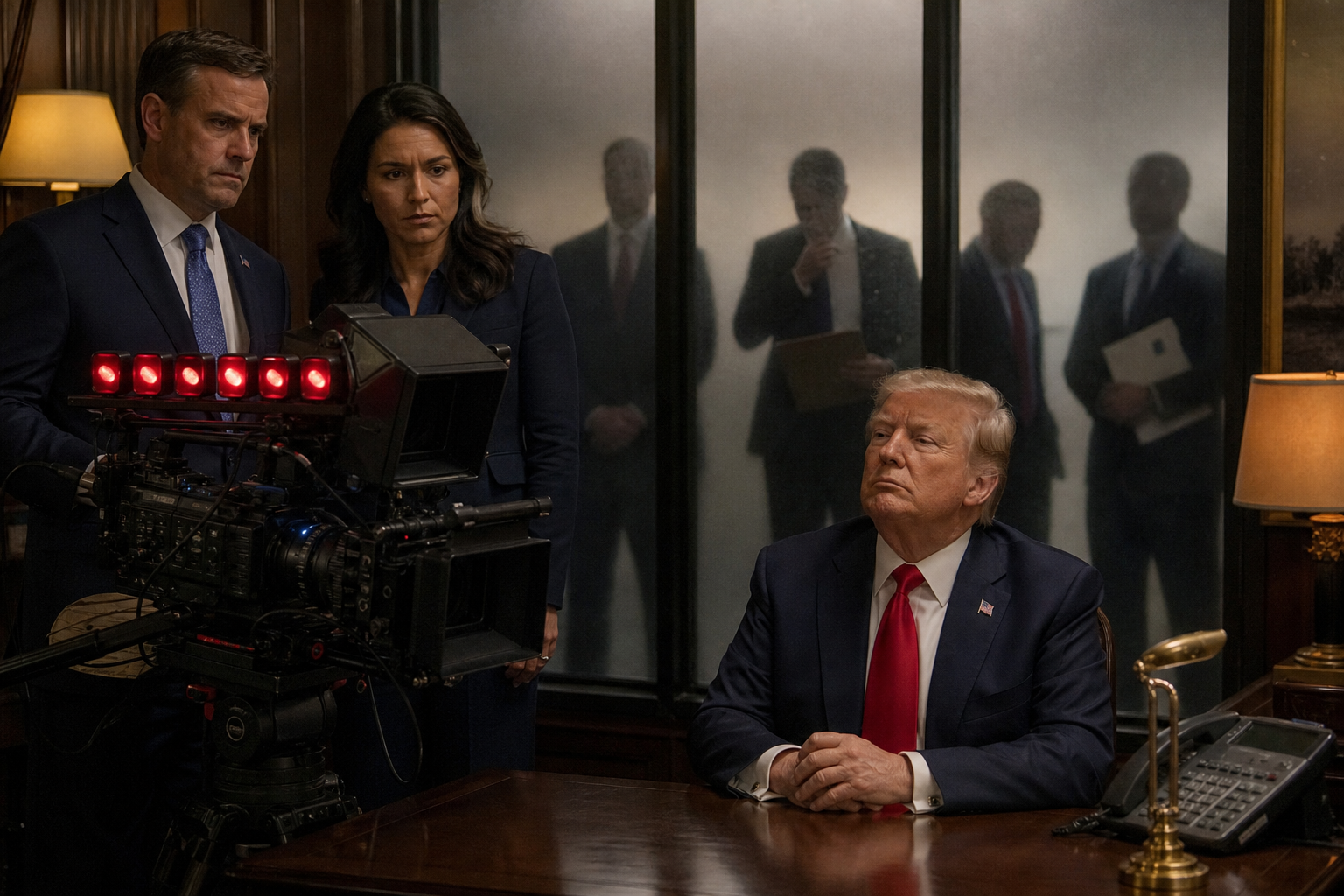
WASHINGTON— Faced with a shrinking window to renew a powerful intelligence surveillance authority before the next Congress arrives with fresh subpoena power and several unreturned calls from civil-liberties groups, Trump administration spy chiefs on Friday unveiled the Advance Apology Program, a streamlined process allowing Republican lawmakers to register any future alarm about government overreach before voting to expand it.
Under the fictional program, members would enter a soundproof Capitol recording suite, face a small camera and deliver a brief statement beginning, “I am deeply troubled by reports that the authority I described as indispensable has been used in ways no one could have anticipated, except everyone who anticipated them.” The recording would then be sealed in a climate-controlled archive until the first oversight hearing capable of generating cable-news clips.
“This is about readiness,” said one fictional intelligence official, standing beside a velvet rope and a bowl of government-issue mints. “America’s enemies do not wait for Congress to become comfortable with a complicated statute. And frankly, neither do we.”
The program emerged after intelligence leaders warned Republican congressional leaders that reauthorizing the surveillance powers was a huge priority before the power shift in Washington turns every classified briefing into an occasion for someone to ask what, exactly, has been happening in the classified briefings.
Supporters of the effort said the country could not afford another drawn-out debate over whether intelligence agencies should retain broad authority to collect foreign communications that may incidentally sweep up Americans’ information. Opponents said that sentence contained nearly all of the debate.
To prevent delays, the Advance Apology Program lets lawmakers choose from three pre-approved future reactions: Gravely Concerned, Demanding Answers and Had No Idea This Was Happening Despite Several Closed-Door Briefings Specifically About This Happening. Members seeking the premium package may also film themselves removing their glasses, staring at a folder and saying, “If true, this raises serious questions,” while an aide gently places the folder back in the drawer marked “Briefed In 2026.”
The first test run reportedly hit a snag when several members asked whether the recordings could be edited later to make it appear they had objected before the vote. Agency staff assured them that was the entire point of recording them now.
A Better Way to Remember What Nobody Meant
The initiative initially looked like a minor administrative convenience. Then the intelligence community’s lawyers introduced its second phase: the Historical Intent Preservation Addendum. Before casting a vote, lawmakers would identify which future interpretation of their current position they planned to adopt.
One option reads: “I supported this authority solely to protect the nation.” Another reads: “My vote was narrowly tailored to prevent a shutdown.” A third, available only to members who had spoken on television within 48 hours, reads: “The clip circulating online lacks the larger context of me saying the same thing much louder five minutes earlier.”
That is where the process became unexpectedly popular. Staffers who had spent years translating votes into post-vote messaging praised the addendum as a major breakthrough in congressional efficiency. Rather than waiting for an abuse, leak, inspector general report or constituent town hall to determine what a member believed, everyone could establish it in advance and move directly to selective amnesia.
“It’s like estate planning, except the estate is your credibility,” said a fictional Republican communications consultant. “Nobody likes thinking about it, but if you don’t make arrangements now, your survivors are left sorting through a terrible mess of floor remarks.”
The program’s rollout also produced a new problem: lawmakers began competing to sound more shocked in recordings meant for future use. One member reportedly requested a fog machine. Another asked whether a retired federal judge could enter halfway through the video carrying an envelope. A third wanted the camera to capture him discovering the program’s existence in real time, despite having helped name it.
Intelligence officials briefly considered banning theatrical flourishes. But they decided the restrictions might discourage participation, and participation remains essential to the program’s central national-security objective: ensuring that when oversight finally arrives, every elected official can demonstrate they had been emotionally prepared to oppose the thing they were urgently asked to pass.
By evening, the recording suite had developed a backlog. A handwritten sign outside read, “PLEASE LIMIT FUTURE CONSTITUTIONAL CRISES TO TWO MINUTES.”
Inside, the final lawmaker of the day adjusted his tie, stared into the lens and began his statement with the only sentence Washington has ever managed to make retroactive: “At the time, based on the information available to me, I was already disappointed in myself.”
Trump’s Spy Chiefs Ask Republicans to Pre-Approve Their Future Outrage
The new surveillance push comes with a simple condition: any objection filed after January must include a receipt proving you did not vote for it in November.
WHAT STARTED THIS MESS
The event underneath the joke is real. The SPILL premise, dialogue and escalation above are fictional parody.
- CBS Feds withhold $113M in Medicaid funds to Minnesota, but officials unsure where the figure came from ↗
- POLITICO Trump administration makes another push at MAHA priority ↗
- FOX Trump's spy chiefs put Republican leaders on the clock over 'huge priority' as power shift looms over Congress ↗
- NPR The Trump administration’s voter roll crusade could continue ↗