Kalshi Turns Don Jr.’s Exit Into a Market It Cannot Resolve
The prediction-market rivalry has finally found an outcome lucrative enough to remain permanently unclear.
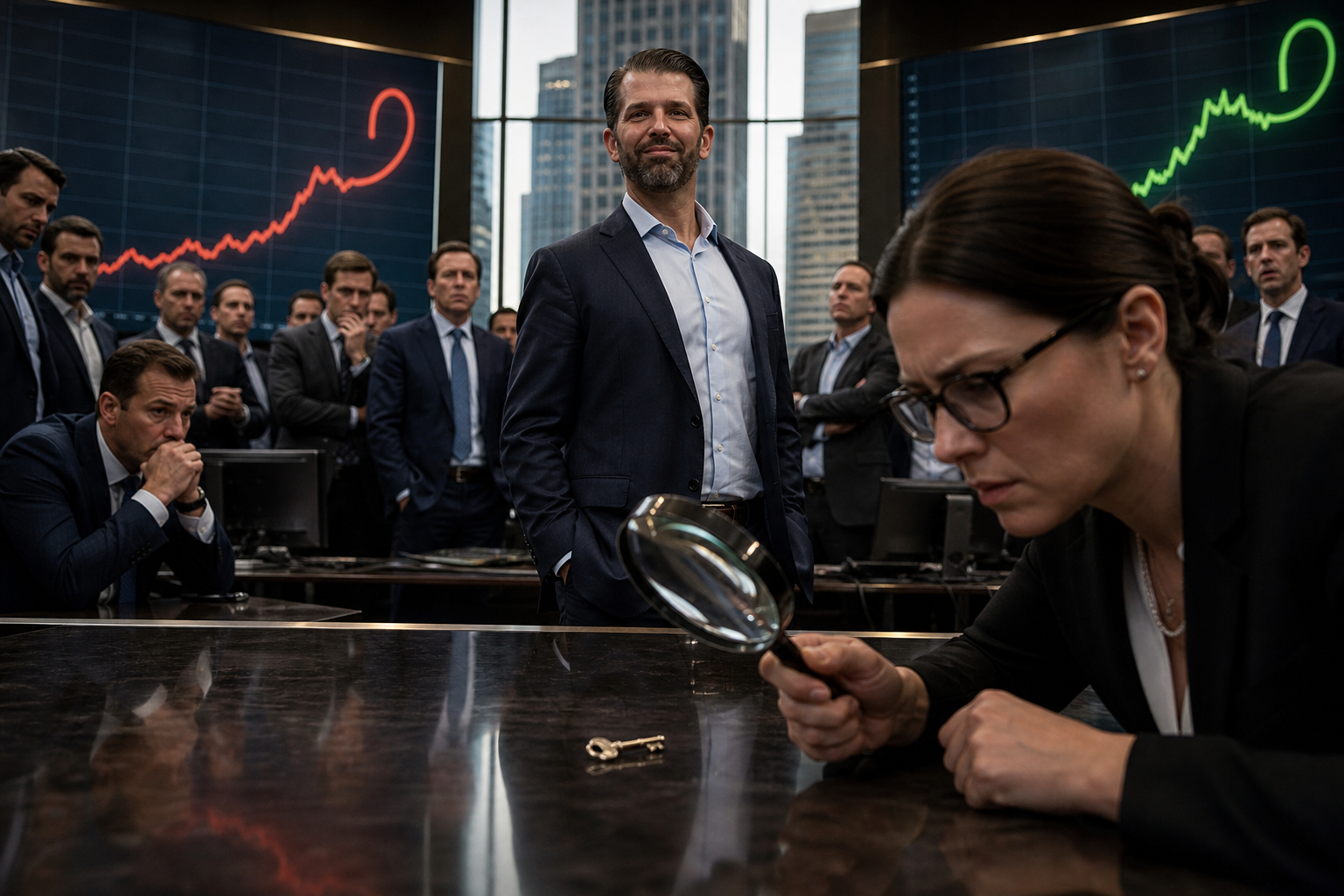
This is parody inspired by a real event.
Within minutes of Donald Trump Jr.’s departure from Kalshi, the prediction-market company unveiled its most emotionally honest product to date: a live contract asking whether he had actually left.
Traders could purchase YES shares if Trump Jr.’s relationship with Kalshi was “fully concluded in every strategic, financial, atmospheric and future-adjacent sense,” or NO shares if he remained “available to reappear wherever an advisory board required a recognizable surname and a tasteful amount of ambiguity.”
The market opened at 61 cents for NO, climbed to 78 cents after someone noticed the phrase “mutually agreed,” and briefly halted when an algorithm flagged the event as both a personnel matter and “a continuing source of volume.”
Kalshi executives said the contract was intended to reassure customers that the company took conflicts of interest seriously enough to monetize their aftershocks. A company spokesman, speaking beside a giant screen showing a line graph attempting to escape the building, said the platform was committed to transparency.
“Markets are at their best when they convert uncertainty into price discovery,” he said. “And if the uncertainty happens to concern whether one of the most politically connected advisers in the industry can be cleanly separated from a rival company in the same industry, that is exactly the kind of civic information our users deserve to trade before lunch.”
The initial resolution criteria ran 43 pages. A departure would count as final only if Trump Jr. did not advise Kalshi, invest in Kalshi, advise someone who advises Kalshi, attend a dinner where Kalshi came up organically, or stand within 500 feet of a podcast microphone while a host used the phrase “prediction markets.”
Then Polymarket’s lawyers objected—not to the contract itself, but to Kalshi’s suggestion that a corporate relationship could ever be considered over merely because the paperwork said so.
That objection created the first major pricing crisis. If Polymarket publicly insisted Trump Jr. had decisively moved on, YES shares surged, making Kalshi’s clean break look credible. If Polymarket suggested he remained spiritually entangled with Kalshi, NO shares rose, making its rival look compromised. For several tense hours, both companies were forced to choose between their preferred narrative and a chance to make money from the opposite one.
“This is the maturest competition has ever been,” said a fictional analyst at the newly formed Center for Financialized Vibes. “Two companies are attempting to destroy each other’s credibility while carefully preserving the ambiguity that keeps the asset liquid.”
The situation worsened when Kalshi’s compliance team discovered that several senior employees had purchased NO shares. They were immediately asked whether they had confidential knowledge about the former adviser’s future intentions. The employees replied that they did not, but believed deeply in the universal permanence of elite political-networking arrangements.
That answer was judged insufficiently legal but extremely market-informed.
By late afternoon, the company had appointed an independent resolution committee composed of a retired commodities lawyer, a former reality-television producer and a man whose title was simply “Strategic Narrative.” The committee’s job was to determine whether Trump Jr. had severed ties with Kalshi without relying on press reports, public statements, investment disclosures, social media posts, event photographs, private conversations, or any facts likely to move the price.
Its first ruling was that the contract could not settle until the market reached clarity. The market, meanwhile, could not reach clarity until the contract settled.
Users hailed the decision as a breakthrough in modern finance. One trader said he had bought NO shares because “nothing involving political access, competing platforms and advisory titles has ever ended in a way that didn’t require a panel discussion three months later.” Another said he bought YES shares out of principle, then hedged by subscribing to every newsletter associated with both companies.
Kalshi has since introduced a companion market asking whether the original market will ever resolve. That contract is currently trading at 99 cents for NO, making it the first prediction market in history to price institutional denial as a blue-chip asset.
Kalshi Turns Don Jr.’s Exit Into a Market It Cannot Resolve
The prediction-market rivalry has finally found an outcome lucrative enough to remain permanently unclear.
WHAT STARTED THIS MESS
The event underneath the joke is real. The SPILL premise, dialogue and escalation above are fictional parody.