Canada Makes Stellantis Complete an Exit Interview Before Leaving Brampton
Ottawa is prepared to recover public money, but first it needs to know whether the automaker felt sufficiently supported.
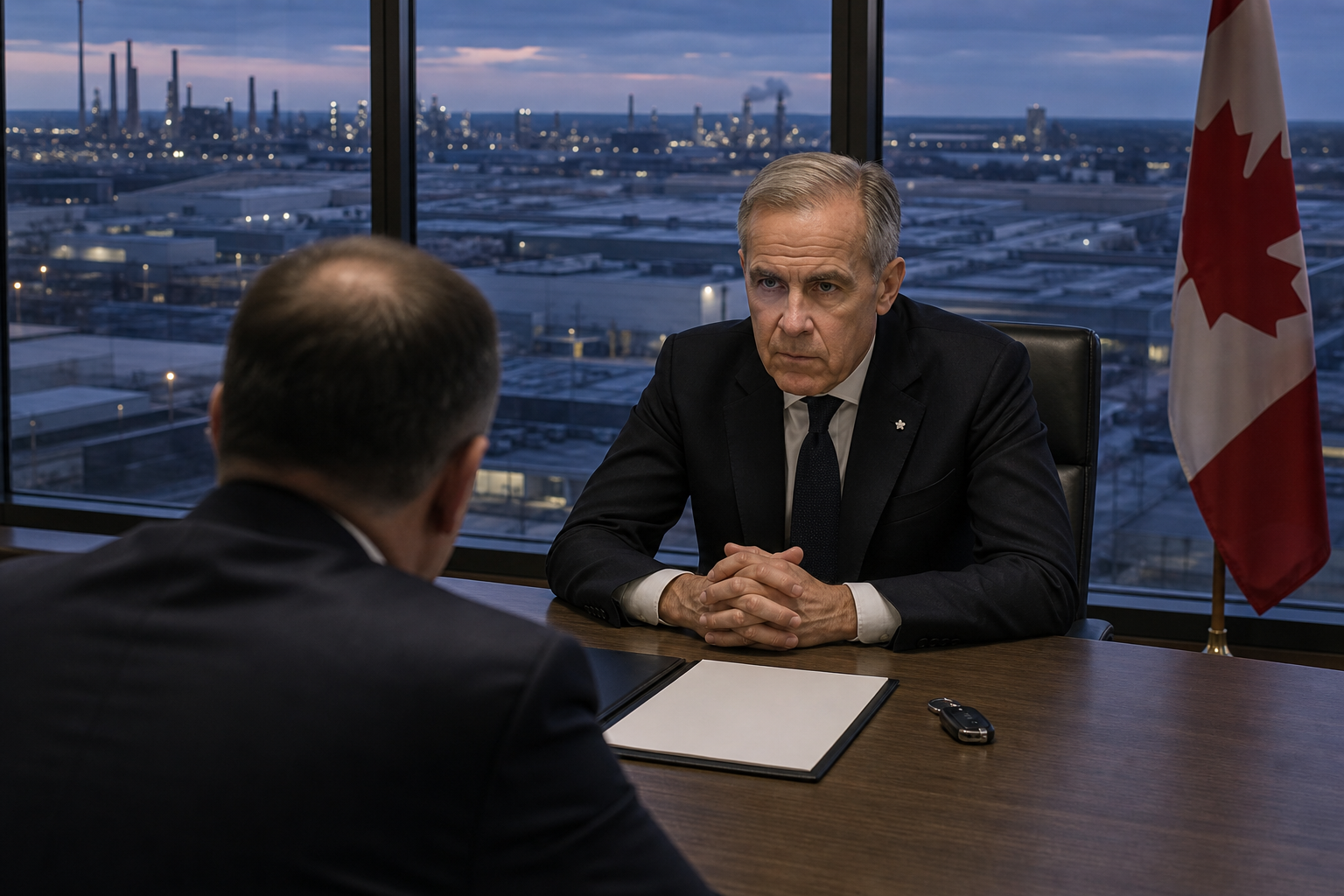
FICTIONAL PARODY INSPIRED BY A REAL EVENT.
Canada has informed Stellantis that before it may sell its idled Brampton, Ontario, assembly plant and shift planned Jeep Compass production to Illinois, it must complete a mandatory exit interview with the entire country.
The interview, scheduled for a windowless conference room somewhere between Ottawa and a Tim Hortons that has seen things, will be conducted by federal officials, Ontario representatives, union leaders and one Canadian who has been appointed to stare silently at the company whenever it says the phrase “market conditions.”
“We are not trying to make this awkward,” said a fictional Canadian industry official, sliding a folder across the table labeled WHY ARE YOU REALLY LEAVING? “We simply need Stellantis to explain why, after receiving public support to retool Canadian facilities, it has decided that its long-term growth requires moving south with a country that has spent the last year threatening its neighbors with tariffs.”
The first portion of the interview will cover culture. Stellantis executives will be asked whether they felt welcomed in Canada, whether anyone made them feel they could not be their authentic multinational self, and why their LinkedIn post announcing the plant sale referred to Brampton workers as “the people who helped make this chapter possible” instead of “the people whose lives we just turned into a press release.”
Executives are expected to respond that the decision was not about Canada, a phrase Canada has already identified as being entirely about Canada.
“We understand businesses have to make difficult choices,” the official said. “But there is a difference between pursuing opportunity and accepting a lavish invitation from an administration that has placed the continent inside a blender, pressed purée, and called it industrial strategy.”
Under the fictional protocol, Stellantis will be required to identify three things Canada could have done differently. The company may not answer “provide a larger market with fewer tariff threats,” because that is not actionable feedback and because it sounds suspiciously like the United States has been reading from the company’s private diary.
At that point, the interview takes an unexpected turn. Canada’s panel will reveal that it has collected similar exit-interview responses from every major manufacturer that has accepted public incentives, praised a skilled local workforce, and then developed a sudden spiritual need to be closer to whatever jurisdiction is currently offering the biggest tax holiday.
The answers, officials say, are nearly identical.
“We value our Canadian relationship.”
“This is not a reflection on the team.”
“The decision reflects a changing environment.”
“We hope to remain friends, suppliers, customers, subsidy recipients and occasional users of your infrastructure.”
After seeing the pattern, Ottawa will reportedly stop treating industrial policy as a courtship and begin treating it as a custody arrangement. Future government funding agreements will require companies to specify which assets they are taking in a breakup, who gets the machinery, and whether executives plan to introduce their new U.S. production plans to Canada gradually or in a holiday card.
There will also be a new clause requiring any company leaving Canada during a tariff dispute to sit through a final PowerPoint titled Before You Go, Here Is the Value We Brought to This Relationship. Slide one will list public investment. Slide two will list workers. Slide three will be a single enlarged screenshot of the company’s old commitment, with the phrase “for the long term” circled in red.
Stellantis, according to fictional people familiar with the meeting, initially asked whether it could simply send a resignation email. Canada declined.
“An email is for leaving a book club,” the official said. “If you accept money to build cars here, promise production here, idle the plant, move the vehicle to Illinois amid a trade war, and sell the building to somebody else, you do not get to write ‘per my last message.’”
The company will then be offered a final chance to reconsider. Not the production decision, which everyone understands has entered the sacred realm of shareholder arithmetic, but the wording of its goodbye.
Canada has prepared a draft statement: “After careful consideration, Stellantis has chosen to pursue a more stable relationship with a partner currently threatening everybody in the relationship.”
If the automaker rejects that language, the exit interview will continue until it produces an answer that does not begin with “We remain committed to North America,” which Canada now considers the corporate equivalent of saying it needs space while carrying boxes toward the truck.
Canada Makes Stellantis Complete an Exit Interview Before Leaving Brampton
Ottawa is prepared to recover public money, but first it needs to know whether the automaker felt sufficiently supported.
WHAT STARTED THIS MESS
The event underneath the joke is real. The SPILL premise, dialogue and escalation above are fictional parody.
- AP Sheinbaum rebuts Trump, says no migrant caravans have reached US border since January 2025 ↗
- Reuters Trump threatens to double tariffs on Mexico if it does not halt migrants ↗
- FOX Trump threatens to double tariffs on Mexico if migrant caravans not stopped ↗
- MS NOW 'It is NOT under control': Ex-Trump staffer WARNS Trump admin unprepared for SHOCK security scandal ↗
- POLITICO Lutnick’s longtime friendship with Trump may not save him ↗
- CNN Trump tells Vance to turn his focus away from Iran: ‘We don’t need a deal’ ↗
- CBS Rubio says U.S. has "no need" to restart combat operations in Iran ↗
- NBC Trump says the U.S. doesn’t ‘need’ a deal with Iran ↗
- NPR Trump's reliance on ousted Nvidia CEO in question ahead of China trip ↗