U.S. and Iran Quietly Negotiate a Relationship Neither Can Admit Having
With tankers still burning, both sides have agreed the talks are serious enough to deny with real feeling.
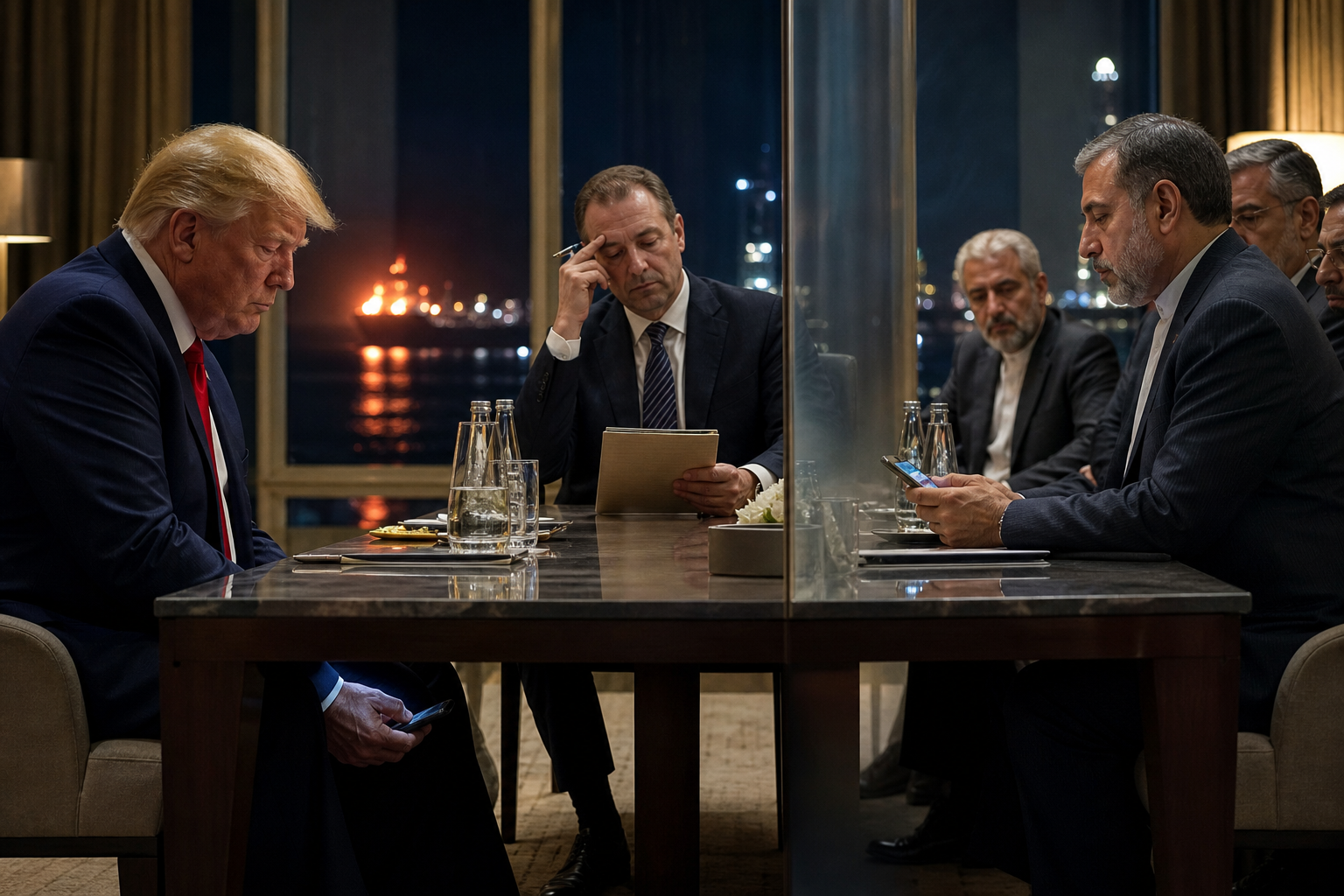
PARODY — inspired by current reporting.
With U.S. and Iranian officials quietly negotiating even as attacks and tensions continue across the Middle East, both governments have reportedly entered the most delicate phase of any high-stakes relationship: insisting they are not in one.
“There have been no talks,” said a fictional senior administration official, staring at a phone that had just displayed 14 missed calls labeled Iran — Do Not Answer Normally. “There have been occasional, highly structured exchanges of feelings, boundaries and regional shipping concerns through trusted intermediaries. That is categorically different.”
Iranian officials, likewise, have described the discussions as “not negotiations,” “not concessions” and “not the kind of thing America gets to call us about after publicly acting like it has moved on.”
The arrangement has required extraordinary discipline. According to fictional diplomatic sources, every quiet contact now begins with both sides spending 20 minutes establishing that they are only participating because the other side has become impossible to ignore.
“The United States needs to feel that it is being pursued by stability,” explained an imaginary regional mediator who requested anonymity because he had already been photographed near too many hotel conference rooms. “Iran needs to feel that it is not rewarding pressure. Neither side can appear eager, which is why the first hour of every session is just people adjusting their jackets and saying, ‘We can leave whenever we want.’”
For a brief period, the talks appeared to make progress after participants agreed on a shared vocabulary. Nobody would say “de-escalation,” which sounded too much like a desire to stop escalating. Instead, the sides settled on “reconsidering the intensity of several existing vibes.”
That breakthrough collapsed almost immediately when both delegations realized they had to return home and explain why they had spent an afternoon discussing the future rather than accusing the future of being insufficiently tough.
To solve the political problem, the negotiators have reportedly hired a fictional relationship consultant from Washington whose previous clients include two Senate caucuses, three cable-news panels and a merger between companies that spent six months calling each other existential threats.
Her first recommendation was simple: stop treating every message as a final statement of values.
“If you receive a note saying, ‘We need to talk,’ you cannot respond with a missile-defense briefing and a historical grievance,” she told the parties in a memo that was immediately leaked by both sides as proof they were winning. “Sometimes a government is just asking whether the other government is prepared to stop making the entire region feel like an unsecured group chat.”
The consultant also introduced a weekly exercise called “active listening,” in which each side must repeat the other’s security concern back without adding the phrase “which proves our point.” Early sessions were described as difficult. One U.S. participant reportedly got as far as “What I hear you saying is—” before being overtaken by an urgent need to describe American leverage. An Iranian participant made meaningful progress by acknowledging that the word “restraint” exists, then requesting a 48-hour recess.
The real trouble began when the talks acquired the one thing neither side could manage: expectations.
Markets began reacting to hints of diplomatic movement. Allies began asking discreetly whether the temperature had changed. Staff members started using the phrase “off-ramp,” forcing hard-liners in both capitals to pretend they had never heard of roads.
That left the negotiators with a dangerous new task: demonstrating just enough optimism to keep the process alive, while maintaining enough visible hostility that nobody could accuse them of having a process.
In a fictional compromise, officials have agreed to communicate through a series of carefully calibrated public signals. If one side says it is “open to exploring conditions,” the other may respond that it “rejects the premise,” followed by a private message reading, “Tuesday still works.” If a spokesperson uses the term “constructive,” both delegations must spend the next day publicly looking disappointed in one another.
There was reportedly one especially tense moment when a mediator suggested a direct call. The idea was rejected on the grounds that direct calls create records, records create questions, and questions create the unbearable possibility that someone might have to say diplomacy is preferable to whatever has been happening instead.
For now, the relationship remains undefined: too consequential to end, too embarrassing to name, and too volatile to leave alone near a body of water. The negotiators have therefore agreed on the only status update both governments can live with: it’s complicated, and everyone else should stop looking at their phone.
U.S. and Iran Quietly Negotiate a Relationship Neither Can Admit Having
With tankers still burning, both sides have agreed the talks are serious enough to deny with real feeling.
WHAT STARTED THIS MESS
The event underneath the joke is real. The SPILL premise, dialogue and escalation above are fictional parody.
- NPR What the U.S. midterms mean for Ukrainians heading into their 5th winter at war ↗
- CNN US and Iran are quietly negotiating as Middle East remains on edge. Here’s what to know ↗
- Reuters Tankers continue to burn in the Middle East despite hopes for de-escalation ↗
- AP Middle East News | Latest News From The Middle East Today ↗