Texas Demands Houston Prove It Isn’t Enjoying Sanctuary State Club
The state’s new anti-membership protocol requires city leaders to deny receiving invitations, liking the menu, or knowing why everyone keeps whispering about local control.
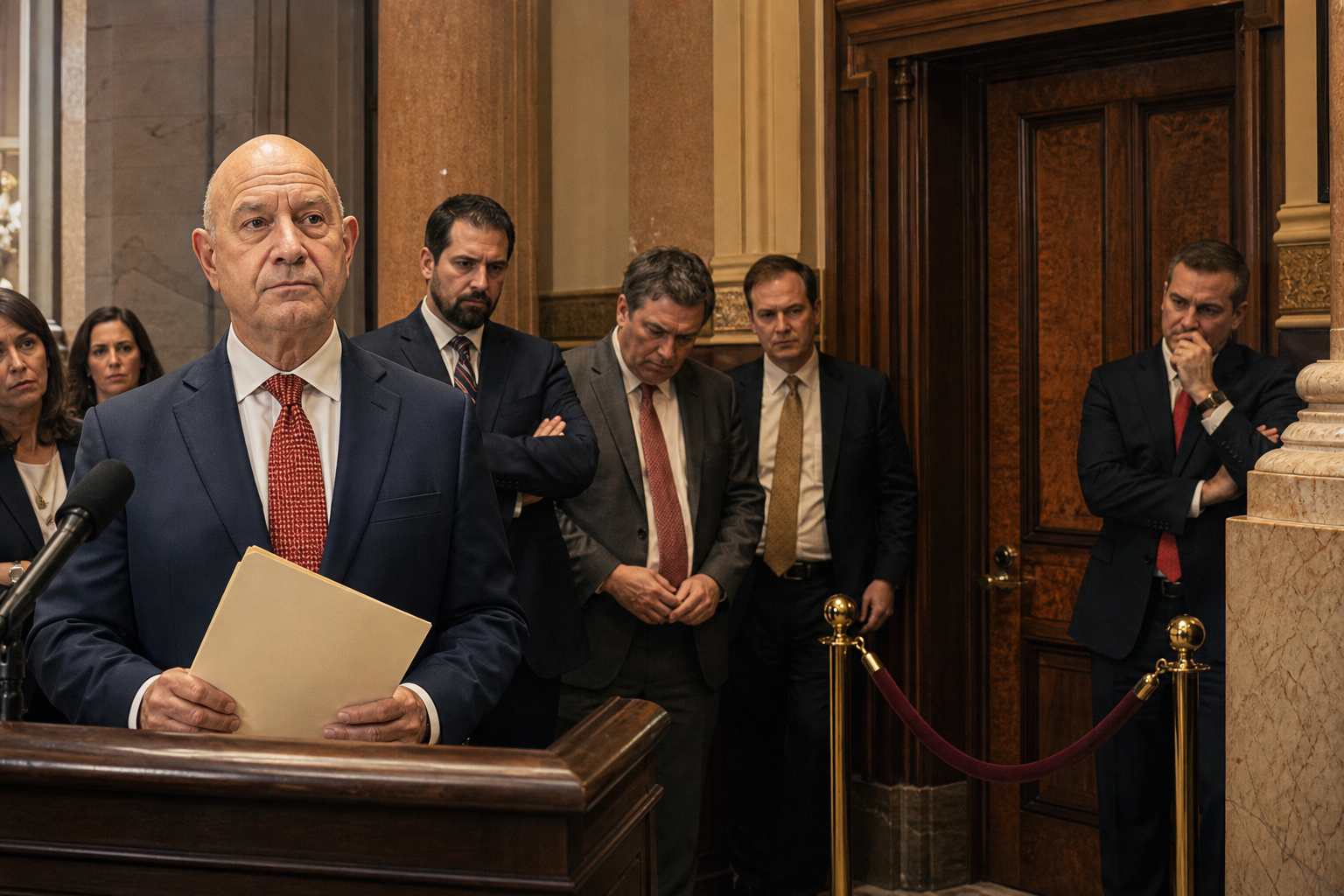
This is fictional political parody inspired by real news.
AUSTIN—Following a televised warning that Texas could be sliding toward the “sanctuary state club,” fictional state political consultants on Sunday unveiled an emergency reassurance program requiring Houston to demonstrate that it is not, under any circumstances, enjoying itself.
The program, called Texas Is Not Like That, directs city officials to issue a sequence of increasingly personal denials. Houston may state that it has never received an invitation to the Sanctuary State Club, has never searched the club’s dress code, and has no knowledge of whether its members receive discounted valet parking for municipal autonomy.
“This is not about immigration policy,” explained a consultant standing before a map of Texas with Houston circled in the anxious red pen normally reserved for weather systems. “This is about the vibe. A state like Texas cannot wake up one day and discover that a city has been quietly developing preferences.”
The warning grew out of concern over Houston Mayor John Whitmire’s move to limit local police cooperation with ICE. But in the fictional Austin response room, that practical disagreement was immediately upgraded into a far more urgent concern: whether Houston had begun talking about its feelings with other levels of government.
By noon, the city had been handed a draft statement assuring Texans that Houston had no desire to “join any club, collective, consortium, alliance, circle, salon, supper series, or loosely governed group chat whose members use the phrase ‘best practices’ without becoming visibly embarrassed.”
It was not enough.
State strategists demanded behavioral proof. Houston officials were asked to photograph themselves declining an imaginary welcome basket. A proposed press conference was nearly derailed when one staffer suggested placing a velvet rope outside City Hall, prompting immediate concern that the rope could be interpreted as “aspirational.”
“We’re simply asking Houston to act like a city that has nothing to hide,” one fictional adviser said. “No one who isn’t considering sanctuary-state membership has this much trouble saying they aren’t considering sanctuary-state membership.”
The campaign’s first complication arrived when several Texas suburbs asked whether they, too, would be required to prove they had never been curious about the club. Consultants said no, then privately commissioned polling on whether suburban voters found the word sanctuary more alarming or more expensive-sounding.
That was when the operation discovered its deeper problem. The Sanctuary State Club, as imagined by the people warning about it, had become an extraordinarily useful place. It was where every local disagreement could be shipped overnight and labeled as a statewide moral emergency. It was where donors could picture their tax dollars being greeted by a maître d’. It was where a mayor’s policing policy could be transformed into an ominous lifestyle choice involving candlelight, artisanal zoning, and somebody saying “we hear you” before ruining the republic.
A consultant’s slide deck, briefly visible during a closed-door meeting, reportedly divided possible Texas futures into three categories: “Still Texas,” “Basically Portland,” and “Portland With a Buc-ee’s.”
Then came the reversal nobody had prepared for. In the parody scenario, the Sanctuary State Club’s alleged admissions committee declined to comment on whether Texas was eligible, explaining through a spokesperson that it does not accept applications from states that arrive already shouting about the club from the parking lot.
The rejection sent Austin into a brief panic. Without the possibility that Texas might be admitted somewhere dreadful, campaign professionals worried voters could begin asking tedious questions about wages, hospitals, housing, schools, utility bills, or the ordinary work of governing a state large enough to contain several competing realities before lunch.
Within hours, the crisis team revised its message. Texas was no longer merely refusing membership. It was now bravely resisting the temptation to receive a hypothetical invitation from an organization that had not acknowledged its existence.
Houston, meanwhile, was instructed to remain calm, stop making eye contact with local discretion, and under no circumstances enjoy the concept of local control where anyone could see it.
By sundown, the club had not admitted Texas, but Texas had already renewed its membership in the fear of being asked.
Texas Demands Houston Prove It Isn’t Enjoying Sanctuary State Club
The state’s new anti-membership protocol requires city leaders to deny receiving invitations, liking the menu, or knowing why everyone keeps whispering about local control.
WHAT STARTED THIS MESS
The event underneath the joke is real. The SPILL premise, dialogue and escalation above are fictional parody.