El-Sayed Requires Foreign Policy Questions to Clear a Michigan Voter
Britain has located a qualified constituent, but she would first like someone to explain her property-tax assessment.
PARODY — The following is fictional.
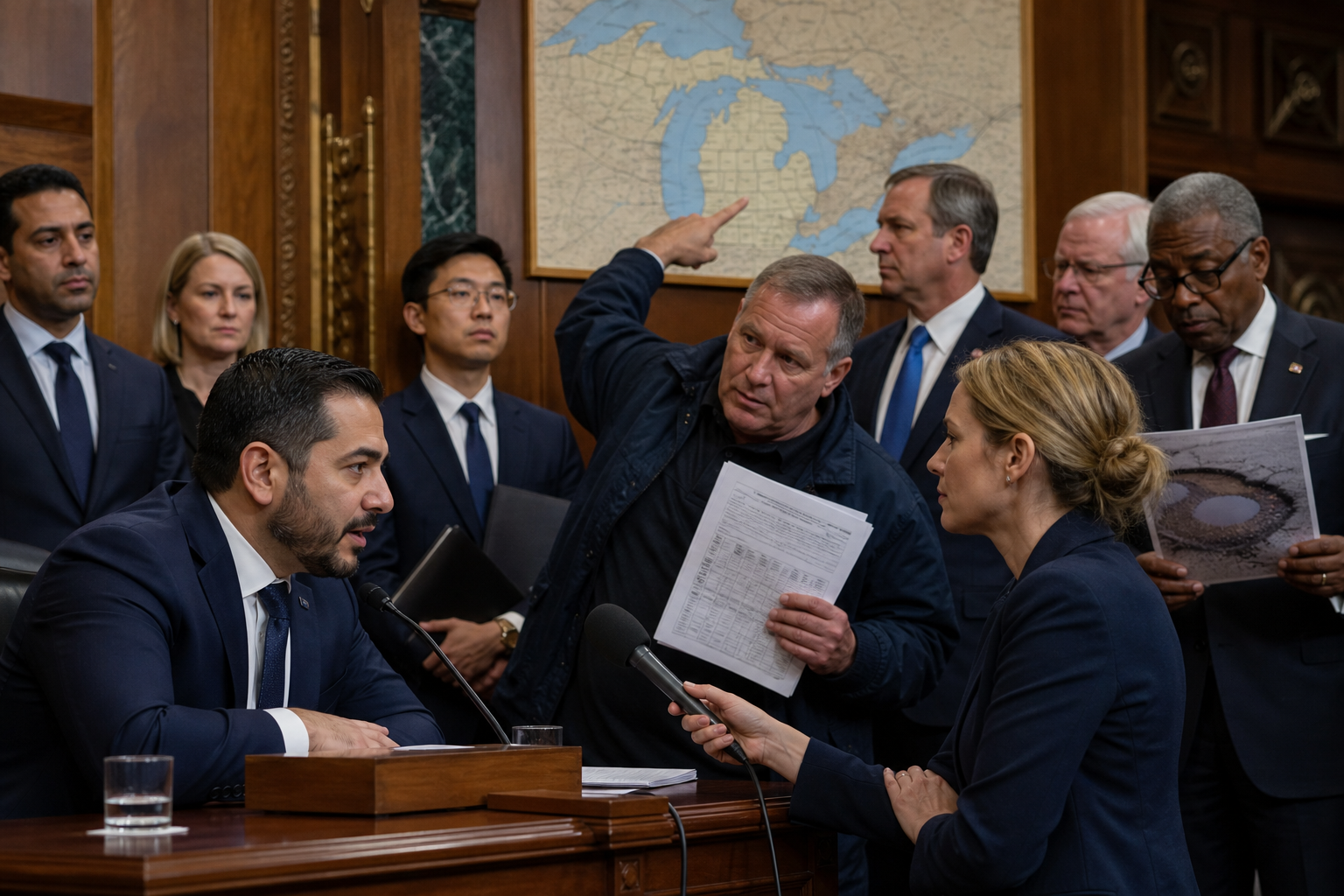
Michigan Senator-elect Abdul El-Sayed’s transition team unveiled a new foreign-policy protocol Wednesday requiring all international questions to be accompanied by a registered Michigan voter who can confirm, under mild social pressure, that the matter affects them personally.
The rule, called the Constituent Proximity Standard, follows El-Sayed’s confrontation with a Sky News correspondent who was unable to vote in Michigan. Under the new system, a British journalist asking about the United Kingdom’s position on anything must first locate a Michigan resident willing to stand nearby and say, “Yes, I’ve heard of Britain.”
“Washington has spent decades allowing foreign governments to simply walk in and have interests,” said a fictional transition aide, placing a laminated map of Michigan over a briefing on NATO. “That era is over. If Norway wants an answer, Norway can find somebody from Grand Rapids who owns a snowblower and has a cousin in the Coast Guard.”
The policy immediately created chaos in diplomatic circles, where embassies had assumed their accredited representatives, treaty obligations and occasional aircraft carriers would qualify as evidence of relevance. The Canadian embassy was reportedly relieved to learn it could access El-Sayed’s office through approximately 10 million nearby voters, then dismayed to learn each one had a different opinion about lumber, hockey and whether Detroit counts as “basically Canada.”
Britain, meanwhile, hired a Lansing woman named Denise to sponsor its first inquiry about transatlantic security. Denise arrived prepared, carrying a voter-registration card, a winter coat and a handwritten list of three unrelated concerns involving an intersection near her house.
“Before we get into Europe, I need to know why the left-turn arrow at Jolly and Okemos disappears at 4:45,” Denise told the assembled foreign correspondents. “And I don’t want a white paper. I want the arrow back.”
Within minutes, the British question had been reclassified as a local infrastructure matter. A Senate aide promised to convene an interagency task force, while a bewildered diplomat from the United Kingdom tried to explain that Russia did not, to his knowledge, control the traffic light.
The second problem emerged when foreign governments began competing for the same credible Michigan voters. France secured a retired social-studies teacher from Ann Arbor. Japan retained an auto-parts supplier in Novi. Germany obtained a very serious man from Kalamazoo who had previously emailed two senators about freight rail and was therefore considered, by diplomatic standards, a five-star asset.
Officials soon discovered that Michigan voters were not passive sponsorship vehicles but actual constituents, each bringing requests. The German delegation’s question on European defense was delayed after its sponsor asked whether the senator could “do something” about windshield salt. A delegation from South Korea lost its speaking slot after the resident it recruited correctly noted that she had been waiting six weeks for an answer about her mother’s prescription coverage.
By Thursday afternoon, the Senate Foreign Relations Committee had reportedly been forced to replace its country placards with folding cards reading “WHO HERE LIVES IN MICHIGAN?” Diplomats seeking recognition now stood in a line behind a man from Flint asking whether federal agencies could agree on which website he was supposed to use.
El-Sayed’s fictional team defended the arrangement as a breakthrough in accountability. “For too long, foreign policy has been dominated by people who believe their problem is important merely because it involves war, trade, alliances, energy markets, nuclear weapons or the collapse of international order,” the aide said. “We are asking one simple question: have they tried being registered in Michigan?”
The system finally stalled when the United Kingdom found an ideal sponsor: a Michigan voter who understood the stakes, followed world affairs closely and had a concise question ready for the senator. Staff immediately flagged her as suspiciously prepared and redirected her to the pothole portal.
El-Sayed Requires Foreign Policy Questions to Clear a Michigan Voter
Britain has located a qualified constituent, but she would first like someone to explain her property-tax assessment.
WHAT STARTED THIS MESS
The event underneath the joke is real. The SPILL premise, dialogue and escalation above are fictional parody.
- NPR Dearborn, Michigan, mayor on city's record turnout and the election of Abdul El-Sayed ↗
- POLITICO How Abdul El-Sayed actually did with Jewish voters ↗
- FOX Jewish leaders in Michigan prepare to work with Abdul El-Sayed despite lingering concerns ↗
- CNN El-Sayed slams Vance as a ‘coward’ but says he would work with him for Michigan ↗
- NBC How Abdul El-Sayed swung young men from Trump by 55 points in Michigan ↗