Zelenskyy Requests One Security Guarantee That Survives the Fine Print
Western allies unveil a promise so carefully worded it may require protection from itself.
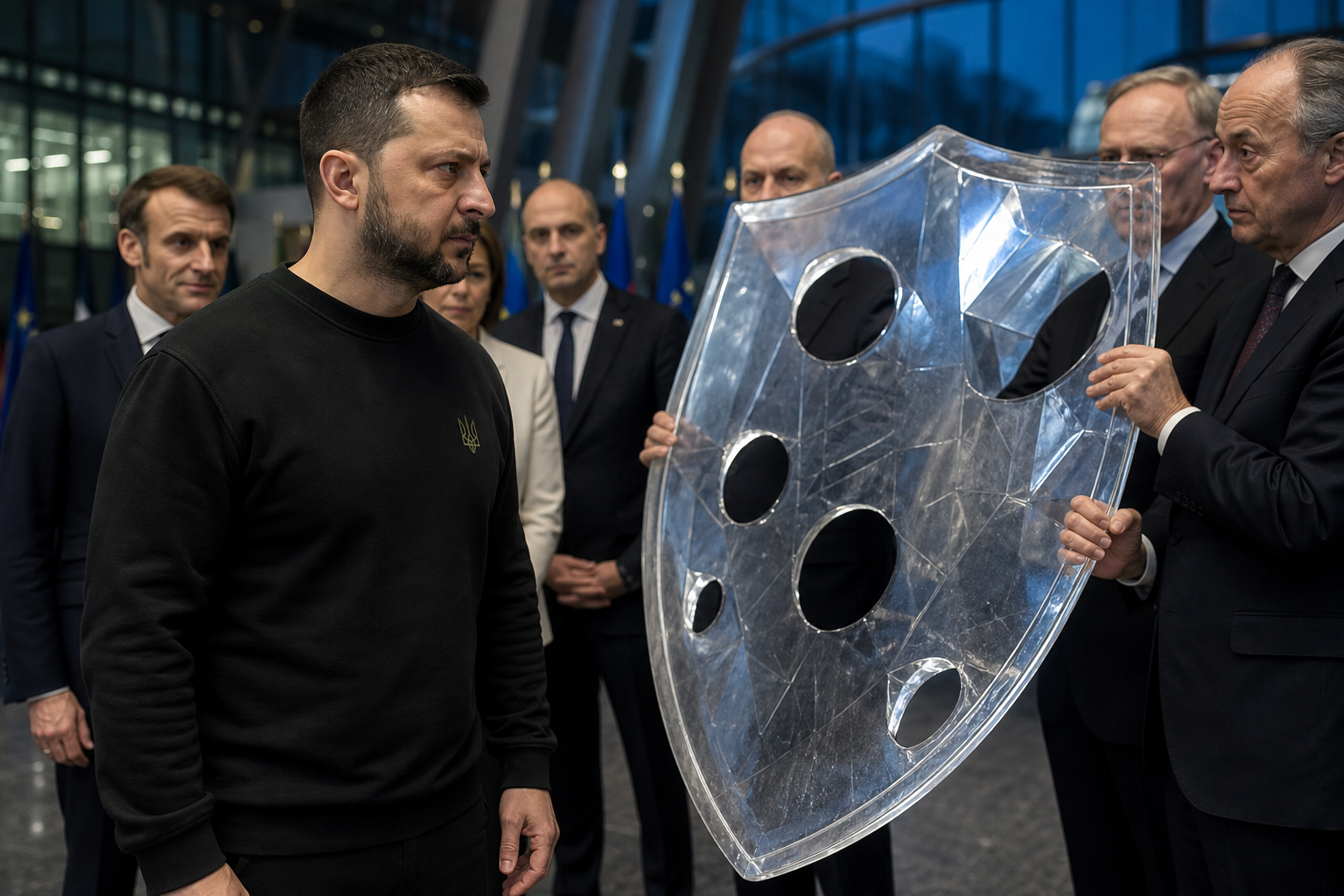
PARODY. President Volodymyr Zelenskyy on Sunday asked Western allies for clear postwar security guarantees, prompting a coalition of European and American officials to unveil what they called the strongest reassurance package ever designed to remain completely untroubling in a domestic political environment.
The document, titled A Forward-Looking Framework for the Durable Consideration of Ukraine’s Future Security Needs, is said to guarantee that any future attack on Ukraine will trigger an immediate sequence of consultations, assessments, notifications, strategic reflections and high-level expressions of grave concern—some of them possibly in person.
“Ukraine deserves certainty,” said a fictional senior diplomat, standing beside a 900-page binder secured with the kind of elastic strap usually reserved for restaurant menus near tourist attractions. “That is why we have removed all ambiguity around our process for determining when we may begin discussing whether certainty would be appropriate.”
The guarantee’s central clause promises that allies will respond to aggression “in a manner commensurate with the full range of circumstances then prevailing, including but not limited to legal, political, electoral, meteorological and vibes-based considerations.” It is accompanied by a glossy flowchart showing a red arrow labeled ATTACK entering a maze of committee boxes and emerging, perhaps, near a tasteful photograph of a summit.
Officials stressed that the wording was the product of months of painstaking diplomacy. Every sentence was reportedly tested against three essential standards: Would it reassure Kyiv? Would it deter Moscow? And could a finance minister describe it on television without immediately being asked what it meant?
The first two standards were eventually classified as aspirational.
Under the new system, any hostile act would automatically activate the coalition’s Rapid Clarity Mechanism, a 24-hour process in which allied leaders agree that the situation has become very clear indeed. A second 24-hour period would then determine whether the clarity was sufficiently actionable, followed by an emergency meeting to prevent individual countries from taking any action so clear that the others might be expected to join it.
“This is not about loopholes,” the diplomat said. “A loophole is something one slips through. This is a broad, sunlit civic atrium through which every government may exit with its constitutional traditions intact.”
Zelenskyy, according to people familiar with the fictional meeting, listened politely before asking whether the security guarantee contained any provision that would make Russia less likely to attack Ukraine again.
The room reportedly went silent long enough for several translators to wonder whether their equipment had failed.
Aides then presented the president with a companion document, the Deterrence Appendix, which explains that deterrence is created when an adversary understands an attack would produce consequences. The appendix carefully declined to identify the consequences, on the grounds that identifying them could create expectations, and expectations were the very thing the framework had been designed to manage.
“We have to preserve strategic ambiguity,” one official said.
“For whom?” Zelenskyy asked.
At that point, the meeting took an unexpected turn. A delegation of allied parliamentary leaders arrived carrying a separate document entitled Our Unshakeable Commitment to Not Being Cornered by a Sentence We Approved. They explained that any guarantee strong enough to be understood by Russia might also be understood by their voters, opposition parties, budget committees and, most dangerously, future versions of themselves.
“You must appreciate the deterrent value of uncertainty,” said one fictional lawmaker. “If no one knows what we will do, they cannot accuse us of failing to do it.”
To demonstrate the coalition’s resolve, officials released a draft declaration stating that Ukraine’s security is “inseparable from the security architecture of Europe, provided architecture is interpreted broadly enough to include a gazebo, a shared calendar and several very sincere briefing notes.”
The draft was briefly praised as a breakthrough because it used the phrase “ironclad” without specifying whether the iron was decorative, load-bearing or available during a recess.
By evening, negotiators had reached a compromise. Ukraine would receive a guarantee that was clear in the same way airport luggage insurance is clear: there is definitely coverage, the coverage is definitely meaningful, and the moment anything actually happens, a helpful representative will explain which portion of reality falls outside the policy.
The coalition then adjourned on an optimistic note, agreeing to reconvene next week to define the word “guarantee” before anybody accidentally uses it near a microphone.
Zelenskyy Requests One Security Guarantee That Survives the Fine Print
Western allies unveil a promise so carefully worded it may require protection from itself.
WHAT STARTED THIS MESS
The event underneath the joke is real. The SPILL premise, dialogue and escalation above are fictional parody.
- AP Ukrainian President Zelenskyy presses Western allies for clear postwar security guarantees ↗
- PBS NewsHour Zelenskyy pushes for 'clear' postwar security guarantees in Ukraine - PBS ↗
- CNN Ukrainian President Zelensky reacts to US midterm election results ↗
- CBS Zelenskyy accuses Russia of ramping up attacks on Ukraine ahead of U.S. talks ↗
- NBC Russia and Ukraine exchange airstrikes as U.S. envoy describes renewed security talks as productive ↗
- POLITICO Russia hits Kyiv in overnight attack days before Abu Dhabi talks ↗
- Reuters Zelenskiy criticises Ukraine's SBU security service over corruption scandal ↗