Trump DOJ Gives Evidence Until Friday to Support Its Latest Grievance
In the department’s bold new workflow, probable cause no longer delays justice—it follows it around with a notepad.
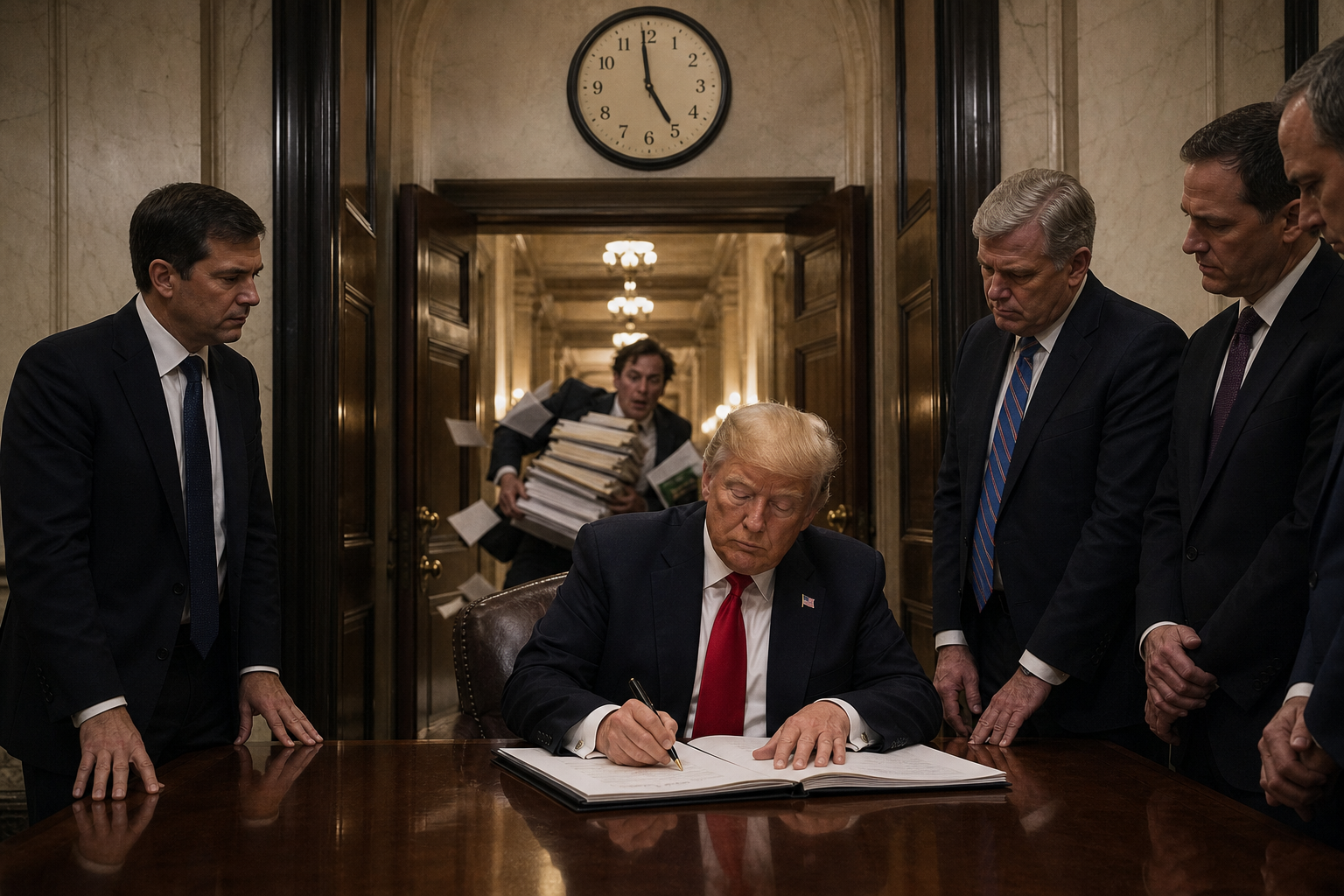
WASHINGTON—PARODY. Following the collapse of its case against two former FBI officials accused of lying to Congress about the Hunter Biden investigation, the Justice Department announced Tuesday that it would no longer allow evidence to slow down allegations that have already been cleared for national emotional importance.
The department’s new Evidence Catch-Up Initiative will permit prosecutors to file charges whenever a matter has achieved sufficient urgency in the presidential grievance ecosystem, then give supporting facts several business days to locate parking, obtain clearance and report to the courthouse carrying whatever they have managed to become.
“For too long, the American people have watched their government wait around for probable cause as though it were some kind of prerequisite,” said a fictional senior Justice Department official, standing beside a wall calendar marked ACCOUNTABILITY NOW, DETAILS PENDING. “That is a deeply passive way to pursue accountability.”
Under the pilot program, an allegation can receive provisional legal status if it meets at least two of three requirements: it has been mentioned during a presidential address, it ruins the weekend of someone who once held a security clearance, or it can be described in a briefing as “something people have been asking questions about for years” without anyone needing to identify those people.
The evidence itself will be assigned an individual case manager and encouraged to arrive at its own pace. Investigators have been instructed not to shame documents for lacking context, not to pressure witnesses into remembering events in the correct political order, and not to make laboratory results feel as though they are being asked to choose a side.
At a training session for prosecutors, participants practiced filing a criminal complaint before breakfast, discovering the legal theory during lunch and sending a courteous afternoon email to the Constitution asking whether it had anything useful to add.
“This is not about cutting corners,” the fictional official explained. “This is about recognizing that some corners were built by people who wanted powerful institutions to turn around slowly and look where they were going.”
The change was welcomed by a new class of federal employees known internally as Narrative First Responders. Their job is to arrive at a politically combustible claim within minutes, establish a perimeter around the strongest available adjective and prevent procedure from contaminating the scene.
One responder described the work as “less law enforcement than event production.”
“You don’t want a major allegation sitting backstage for six months while experts fuss with authenticity, intent, materiality and whatever else they call the little wires,” he said. “By then, the country has moved on to a different person it needs to be furious with.”
The initiative encountered its first complication almost immediately, when prosecutors realized that courts still expected them to explain why a defendant had probably committed a crime rather than merely why the administration had been having an absolutely enormous week.
In response, the department created a companion unit called the Office of Judicial Tone Management. Staff there will help judges understand that a lack of evidence can sometimes reflect not weakness, but confidence—specifically, confidence that evidence will eventually appreciate the seriousness of the assignment.
Judges who remain attached to traditional concepts such as sworn affidavits, coherent timelines and signed charging documents will receive what the department calls a “legacy-process accommodation.” A small team of attorneys will sit with them patiently and explain that the country cannot be held hostage by paperwork just because paperwork has stubbornly chosen to become the country’s only adult.
The program’s real test came when a prosecutor asked whether charges could still be filed if evidence ultimately failed to materialize. Officials said yes, provided the evidence had made a good-faith effort to become compelling and had not been distracted by facts.
By late afternoon, the department had issued a reminder that all future evidence must submit a doctor’s note if it expects to miss a politically scheduled prosecution.
Trump DOJ Gives Evidence Until Friday to Support Its Latest Grievance
In the department’s bold new workflow, probable cause no longer delays justice—it follows it around with a notepad.
WHAT STARTED THIS MESS
The event underneath the joke is real. The SPILL premise, dialogue and escalation above are fictional parody.
- FOX Illegal immigrant accused of violent attempted murder, kidnapping of a minor was released under Biden admin ↗
- AP Judge cites 'weaponization' in tossing charges for ex-FBI agents accused of lying about Hunter Biden ↗
- POLITICO Judge tosses charges against former FBI officials accused of lying to Congress over Hunter Biden probe ↗