Corporate America Classifies Democratic Congress as a Non-Material Development
The election may have changed Washington, but the earnings call has determined it does not change guidance.
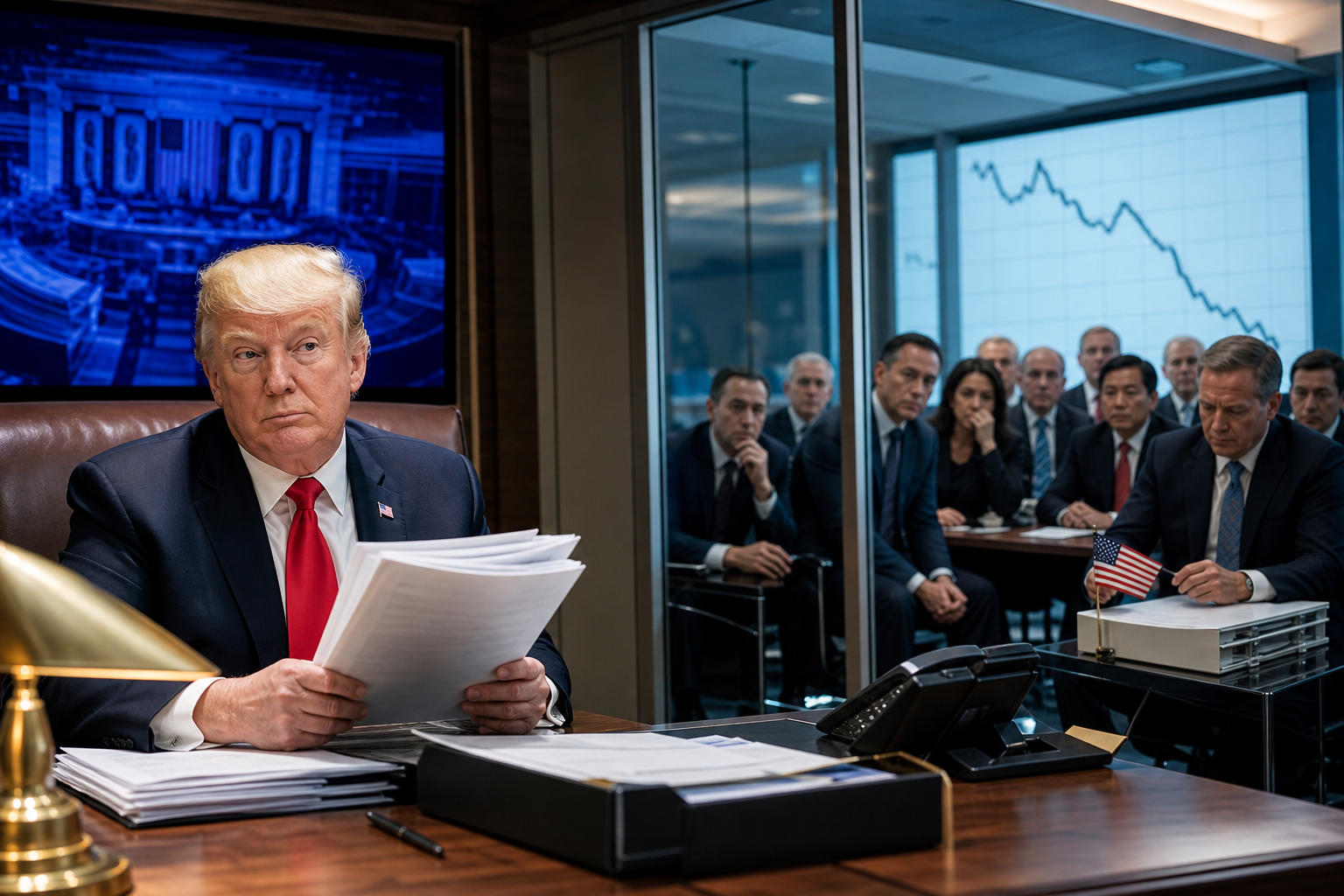
In a fictional move applauded by analysts who had already opened spreadsheets before the results were called, America’s largest companies have classified Democrats’ capture of Congress as a non-material political development, placing the election somewhere between an executive weather delay and a board member’s regrettable podcast appearance.
The designation means corporations must acknowledge that Congress exists, that it has changed hands, and that television panels are now using the phrase “new era” at an unsustainable rate. It does not, however, require companies to alter earnings guidance, lower prices, revisit tariff assumptions, or stop describing every ordinary operational headache as “an environment of unprecedented complexity.”
“We are pleased to see democracy functioning,” said a fictional chief financial officer during an earnings call conducted from a room with no windows, no clocks and one enormous graph labeled Headwinds. “At this time, we have not identified a direct pathway from democracy functioning to our shipping containers costing less.”
The classification followed a difficult morning for executive teams, who had spent months explaining that Washington was too unstable to plan around and then awoke to a sweeping election result that, by their own account, would change almost nothing in the near term.
“It’s actually the best of both worlds,” said one investor-relations consultant, placing a tiny American flag beside a quarterly-loss estimate. “Companies can welcome stability, cite uncertainty, praise the voters, blame the tariff environment, and leave every number exactly where it was. This is what markets mean when they say they love clarity.”
Under the new reporting standard, firms are required to mention the incoming Democratic Congress on slide four of their investor deck, immediately after “macroeconomic volatility” and immediately before “consumer softness.” The approved language reads: “While the electorate has expressed a historic preference, management continues to anticipate substantial friction from conditions that existed before, during and after the electorate expressed it.”
Several companies reportedly struggled with whether an election that rearranged both chambers of Congress could truly be considered non-material. The question was resolved after lawyers explained that the administration’s tariff machinery remained largely under executive control, while any congressional effort to unwind it would have to survive a hostile White House, an approaching funding deadline, and the ceremonial appearance of at least six lawmakers explaining why they were deeply concerned about the procedure.
At that point, the election was reclassified from “transformative” to “worth monitoring.”
The first surprise came when companies began receiving investor questions about why they had spent the previous year treating every hint of congressional movement as an urgent threat to shareholder value. A grocery chain that once warned that a committee hearing could affect mayonnaise pricing now explained that control of Congress was “primarily an atmospheric development.” A manufacturer that had described one senator’s trade tweet as a supply-chain event said both houses changing hands amounted to “a medium-term governance texture.”
“The market has matured,” the grocery chain’s fictional CEO said. “We no longer panic at the sight of elected institutions. We have learned to reserve panic for freight insurance.”
Then came the complication: employees began asking whether their annual raises could also be classified as non-material developments, since payroll expenses had apparently become the only force in the universe capable of changing guidance.
Corporate leaders immediately convened emergency workshops on the difference between a democratic mandate and a cashier requesting forty additional cents an hour. The sessions were tense. One presentation, titled Why Voters Are a Macro Signal but You Are a Cost Center, was withdrawn after an attendee asked whether the company’s commitment to civic participation extended to people with W-2 forms.
By afternoon, the Business Roundtable had issued a fictional joint statement reassuring the country that it respected the election’s message and would carefully consider it as soon as it stopped affecting the share price in either direction.
The statement also encouraged elected officials to restore confidence by delivering predictability, lower input costs, stable trade rules, reliable energy, manageable inflation, improved consumer demand and the ancient Roman luxury of being unable to veto anything.
For now, companies say they are watching Congress closely from the same safe distance they use for hurricanes, labor negotiations and a customer who has found the corporate email address of the chief executive. The election may have remade the political landscape, but Wall Street has already entered it into the ledger under “miscellaneous weather.”
By next quarter, executives expect to report that democracy remains strong, uncertainty remains high, and tariffs have somehow been promoted to senior management.
Corporate America Classifies Democratic Congress as a Non-Material Development
The election may have changed Washington, but the earnings call has determined it does not change guidance.
WHAT STARTED THIS MESS
The event underneath the joke is real. The SPILL premise, dialogue and escalation above are fictional parody.