Paxton and Talarico Face Texas’s Most Ruthless Moderator: A Grocery Receipt
After a record flood of Senate ad money, both campaigns discover the one document nobody can spin is already in everyone’s kitchen drawer.
This is fictional political parody inspired by a real election story.
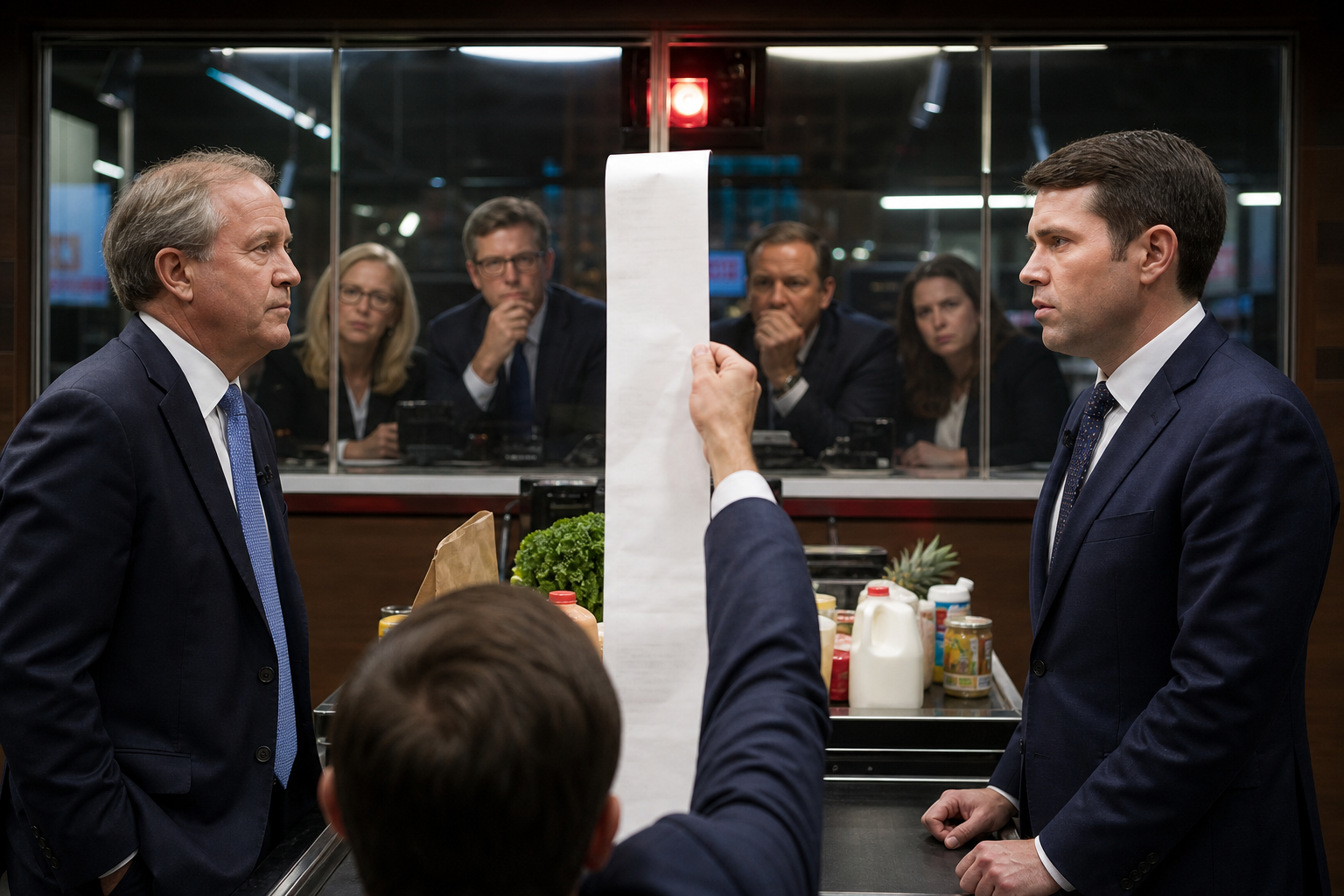
Austin—With the Texas Senate race approaching its billion-dollar finish line and voters stubbornly continuing to buy food instead of impressions, the campaigns of Ken Paxton and James Talarico have agreed to settle the contest before the state’s most feared neutral authority: one 34-item H-E-B grocery receipt, projected onto a screen large enough to intimidate a refinery.
The event, called Texas Answers for Things That Used to Cost Less, will replace the final week of stump speeches with a single question repeated until somebody makes eye contact with it: “Why is this total $287.41?”
Campaign officials said the format was necessary after polling showed affordability could matter to Texans nearly as much as the 47 television ads in which candidates stand in a field, a factory or an aggressively symbolic pickup truck and promise to fight.
“For too long, politicians have been allowed to speak about kitchen-table issues without ever being required to identify an item currently on a kitchen table,” said debate moderator Dana Checkout, a former forensic accountant who was hired after correctly locating the line item for dishwasher pods without asking a consultant what working families wanted.
Paxton’s team arrived with a binder titled Freedom From the Suggested Retail Price, arguing that the receipt should be considered hostile evidence because it had been generated in a commercially compromised environment. Talarico’s advisers countered with an eight-minute opening statement about corporate concentration, after which Checkout asked why the family-size cereal appeared to cost more per ounce than the smaller box.
Neither campaign had prepared for this level of specificity.
At first, the candidates tried their established lanes. Paxton blamed Washington, international instability, regulatory overreach and a suspiciously timed avocado. Talarico blamed billionaires, consolidation and a system designed to make a person feel personally at fault for needing paper towels.
The receipt, which had no visible partisan affiliation and had declined three requests to join a panel discussion, remained devastatingly calm.
Then came the reveal that rattled both camps: the receipt had been purchased with a debit card.
Until that moment, the campaigns had treated affordability as a broad emotional weather system—something that could be acknowledged in a 30-second spot while a candidate stared thoughtfully at a gas pump. A debit purchase meant the groceries had not been acquired by a focus group, a donor retreat or a political-action committee attempting to expense queso as democracy support. They had been paid for by someone who did not receive a commemorative fleece vest afterward.
Paxton advisers immediately requested a review of the receipt’s provenance. Talarico staffers asked whether the family had considered buying in bulk, then realized that was the kind of sentence that gets printed on a mailer beside a candidate’s face in grayscale.
Behind the scenes, both campaigns discovered that their record-breaking ad budgets had created a catastrophic knowledge gap. Consultants could name the exact second a persuadable suburban voter might become receptive to a message about economic anxiety. Nobody could say whether $6.89 for strawberries was normal, alarming or an acceptable price for fruit that expires during a conference call.
The emergency response was swift. Each campaign hired a Cost-of-Living Liaison, a senior operative authorized to enter a supermarket without being filmed beside artisanal sparkling water. The operatives were instructed to observe ordinary prices silently, avoid saying “What a fascinating consumer touchpoint,” and under no circumstances ask a cashier whether coupons were “a turnout operation.”
But the receipt hearing soon exposed a deeper crisis. Every proposed solution had to survive a follow-up question from Checkout, who had developed the unshowy tyranny of a person holding exact change.
When Paxton promised to defend Texas families from federal interference, she tapped the total beside ground beef. When Talarico promised to stand up to concentrated power, she tapped the total beside a bag of limes. When both candidates promised to fight, she asked whether fighting had ever lowered the price of anything besides a campaign consultant’s self-respect.
By the closing segment, the campaigns had reached a rare bipartisan consensus: groceries were behaving with unacceptable independence.
They jointly proposed a new Texas tradition in which every Senate candidate must spend one unsupervised hour at a checkout line before being permitted to use the phrase “working families.” The plan fell apart when strategists learned the checkout line could not be reserved, branded or persuaded to wait until after Election Day.
The receipt was last seen being folded into a wallet, where it will reportedly continue its campaign against everyone.
Paxton and Talarico Face Texas’s Most Ruthless Moderator: A Grocery Receipt
After a record flood of Senate ad money, both campaigns discover the one document nobody can spin is already in everyone’s kitchen drawer.
WHAT STARTED THIS MESS
The event underneath the joke is real. The SPILL premise, dialogue and escalation above are fictional parody.