Both Parties Rehearse Historic Moral Victories in Defeat
Campaign consultants have concluded that losing is only bad if you let the other side describe it first.
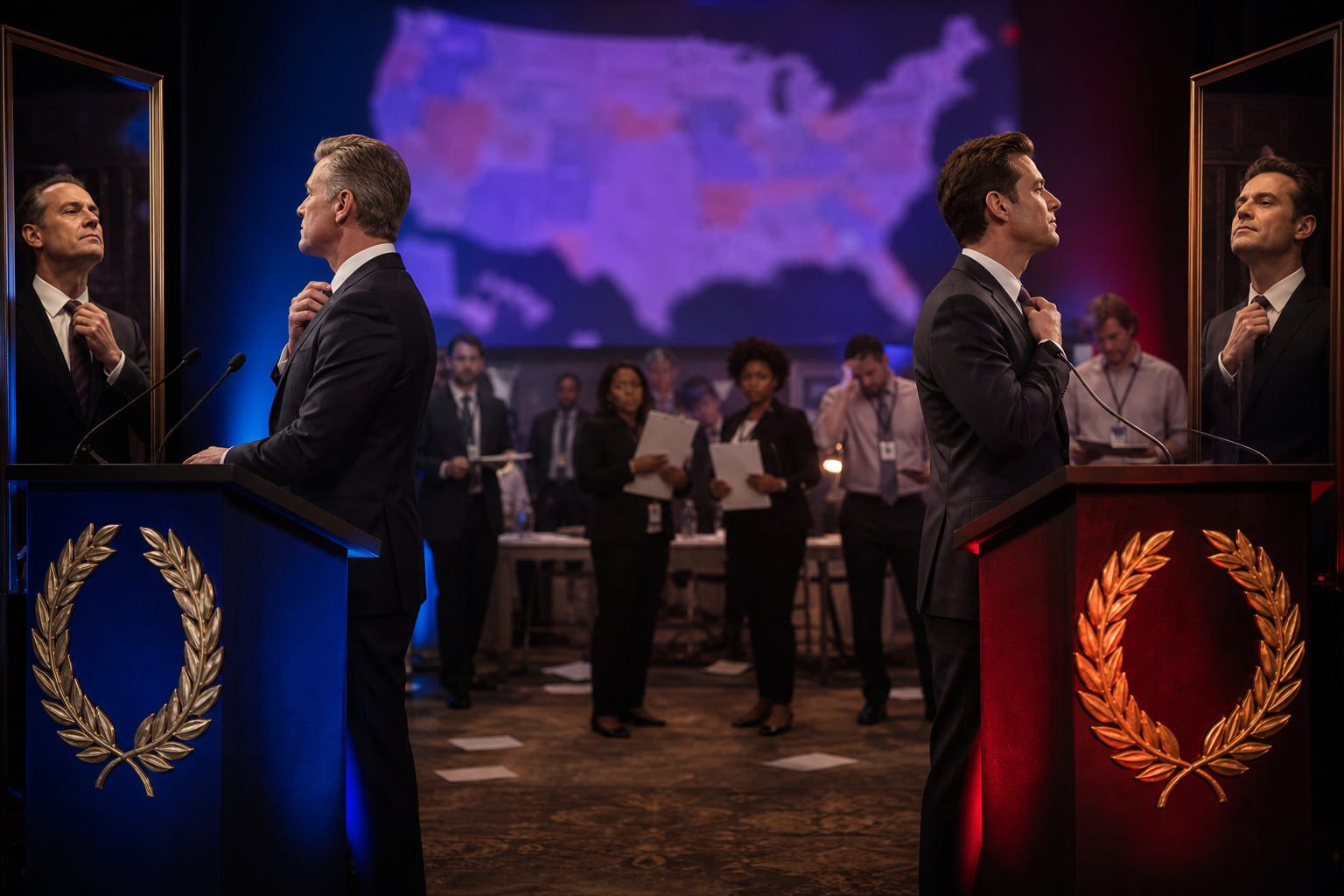
WASHINGTON— With the fight for control of Congress entering its final stretch, both national parties have begun rehearsing the only election-night message capable of surviving modern politics: a solemn declaration that whatever just happened was, in a deeper and more strategically useful sense, an overwhelming victory.
At a secure hotel ballroom outside Washington, Democratic and Republican consultants spent the weekend workshopping a range of outcomes once known by the crude, pre-professional terms “winning” and “losing.” Under the new system, a party that captures Congress has demonstrated a broad national mandate. A party that narrowly fails to capture Congress has exposed the winner’s catastrophic inability to inspire confidence. A party that gets demolished has “forced a conversation” so urgent it apparently required losing 43 seats to begin.
“The public thinks an election result is a result,” said one senior strategist, surrounded by dry-erase boards labeled IF WE WIN BIG, IF THEY WIN SMALL, and IF THE NETWORKS GET WEIRD ABOUT MATH. “That’s adorable. A result is just raw material. We turn it into moral weather.”
Each party has reportedly assembled a specialized team of speechwriters, pollsters and former governors whose only job is to locate the exact margin at which disappointment becomes destiny. One consultant demonstrated the process using a hypothetical House loss of seven seats.
“Seven seats is not seven seats,” she explained. “Seven seats is voters sending a thunderous message that the other party now owns every inconvenience in American life, including the noise made by refrigerators. If we lose eight, it becomes a stunning repudiation of their failure to earn nine.”
The Republican operation, according to people familiar with the rehearsal, has developed an even more advanced model called the Mandate Compression Protocol. It allows any favorable result, however narrow, to be described as a public demand for immediate, sweeping action, while any unfavorable result is classified as proof that the country remains tragically divided and therefore must not change course.
“It’s about respecting nuance,” said a party official, while an aide adjusted a podium sign reading THE PEOPLE HAVE SPOKEN, SUBJECT TO FINAL MESSAGING. “When we win by one, democracy has issued a crystal-clear instruction. When they win by one, democracy is clearly asking everyone to slow down and consider whether one is really a number.”
But the planning took an unexpected turn after both parties realized their victory narratives required the same scarce resource: ordinary Americans who could be portrayed as having delivered exactly the lesson the party had already prepared.
Campaigns are now competing to identify voters whose motives can be interpreted with sufficient elasticity. A person who voted because of grocery prices, foreign policy, housing costs, abortion rights, taxes, disgust, hope, habit, or a flyer they accidentally found in a tote bag may soon be cited as decisive evidence that the nation has endorsed a 46-page consultant memo written last spring at an airport Marriott.
“We’re looking for people with complicated lives,” said a communications director. “Those are ideal. If someone has three concerns, we can take one and call it a mandate. The other two become proof that the opposition failed to listen.”
By Sunday night, the rehearsals had grown so detailed that both parties were testing facial expressions for candidates who must appear humbled by a victory they will spend the next eighteen months describing as a sacred obligation to overreach.
One gubernatorial surrogate practiced looking grave while accepting applause. Another spent twenty minutes perfecting the expression required to say, “This is not the outcome we wanted,” while standing beneath a banner large enough to be visible from low Earth orbit.
The final complication came when several consultants warned that an unambiguous landslide could actually make post-election messaging harder. In that scenario, there would be too little ambiguity to weaponize, too few decimals to interpret, and no plausible way to insist that a straightforward result secretly contained a warning for the winner.
“That’s why we’re preparing for every possibility,” said one strategist. “Victory, defeat, uncertainty, recounts, weather, a cable-news panel deciding suburban counties have vibes. Democracy is resilient. More importantly, our interpretation of democracy is infinitely renewable.”
At press time, both parties had agreed that the true winner of the midterms would be whichever one could hold the first press conference in front of a map before anyone had time to notice what color it was.
Both Parties Rehearse Historic Moral Victories in Defeat
Campaign consultants have concluded that losing is only bad if you let the other side describe it first.
WHAT STARTED THIS MESS
The event underneath the joke is real. The SPILL premise, dialogue and escalation above are fictional parody.