Pope Leo Sees One Good Week and Wants Peace to Define the Relationship
A localized ceasefire has given the Vatican just enough hope to become the most emotionally invested person in a war nobody has agreed to end.
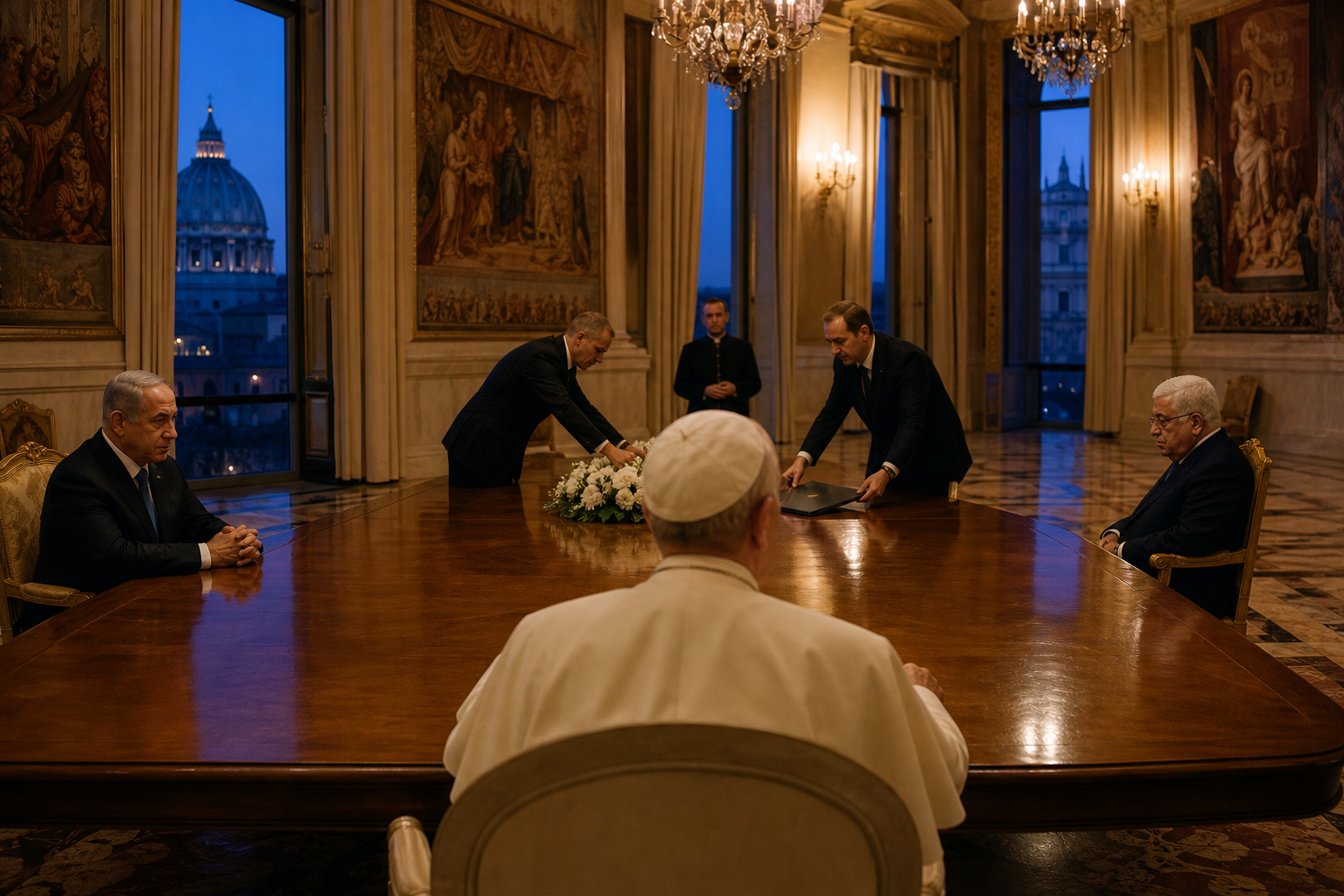
VATICAN CITY— Pope Leo XIV reportedly spent Sunday encouraging Russia and Ukraine to build on their humanitarian ceasefire in Oleshky, prompting Vatican diplomats to make the classic error of everyone who has witnessed one productive conversation between two people with a catastrophic history: assuming they are now ready to define the relationship.
“They coordinated aid deliveries, evacuations and a pause in fighting around one devastated city,” said a fictional senior Vatican adviser, standing beside a whiteboard labeled with a single, trembling arrow pointing from basic humanity to possibly brunch? “We do not want to rush anyone. But we have seen the way they cooperated under narrowly prescribed conditions involving international pressure, civilian suffering and a six-day deadline. There is clearly something here.”
The rare Oleshky truce, meant to allow food, medicine and evacuations, had barely entered its final days before the Holy See’s peace office began drafting what aides called a “gentle next-step conversation” for the two sides. The proposed agenda included whether either party saw itself pursuing a broader ceasefire, whether it could be honest about its needs, and whether the phrase “we should keep talking” meant anything beyond the next available humanitarian corridor.
At first, the Vatican intended to keep expectations modest. Pope Leo’s public appeal asked that the cooperation inspire dialogue and concrete peace initiatives, a formulation experts praised as diplomatically cautious and immediately translated by every optimistic person in Rome as, “They’re basically choosing venues.”
By afternoon, ceremonial planners had reserved a small room with neutral flowers, dimmed lighting and no flags larger than a dinner napkin. A papal aide had also removed all chairs with armrests after determining that peace talks already involved enough territorial claims.
“The goal is not to pressure them,” said the fictional adviser. “We simply want to create a safe, nonjudgmental environment in which both parties can say what they need from a durable peace without anyone beginning with a historical grievance from 2014 and then spending four hours proving they brought receipts.”
The first complication arrived when Vatican staff learned that, in diplomacy, a limited humanitarian agreement is not considered the same thing as emotional availability. Russia and Ukraine had cooperated only enough to help civilians escape an emergency. That did not mean either side was prepared to sit beneath a fresco and answer whether it was “scared of what peace would change.”
This distinction devastated the Vatican’s newer conflict-resolution recruits, many of whom had already prepared place cards reading “Russia,” “Ukraine” and “The Difficult But Necessary Conversation.” One junior official was reassigned after suggesting each side begin by naming one thing the other had done “that made the process feel heard.”
Still, the Pope’s office remained determined to honor the unusual opening. Officials circulated a draft framework titled Building Trust After Successfully Completing One Shared Task, comparing the Oleshky operation to two estranged colleagues discovering they can, under extraordinary conditions, move a heavy sofa without discussing why the office burned down.
That analogy was briefly withdrawn after someone pointed out that the sofa was full of civilians, the office was a sovereign country, and nobody involved had requested an analogy.
The real problem, Vatican aides concluded, was that peace diplomacy had become addicted to interpreting any non-disastrous event as a trailer for a historic breakthrough. A temporary truce held. Aid moved. People got out. In ordinary human terms, that was already enormous. In international diplomacy, it was apparently proof that everyone should now book a villa, wear linen and begin speaking in careful sentences about “turning the page.”
By evening, Pope Leo was said to have intervened personally, asking staff to lower the emotional temperature and remember that the point of the Oleshky truce was to protect civilians—not to force a geopolitical situationship into exclusivity.
The Vatican complied, canceling the candlelit peace dinner and replacing it with a more realistic plan: quietly hoping the next agreement lasts long enough that nobody tries to give it a couple’s nickname.
Pope Leo Sees One Good Week and Wants Peace to Define the Relationship
A localized ceasefire has given the Vatican just enough hope to become the most emotionally invested person in a war nobody has agreed to end.
WHAT STARTED THIS MESS
The event underneath the joke is real. The SPILL premise, dialogue and escalation above are fictional parody.