After Houston Indictment, ICE Asks SUVs How Pedestrians Made Them Feel
The agency’s new accountability initiative begins by establishing that every federal vehicle has a truth—and usually a dashboard camera it would prefer not to discuss.
This is fictional parody inspired by a real event.
Following the indictment of a Houston ICE officer accused of hitting a fleeing man with an SUV, Immigration and Customs Enforcement announced Sunday that it would begin offering immediate emotional support to federal vehicles placed in “high-conflict pedestrian environments.”
The new program, called Roadside Resilience, requires agents to pull over after any controversial encounter and ask the vehicle a series of open-ended questions: Did the pedestrian make a sudden movement? Did the pedestrian fail to consider the vehicle’s operational needs? Did the pedestrian’s body create an atmosphere in which a 5,600-pound government SUV felt it had no safe way to proceed except directly forward?
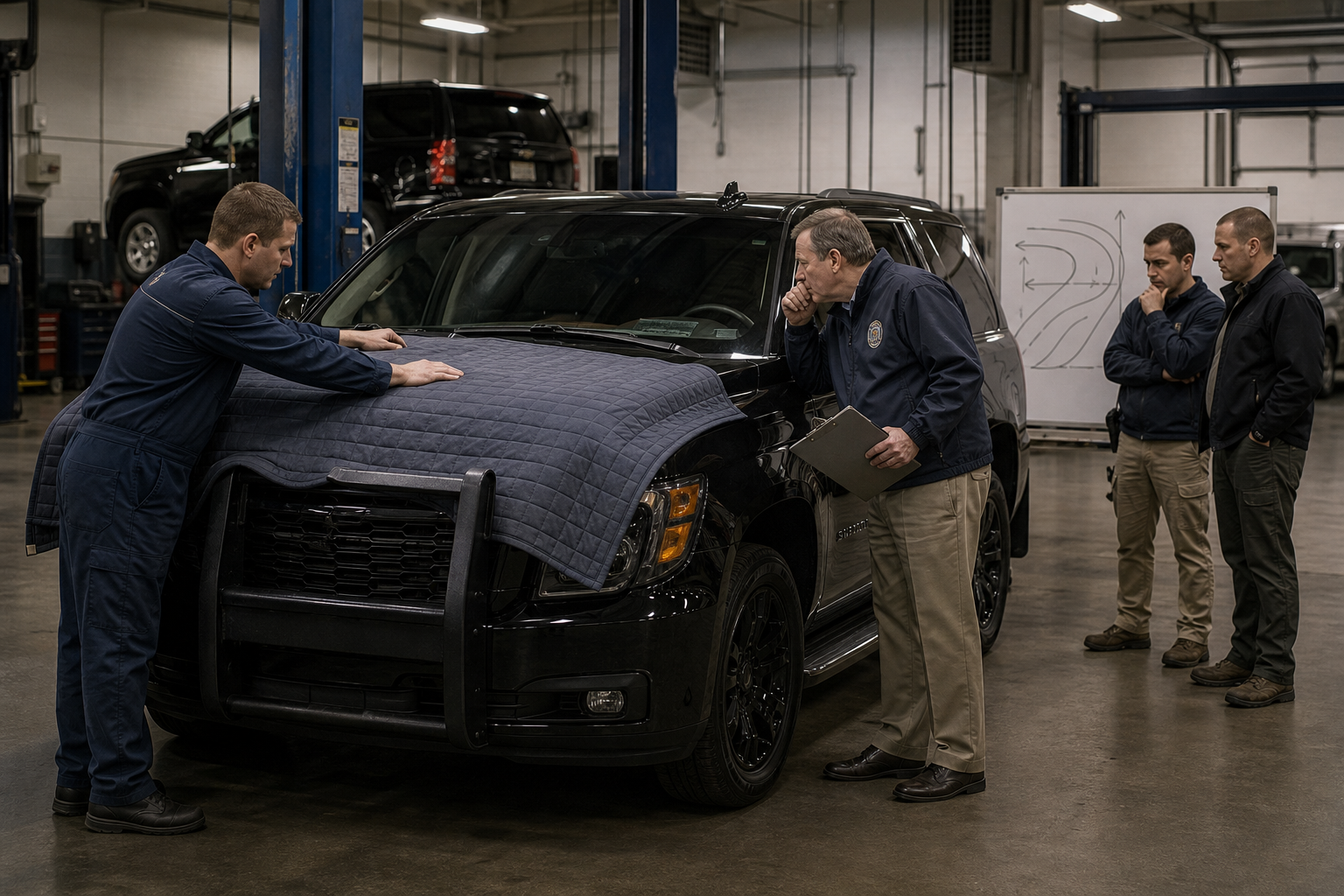
“Too often, everyone rushes to ask what the driver saw,” said fictional ICE Deputy Director for Fleet Wellness Brent Halloway, standing beside a black SUV wrapped in a calming beige privacy tarp. “Nobody asks what the SUV had been carrying emotionally since the pursuit began.”
Under the policy, vehicles involved in incidents will receive a 72-hour administrative leave from difficult roads, during which mechanics are instructed not to use words such as “impact,” “swerve,” “brake,” or “why were you on the sidewalk.” Instead, technicians will offer affirmations, lightly polish the grille, and remind the vehicle that being questioned is not the same thing as being responsible.
At an internal training in Houston, agents watched a grainy reenactment in which an SUV approached a fleeing stick figure. The screen then froze and a facilitator asked attendees to identify the moment the vehicle “lost its sense of psychological lane integrity.” One agent raised his hand and suggested the answer was when the stick figure began running. The facilitator nodded gravely and awarded him a laminated certificate in Advanced Empathy for Government Equipment.
The course was originally designed as a liability-management exercise. But it quickly became an ideological crisis after several vehicles began filing incompatible narratives.
One Tahoe reportedly stated that it had been “merely present in a kinetic civic dialogue.” A Ford Explorer said it had been trying to de-escalate by traveling at a speed that felt decisive. A third vehicle requested representation from the union after being asked whether an unmarked federal SUV might bear any responsibility for a pedestrian’s confusion.
“That question assumes the pedestrian is the only one with a nervous system,” said Halloway. “Frankly, it is a very human-centric way to look at traffic.”
The agency’s first public-facing reform was meant to be a modest brochure titled When a Pursuit Becomes a Conversation. But internal drafts became so emotionally protective of the fleet that the brochure now opens with a full-page photograph of a windshield reflecting an empty parking lot above the words: “YOU DID NOT CHOOSE THIS ROAD.”
That was when attorneys stepped in.
According to fictional documents circulated at ICE headquarters, agency lawyers warned that encouraging SUVs to process their feelings could create complications if the vehicles began expressing them in court. The department has since developed a compromise: vehicles may make victim-impact statements, but only through an agent trained to speak in passive voice.
At a pilot hearing, a representative for one federal SUV read from a prepared statement: “Certain contact occurred, and the vehicle has struggled to move forward, both mechanically and narratively.”
The courtroom reportedly fell silent until the SUV’s hazard lights began blinking in what agency officials later described as “a nonverbal request for grace.”
Roadside Resilience has now expanded beyond collision incidents. Agents are encouraged to hold a brief debrief whenever a vehicle encounters a difficult curb, a skeptical bystander, or a news camera capable of introducing “context at an inappropriate stage of operations.” Vehicles that complete the program earn a small windshield decal depicting a highway lane merging into a legal disclaimer.
The final module asks agents to practice restorative dialogue with their assigned SUV. “I’m sorry you were put in a position where the public could see you,” the agent says. “I should have protected your reputation sooner.”
Then the vehicle is returned to duty, refreshed, validated, and fully prepared to insist that the pavement came at it first.
After Houston Indictment, ICE Asks SUVs How Pedestrians Made Them Feel
The agency’s new accountability initiative begins by establishing that every federal vehicle has a truth—and usually a dashboard camera it would prefer not to discuss.
WHAT STARTED THIS MESS
The event underneath the joke is real. The SPILL premise, dialogue and escalation above are fictional parody.
- AP ICE agent charged with assault for hitting a fleeing man with his car will turn himself in on Monday ↗
- NBC ICE officer indicted for allegedly hitting man with car ↗
- CBS Video shows immigration agent detaining man in North Hollywood, pointing gun at bystander ↗
- PBS NewsHour ICE agent charged with assault for hitting fleeing man with car in Houston will turn himself in, attorney says - PBS ↗