Trump DOJ Opens Precrime Division for Ballots It Cannot Find
The new unit will stop suspicious votes before they commit the crime of being counted.
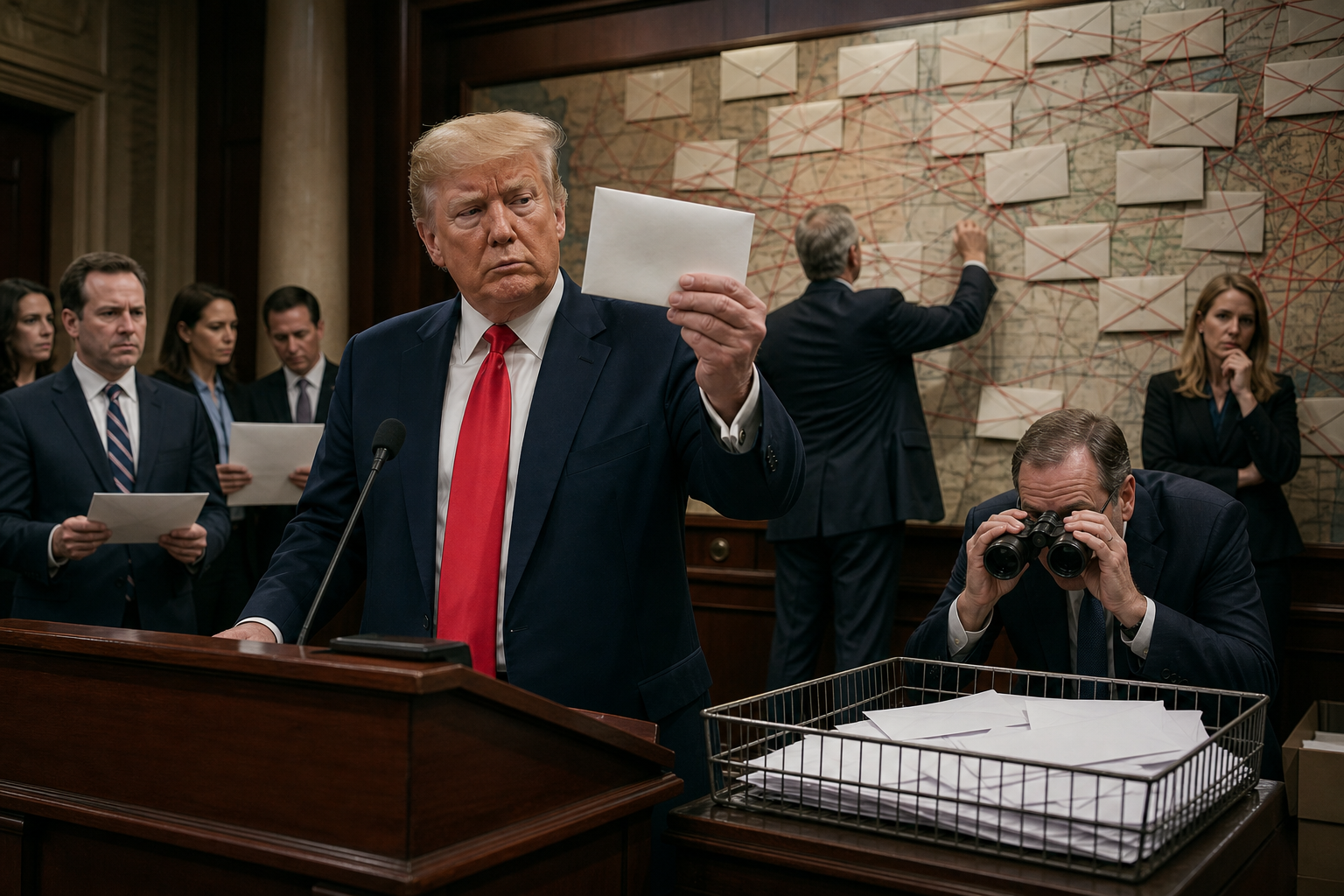
This is fictional political parody inspired by a real court ruling.
Hours after a federal appeals court rejected the Trump administration’s attempt to force California to set aside thousands of mail ballots tied to a disputed list of suspected noncitizens, the Justice Department announced the creation of its newest public-safety initiative: the Ballot Precrime Division.
The unit’s mission is to identify dangerous votes before they have done anything wrong, ideally before they have been cast, mailed, received, signature-checked, removed from an envelope or given the confidence to believe they live in a country where paperwork occasionally ends.
“The old model waits for a ballot to be counted,” said fictional acting director Grant Vellum, standing before a wall of red string connecting a county map, three magnifying glasses and a printout of the word perhaps. “That is unacceptable. By then, the ballot has already had an opportunity to influence the emotional weather inside several cable-news studios.”
The division will use predictive analytics, federal databases, intuition, suspiciously timed eyebrows and a proprietary risk score known as VIBES — Voter Irregularity Based on Extremely Seriousness. Ballots receiving a high VIBES score will not be rejected, exactly. They will be placed in what the department calls a “temporary zone of constitutional uncertainty,” where analysts can study them under flattering but accusatory lighting.
California election officials had reportedly hoped that the court decision would allow them to resume the dull, legally prescribed work of processing ballots. Instead, they received a 46-page welcome packet explaining that every ballot now carries a “pre-history,” including where it might someday lead the nation emotionally.
“We are not alleging these voters did anything,” Vellum clarified. “We are saying the government should have the freedom to worry about them professionally.”
The first week of the program has produced mixed results. Agents flagged one ballot as “statistically evasive” after it was placed inside an envelope, and another as “operationally theatrical” because the voter used blue ink. A third ballot was cleared after an analyst determined its handwriting conveyed “the settled resignation of a homeowner who has definitely compared utility rates.”
Then came the complication nobody in the department had anticipated: the ballots were secret.
For decades, election administrators have used ballot secrecy to protect voters from pressure and retaliation. But the Precrime Division found the practice deeply obstructive. Without knowing which candidate a ballot supported, agents could not determine whether its suspected future wrongdoing felt alarming, merely concerning or potentially useful in a recount narrative.
Officials briefly proposed opening all ballots in a secure federal environment so analysts could assess motive, vibe and whether the voter appeared to be “using democracy recreationally.” That plan was withdrawn after a focus group of former prosecutors asked why a government office needed to know someone’s vote in order to decide whether it had already broken the law.
The division has since pivoted to a more ambitious model: stopping ballots at the thought stage.
Under a pilot program, federal agents will visit households where someone has recently said phrases such as “I should probably vote,” “Where did I put that envelope?” or “This election is a mess.” Residents will be offered a voluntary screening in which they may reassure the government that no unauthorized civic impulses are developing.
One fictional DOJ memo advises agents not to be confrontational. “Remember,” it says, “many Americans do not realize they are becoming administratively interesting until we arrive.”
The court ruling has apparently forced the division to work faster. With ballots continuing to move through California’s existing system, Precrime staffers have begun issuing predictions retroactively, a process officials say is more efficient because it allows investigators to know exactly what they should have suspected all along.
At a late-afternoon briefing, Vellum unveiled the program’s first major success: a ballot that had been treated as suspicious for nearly six hours before analysts discovered it belonged to a voter who was not on the government’s list, had not been accused of anything and had already been counted.
“That is precisely why we need this division,” he said, lowering his voice. “Imagine how close we came to not worrying about it.”
Trump DOJ Opens Precrime Division for Ballots It Cannot Find
The new unit will stop suspicious votes before they commit the crime of being counted.
WHAT STARTED THIS MESS
The event underneath the joke is real. The SPILL premise, dialogue and escalation above are fictional parody.
- FOX California woman accused of killing trans son-in-law puts blames on husband in new docs: reports ↗
- Reuters ICE raids in a California toss-up district spark accusations of voter intimidation ↗
- PBS NewsHour Analysis: More than 40% of names on DOJ list of alleged noncitizens not on California's voter rolls - PBS ↗
- CBS Appeals court rejects DOJ request to have California set aside disputed ballots ↗
- AP More than 40% of names on DOJ list of alleged noncitizens not on California's voter rolls: analysis ↗
- NPR Final Days Of Midterm Campaigning, Alaska Senate Race Controversy, Iran War Plans ↗
- MS NOW Jacob: ‘Trump’s charade is no longer holding up in court’ ↗